Taxed by X
X quietly rewrote the rules of reach after Elon Musk’s acquisition — penalizing the very creators who generate the platform’s most credible content. New 2026 data shows the situation has worsened. Here’s the full story, and nine concrete ways to fix it.
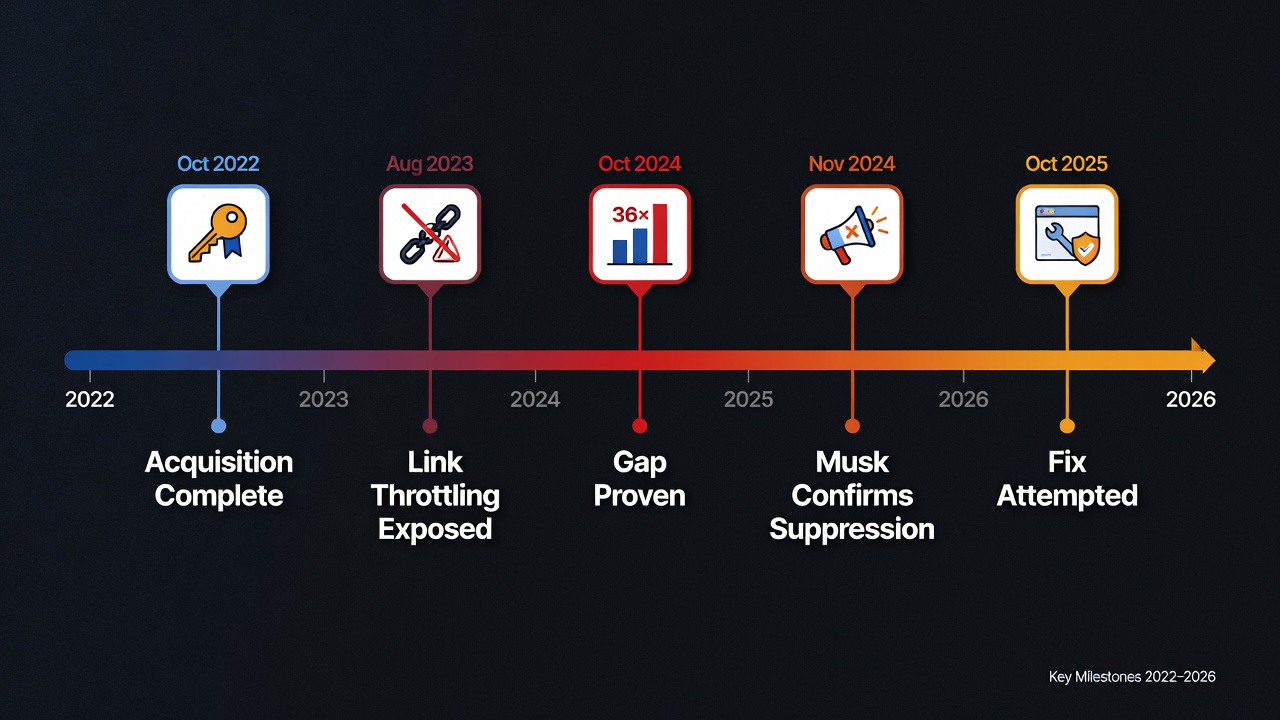
When Elon Musk completed his $44 billion acquisition of Twitter in October 2022 and rebranded it X, the platform’s tens of millions of business users had every reason to believe the change would benefit them. Musk had promised a freer, more open internet — a “digital town square” where ideas and information could flow without friction. For professionals who had spent years building audiences, Twitter was an indispensable distribution engine: post a link, reach your followers, drive traffic to your work.
What happened next was almost the opposite. Quietly, without formal announcement, the recommendation algorithm was recalibrated. Posts containing external links — the very mechanism through which journalists, entrepreneurs, consultants, and creators connected their X audiences to their substantive work — began to disappear from feeds. Reach collapsed. Traffic from X to external sites plummeted. And for months, the company offered no official explanation.
By 2026, the data has only grown more damning. This is an investigation into how that decision was made, why it backfired, and what X is now doing — haltingly, and not without internal contradiction — to repair the damage.

A Contradiction at the Heart of X’s Identity
Before examining the mechanics of the algorithm, it is worth pausing on a deeper irony — one that Elon Musk, of all people, should be the first to recognize.
Musk is not merely a technology executive. He is, by any serious measure, one of the most consequential entrepreneurs in American and global history: the man who forced Detroit to go electric, restored U.S. access to orbital space after the Space Shuttle’s retirement, and is wiring entire continents through Starlink. His track record reflects a Schumpeterian worldview — a conviction that entrepreneurial ambition, risk-taking, and the relentless creation of new value are the engines of civilizational progress.
This is not peripheral to how Musk defines himself. It is central. He has described his ventures not as profit-seeking enterprises but as attempts to solve problems that matter at civilizational scale. The implicit premise is that business — specifically, business driven by genuine innovation and the willingness to challenge entrenched structures — is the mechanism through which societies advance. From the merchant republics of Venice to the Industrial Revolution to Silicon Valley: commerce and the people who drive it have been the primary forces through which knowledge spreads, standards of living rise, and previously impossible things become ordinary.
“Throughout history, it has been business — the merchant, the inventor, the builder — that has moved civilization forward. Not by waiting for permission, but by creating value where none existed before.”A principle Musk’s own career has consistently embodied
Which makes X’s link suppression policy not merely a product decision — but a contradiction in values. The most active, substantive users of X are disproportionately the kind of people Musk has spent his career celebrating: founders sharing their thinking publicly, consultants building expertise in the open, researchers distributing findings, creators building businesses around their ideas. These are not passive content consumers. They are producers. And the links they share are not spam — they are the connective tissue between X and the broader economy of knowledge and commerce that Musk has always championed.
To suppress those links is to tell those users that their work — the work of building, creating, and sharing value — is algorithmically unwelcome on a platform that charges them for the privilege of being there. That tension is the real subject of this investigation.
The Cost of Trust: A Premium Plus Subscriber’s Account
To understand the real stakes of X’s link policy, it is worth grounding the analysis in concrete experience — the kind shared by thousands of professional users who invested seriously in the platform.
As a Premium Plus subscriber and an author who regularly publishes analytical articles and business content, I regarded X as a professional stage — a place where serious content meets a serious audience. Premium Plus subscriptions are not inexpensive. I paid for extended reach, for promotional tools, and for what I understood to be a mutual relationship: I bring credible content and financial investment to the platform; the platform amplifies my work and respects my presence as a contributor to its ecosystem.
My account was frozen twice.
After each freeze, I filed an appeal. The response was identical: “This was an algorithmic error. Your content has been reviewed manually and confirmed as fully compliant with platform rules.” Not once — after the first freeze or the second — did I receive an apology. No acknowledgment of what it means for a content creator to lose access to their audience through the platform’s own fault. Just a notice that the freeze was lifted, and silence.
After the first freeze, my follower count dropped, reach collapsed to zero, and impressions fell completely flat. Worse: all scheduled publications disappeared — articles planned and ready to publish for months ahead were wiped when access was cut off. After the second freeze, the scheduled posts fortunately survived in the queue — but the damage from lost audience momentum and zero reach was again real and measurable, with no compensation or explanation offered.
These freezes changed my relationship with the platform fundamentally. Not out of resentment — but because I drew the rational conclusion of a business-minded person: you cannot build the foundation of your digital presence on a resource that can cut off access to your work at any moment, without adequate explanation and without accountability.
After the second freeze, I built my own website. It required time and meaningful investment — but my articles now belong to me. No algorithm can lock me out overnight. I no longer live in fear that content I spent months developing will vanish because of someone else’s system error.
“I stopped using the Articles feature in my X account — not because it is poorly designed, but because on my own site I can create content of incomparably higher quality, without the risk that it disappears at someone’s algorithmic mistake.”From the author’s personal experience
The suppression of posts containing external links — specifically, links to my own website — only deepened this conclusion. If X algorithmically penalizes my posts for including a link to the very site I created because the platform proved twice to be unreliable, then a simple business question arises: why invest time and money in promoting a platform that actively limits my ability to show my audience my work? This is not a rhetorical question. It is the business calculation that thousands of professional X users across the U.S. and globally are making right now.
The Evidence: Links Are Penalized
The suppression of external links on X is not a theory circulated by disgruntled users. It is a documented, quantifiable reality — confirmed, ultimately, by Elon Musk himself, and now reinforced by the platform’s own open-source algorithm code.
Among the clearest demonstrations: in October 2024, analyst Jesse Colombo published the results of a controlled A/B test on his own X account. Two nearly identical posts, published 24 hours apart. The only variable was an external link.
with external link
without external link
same content · same author · same day
The difference in reach was 36-fold. Paul Graham, the influential Silicon Valley investor with nearly two million followers on X, went public with his frustration in November 2024.
“The deprioritization of tweets with links in them is Twitter’s biggest flaw. It bothers me more than all the new right-wing trolls. What draws me to Twitter is to find out what’s going on — and you can’t do that without links.”Paul Graham, Technology Investor — November 2024
Musk responded directly to Graham’s complaint — and in doing so, made the policy official. He advised users to place links in the first reply rather than the main post body, describing posts with only a link as “lazy linking.” The implication was explicit: posts with external links in the body receive weaker distribution by design.
What the 2026 Data Shows
The problem has not improved since 2024 — it has intensified. Analysis of X’s open-source algorithm code and platform behavior data through early 2026 reveals a significantly worsened picture:
Since March 2026, non-Premium accounts posting content with external links are experiencing near-zero median engagement. Even Premium subscribers — who pay specifically for enhanced reach — face a persistent 30–50%+ reach penalty on posts containing external links compared to identical link-free posts. And X’s open-sourced algorithm code, reviewed by independent engineers in 2026, contains explicit scoring mechanisms that deprioritize posts with outbound links. The suppression is not a side effect. It is a design choice.
If you are a non-Premium user on X in 2026 and you post content with an external link, the data suggests your reach will be statistically close to zero. If you are a Premium or Premium Plus subscriber, you face a built-in penalty of 30–50%+ regardless. You are paying for distribution that the platform’s own algorithm is simultaneously throttling.
The Business Logic — And Its Flaws
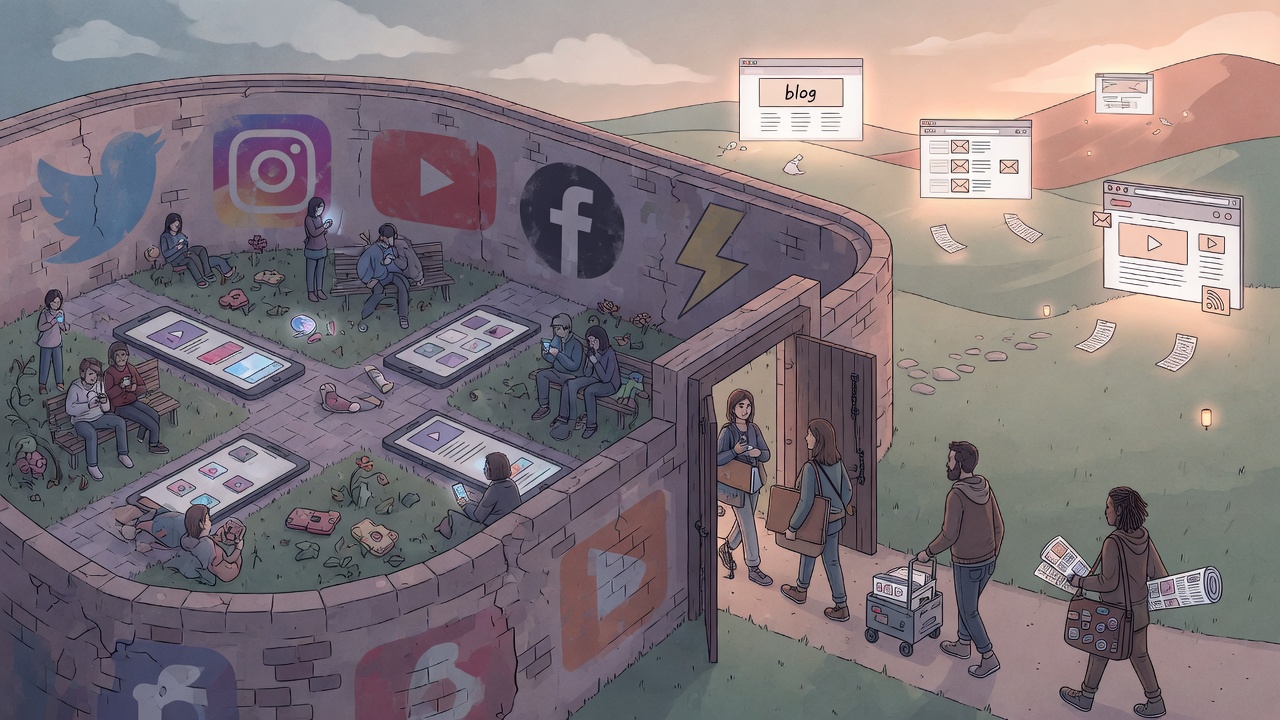
To understand why X took this path, it is necessary to understand the platform’s commercial pressures. X’s primary revenue source is advertising. Advertising revenue is a function of time-on-platform: the longer a user stays within the X ecosystem, the more ad impressions are served. Every outbound click — every tap on a link that takes a user to an external website — is, from this perspective, a lost opportunity.
This logic is not unique to X. Facebook, Instagram, TikTok, and YouTube have all applied algorithmic penalties to content that drives users away from their platforms. The difference lies in the degree of suppression, the transparency of communication, and the degree to which the policy undermines the platform’s foundational value proposition.
In August 2023, a Washington Post analysis revealed that X had imposed artificial loading delays on links directed to rival platforms — including Facebook, Bluesky, and Substack — as well as major U.S. news organizations including the New York Times. The delays were routed through X’s t.co link-shortening domain. The New York Times publicly expressed concern about what it called “targeted pressure applied to any news organization for unclear reasons.”
The structural problem with applying this logic aggressively on X is that Twitter — unlike Instagram or TikTok — was never built around self-contained media. Its original cultural function was sharing, annotating, and debating external information. The link was not incidental to Twitter; it was constitutive. To penalize links is not merely to adjust the algorithm; it is to redefine what the platform is for.
The Premium Subscriber Paradox
The policy creates a particularly damaging paradox for X’s paid user base. Premium and Premium Plus subscribers — whose fees contribute directly to platform revenue — include a disproportionate share of the users most likely to post external links: journalists, analysts, startup founders, management consultants, academics, and subject-matter experts. A Premium Plus subscriber paying for reach, only to have their posts algorithmically suppressed for including a link to their own published work, faces a straightforward calculation: the platform is not delivering the value for which they are paying.
The Timeline: From Suppression to Retreat
X’s Attempted Fix — And Its Limits
By October 2025, the internal pressure had become impossible to ignore. Nikita Bier, X’s Head of Product, publicly acknowledged the problem and announced a redesigned in-app browser that would display linked content within the X interface, keeping the original post partially visible while users browse the linked page.
The mechanism reflects a genuine insight. When a user taps a link and the browser opens, covering the original post, they frequently forget to return and engage via like or reply. The algorithm, receiving no engagement signal, interprets the post as low-quality and reduces its distribution. The in-app browser keeps engagement buttons visible — allowing X to collect interaction data without forcing users to choose between reading the link and engaging with the post.
“For creators, a common complaint is that posts with links tend to get lower reach. This is because the web browser covers the post and people forget to Like or Reply, so X doesn’t get a clear signal whether the content is any good. The goal is to ensure that all content on the platform has equal visibility in the timeline.” — Nikita Bier, Head of Product, X, October 2025
However, Musk’s public response introduced an immediate complication: he stated that xAI — not the product team — is responsible for building the recommendation algorithm. The result: X’s own leadership does not appear fully aligned on the nature of the problem or the solution — which is itself a signal worth noting. When the CEO and Head of Product publicly disagree on who controls the algorithm, creators cannot make rational investment decisions about the platform.
What the Platform Got Right (And Should Preserve)
A rigorous analysis requires acknowledging that not all of X’s post-acquisition changes have been harmful.
Transparent Algorithmic Code
In 2023, X published the source code of its recommendation algorithm on GitHub — an unprecedented move among major social platforms. The algorithm operates as a neural network with approximately 48 million parameters, evaluating each post across 19 positive engagement signals. The 2026 open-source review has confirmed both the algorithm’s sophistication and, unfortunately, the explicit link penalty mechanism.
The Phoenix Algorithm Update
X’s 2025 “Phoenix” update moved the platform toward semantic content understanding. Rather than simply counting keywords, the system — built on the Grok AI foundation — attempts to understand the meaning and context of posts. In principle, this rewards genuine expertise and penalizes low-quality engagement bait.
Expanded Monetization Infrastructure
X has expanded creator monetization options: subscription-based content, ticketed Spaces events, and tipping. These tools give professional creators more pathways to generate direct income from their X presence, partially reducing dependence on external traffic.
Reduced Coordinated Content Suppression
The publication of the “Twitter Files” documented instances of coordinated content moderation on the previous platform. A platform less susceptible to coordinated external pressure is structurally more reliable for business users who cannot predict which topics might become politically sensitive in the future.
Nine Constructive Recommendations for X Leadership
The tension between platform retention and creator utility is real — but it is not irresolvable. The following recommendations are grounded in X’s stated goals, existing technical capabilities, and the platform’s genuine interests as a sustainable business.
Establish a verified professional creator designation with explicit reach guarantees for link-containing posts. Premium Plus subscribers meeting quality thresholds should receive equal distribution regardless of whether their post contains an external link.
Provide creators with a clear breakdown of why each post received its distribution level — including whether a link penalty was applied. Opacity breeds distrust; transparency enables optimization and builds platform loyalty.
If the iOS experiment demonstrates improved engagement on linked posts, deploy globally and immediately. The technical fix exists. Every month of delay is another month of creator attrition.
Creators cannot optimize for a policy being publicly contested by the people who set it. A unified, written, public statement on link distribution policy is not optional — it is basic organizational hygiene.
Rather than penalizing all external links equally, implement a domain reputation system. A link to a creator’s professional site should be scored differently from a link to a spam farm. The infrastructure already exists within X’s t.co system.
When X’s algorithm wrongly freezes a Premium account later confirmed compliant, the platform must issue a formal apology, provide compensation, and restore any lost scheduled publications. Silent correction is not a policy of respect.
Implement an automatic 50–100% reach boost above baseline for Premium Plus subscribers posting links to their own verified domains. X already knows which domains are associated with which accounts. This single change would directly address the most damaging contradiction in current policy.
Build a native analytics feature showing each creator the estimated reach differential between their post with a link and without one. Make the algorithm’s behavior visible in real time. The data already exists internally — surfacing it is an engineering task, not a policy question.
Develop a cumulative reputation system tracking the quality of engagement generated by each creator’s external links over time. Creators whose links consistently generate quality engagement should see their link penalty reduced progressively, eventually to zero.
The Platform’s Central Dilemma
X’s link suppression policy reflects a broader strategic error: treating professional creators as a cost center rather than a value driver. The platform’s credibility — its ability to attract and retain the quality audience that makes it attractive to advertisers — depends entirely on the professional creators it is now penalizing.
The 2026 data makes this clearer than ever. When non-Premium users posting links reach near-zero median engagement, and Premium subscribers face a built-in 30–50% penalty, the platform is actively degrading the experience of its most productive users. This is not a sustainable position for a platform that charges a premium subscription price on the premise of professional utility.
Nikita Bier’s October 2025 announcement signals that X understands this, at least partially. The in-app browser experiment represents an acknowledgment that the zero-sum framing — platform retention versus creator utility — was a false choice. It is technically possible to keep users inside the X ecosystem while they browse external content, and to capture engagement signals in the process.
The nine recommendations in this report are not demands. They are a roadmap toward a platform that can simultaneously serve its commercial interests and honor its obligations to the professional creators who make it worth using. A platform that extracts credibility without compensating those who provide it is not a town square. It is an extraction mechanism.
For Premium subscribers who have paid to build audiences on this platform — and who have been let down by it — that distinction is not theoretical. It is being made, account by account, every day.

Based on official X statements from Musk and Bier, the current best practices for professional link-sharing on X:
- Write the post as fully self-contained content. Assume no reader will click the link. The post must stand alone and deliver value independently.
- Add a compelling image or video thumbnail. Visual content receives significantly higher engagement signals than text-only posts.
- Post the external link as the first reply, not in the post body. This is X’s own official guidance as of November 2024.
- Engage actively with comments in the first 30 minutes. The algorithm weights early engagement signals heavily. A post that generates immediate interaction is classified as higher quality and distributed more broadly.
If this investigation was useful to you — support independent journalism
☕ Buy me a coffee