

THE MAN WHO
WASN’T THERE
A Psycho-Emotional Profile of Vladimir Putin — Behind the Image Machine
This is not a clinical diagnosis. This is investigative journalism built on primary sources: documented testimony from people who knew Putin personally, video evidence from public appearances, internal communications obtained by independent media, and academic psychological profiles. Every claim is attributed. Every fact has a source. Where analytical interpretation is present, it is clearly identified as such.
The reader will notice that the illustrations accompanying this piece are not documentary photographs. This is an editorial decision, not a technical limitation.
Photographs of Vladimir Putin are widely available online — hundreds of images covering every documented episode described in this article. However, an independent journalistic outlet publishing critical material about a sitting head of state faces documented legal risks that must be named directly.
What happens in practice. Search engines index hundreds of Putin images labeled “free license” or “Creative Commons.” When a journalist uses such an image in good faith — the source page disappears, the license is revoked retroactively, and the publication receives a legal demand. This mechanism — known in the media industry as copyright trolling and the license trap — is documented in connection with critical publications about the Kremlin.
What we did instead. All illustrations in this piece were created using artificial intelligence specifically for POWER MASK. Each illustration is accompanied by search queries: if you want a documentary photograph of a specific episode, you can find it yourself through licensed resources such as AP Images, Reuters Connect, Getty Images, or public archives.
This is not an evasion of evidence. Every fact in this piece is attributed and verified. This is editorial protection for an independent outlet against instruments of pressure that exist and are used.
THE BOY IN THE COURTYARD — THREE LEVELS OF FORMATION
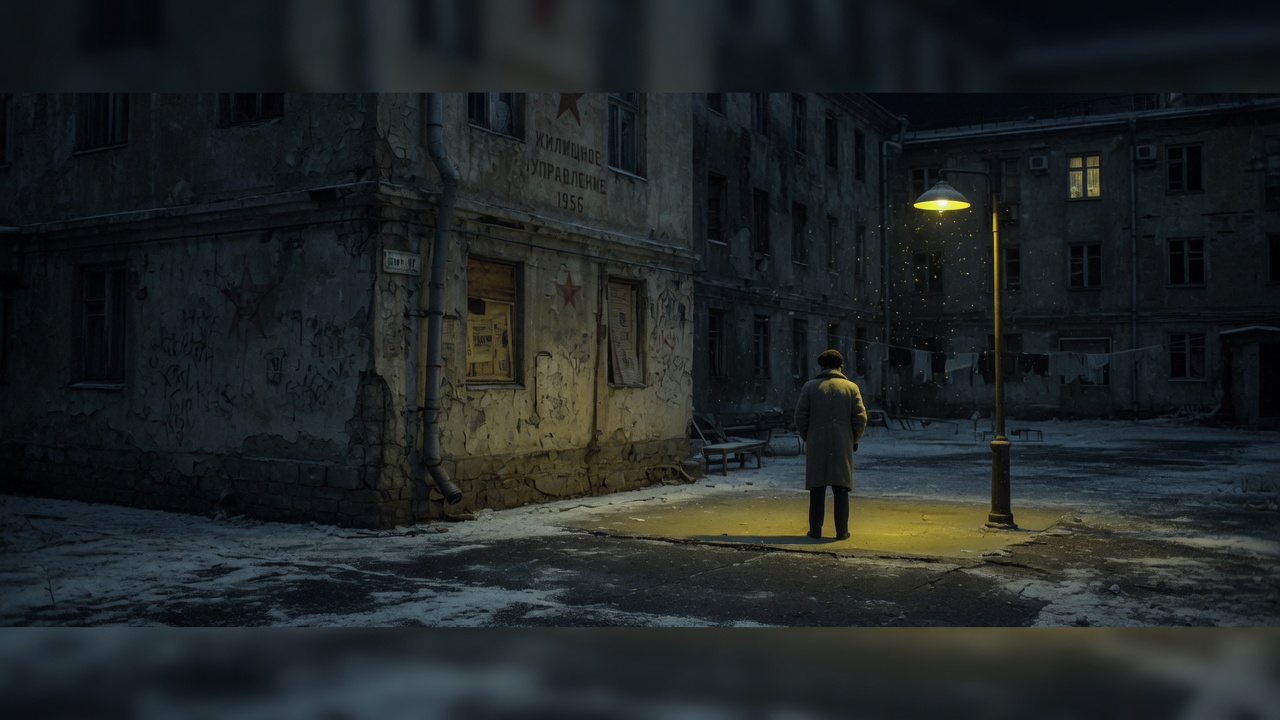
Before the Kremlin. Before the KGB. Before the poisonings, the Arctic colonies, and the long empty tables. There was a thin, pale, unremarkable boy in postwar Leningrad. Look at the surviving photographs. He stands at the edge of group shots, taking up as little space as possible, pressing against the person next to him as if borrowing their authority as cover for his own uncertainty, almost never smiling. This is the baseline. Not a hero. Not a fighter. A child who learned to survive in conditions where mistakes were very costly.
Putin was born in 1952 into material deprivation that was severe even by Soviet standards. His family lived in a single room of a crumbling communal apartment shared with two other families — no hot water, no bathtub, almost no heat. His father, badly wounded in the war, worked in a factory. His mother barely survived starvation during the Nazi siege of Leningrad and had already lost two children before Putin was born.
The boy grew up in the yard below the building — in the dvor, the particular Russian institution of the working-class communal courtyard, dominated at that time by drunk adults, petty crime, and the law of the strongest. He was small. He was poor.
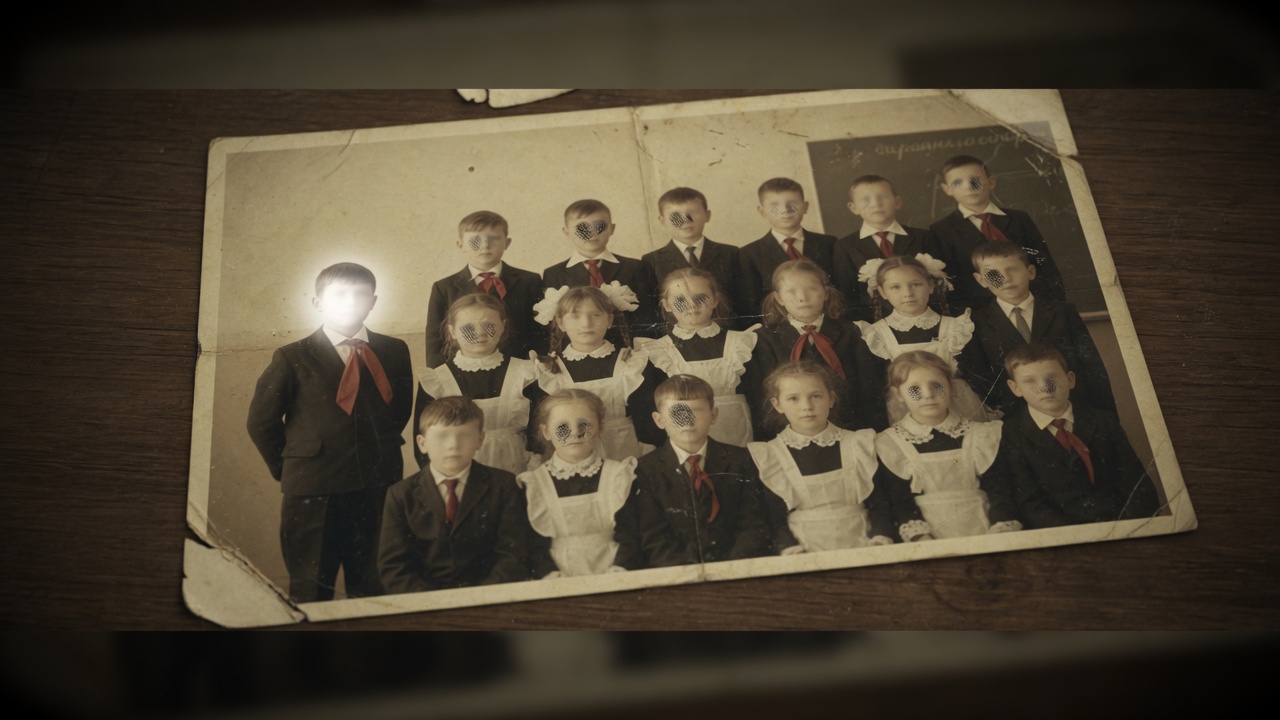
Polish investigative journalist Krystyna Kurczab-Redlich has published an alternative account of Putin’s childhood biography that differs substantially from the official version. Which account is accurate is a subject for separate investigation. POWER MASK will return to this question in future installments.
▸ Newsweek: ‘Portrait of the Young Vladimir Putin’ · Psychology Today, Dr. Nina Cerfolio, Mount Sinai, April 2024 · Masha Gessen, ‘The Man Without a Face’ · PACEs Connection, January 2023
There is an officially sanctioned story of the young Putin as a person who “threw himself at anyone who offended him — scratching, biting, pulling hair, just to avoid humiliation.” This quote appears in the book First Person — an authorized biography compiled from interviews that Putin personally agreed to give, written by journalist Andrei Kolesnikov, whom Putin himself chose as his personal correspondent.
A source chosen by the subject to tell his own story is not a biography. It is a managed narrative. And this particular narrative serves an exact function: it lays the foundation myth of a man who was strong, never afraid, always fought back, and was never cornered.
The photographs tell a different story. Independent journalists and authors who have studied Putin’s childhood — including Masha Gessen, Julia Ioffe, and Philip Short — describe not a fighter but a survivor. A person who learned to read the room. A person who understood early and instinctively: in a courtyard governed by physical hierarchy, the safest position is not confrontation but attachment.
This behavioral template runs as a red thread through Putin’s entire career. Sobchak was his patron in St. Petersburg. Berezovsky and the Yeltsin family were his patrons in Moscow. He borrowed their weight, ran their errands, and sheltered behind their power — until he had accumulated enough of his own. Then, one by one, he disposed of each of them — or destroyed them. Berezovsky died in exile under unexplained circumstances. The Yeltsin family was neutralized through guaranteed immunity. Sobchak’s cases were dropped at the moment Putin became powerful enough to arrange it — and Sobchak soon died under strange circumstances.
The boy who learned to survive by attaching to the powerful became the man who uses the powerful — until they are no longer needed.
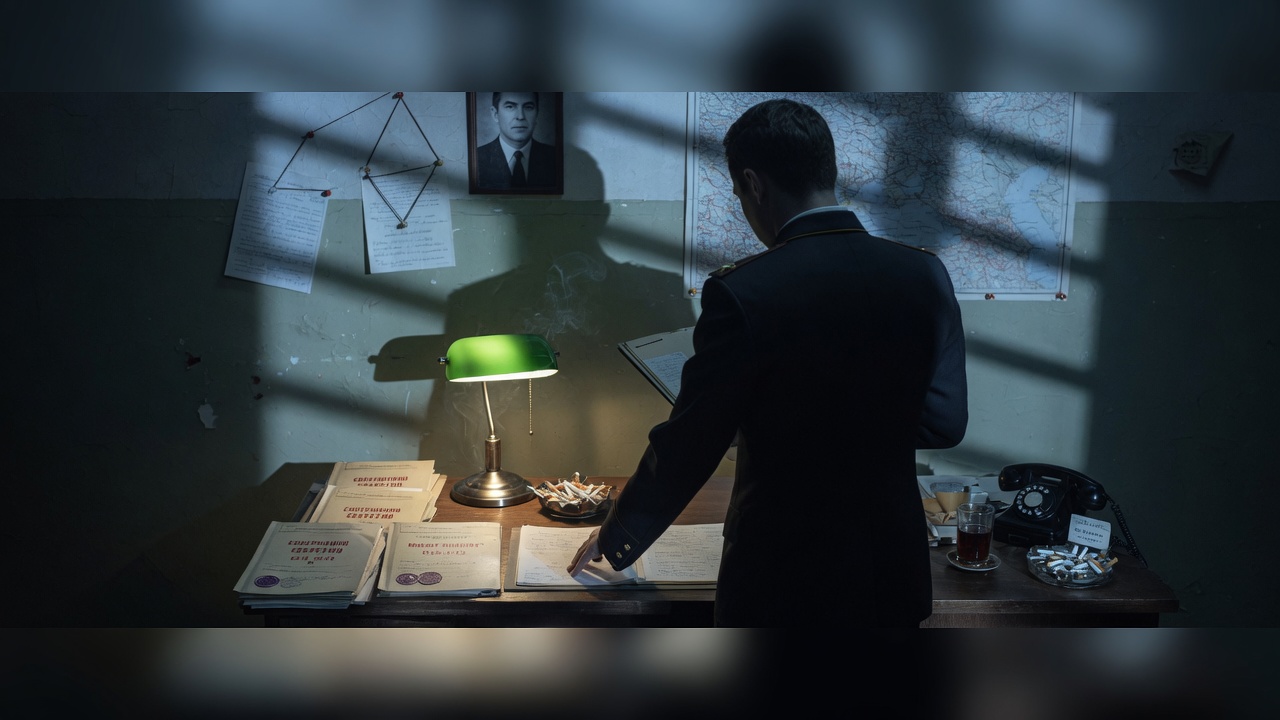
One critical analytical error must be corrected here: the pattern of acting through proxies, maintaining deniability, engineering outcomes that cannot be legally attributed — this is not a psychological quirk that developed in a Leningrad courtyard. It is a trained professional skill.
Putin spent fifteen years in the KGB — an institution whose operational doctrine was built on precisely this principle. Operations are structured so that attribution is impossible. Responsibility is distributed through chains of intermediaries. The outcome is engineered; the evidence is managed; the executor remains invisible. This is standard tradecraft. It is taught. It is drilled. It is institutionalized.
When Putin applies a nerve agent against political opponents in a foreign city, when he plants a prisoner infected with a highly dangerous terminal disease in a dissident’s cell, when he constructs a chain of prison officials for the systematic destruction of a person over three years without a single order that can be directly tied to him — this is not the improvised cruelty of a traumatized child. This is professional technique applied at the highest level of state power.
The same technique appears in his interviews. When journalists ask uncomfortable questions, Putin doesn’t answer — he redirects. In February 2024, Tucker Carlson asked about the territorial goals of the war in Ukraine — Putin spoke for roughly half an hour about Russian history going back to the eighth century. Professional intelligence technique: you don’t answer the question — you build a bridge to territory where you control the conversation.
▸ Global Defense Corp / The Sun Online: ‘Leaked FSB document,’ April 2023 · Gulagu.net
The full picture requires holding both levels simultaneously. The emotional raw material — the need for a stronger protective figure, the instinct to retaliate only from a position of safety — comes from the courtyard. The operational methodology — untraceable chains of action, managed deniability, patient waiting — comes from the KGB.
Sobchak knew too much. He wasn’t just a mentor — he was a witness. A living archive of crimes in which Putin was complicit. So first he helped him escape — flew him out on a medical plane to Paris when he was under investigation. But a living witness is an unresolved question. The question was resolved in February 2000 in Kaliningrad.
Prigozhin — the man who launched a mutiny — was not publicly executed or jailed. He was allowed to leave. True, he left with fireworks — in a plane crash over the Tver region. But in Putin’s logic this was not an execution. This was a dignified end. A hero doesn’t go into a cage. A hero burns in the sky.
Leonid Usvyatsov served approximately 20 years in Soviet labor camps on two convictions. The first was for gang rape. In Soviet prison hierarchy — documented by sociologists and human rights researchers — those convicted of sexual violence occupied the lowest caste. This status had specific and documented consequences for their standing among other prisoners. This is not inference. This is the recorded reality of Soviet penitentiary culture.
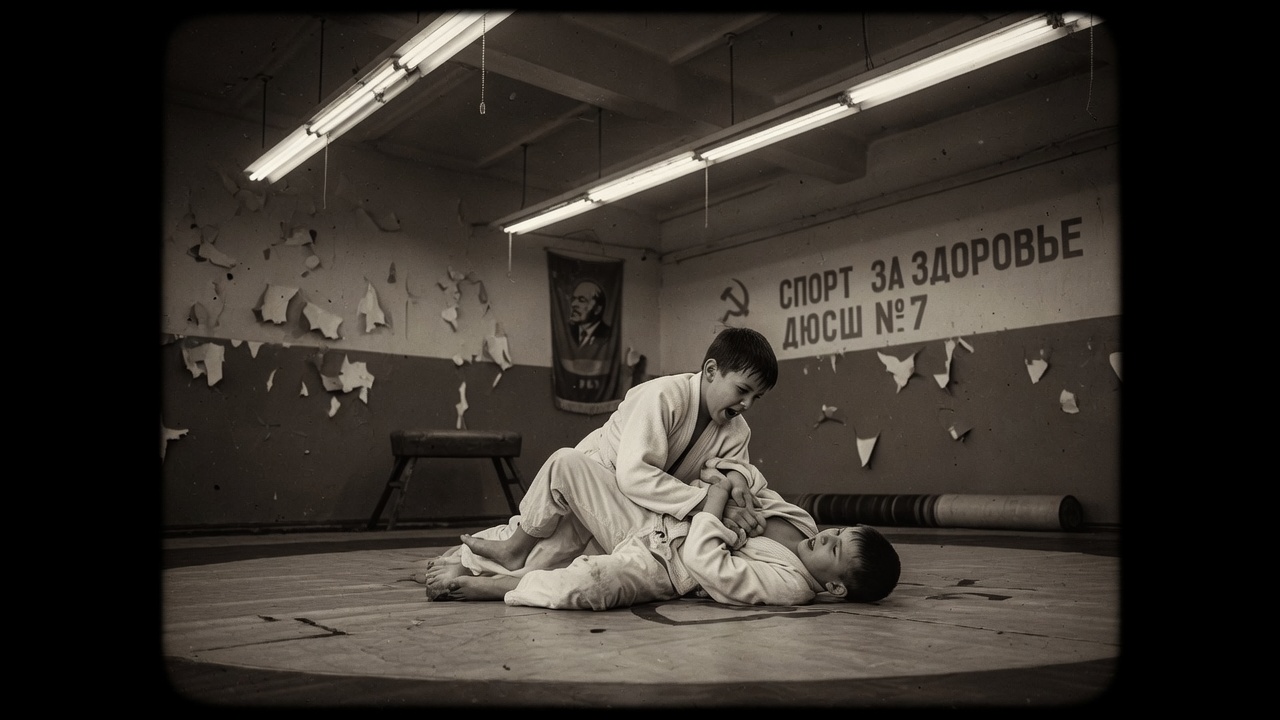
Between his two sentences — from 1968 to 1982 — Usvyatsov worked as a judo coach. During this period, a 16-year-old boy named Vladimir Putin, son of a janitor and a factory worker, without family connections and without notable athletic achievements, came under his personal patronage. Usvyatsov arranged his admission to the elite law faculty of Leningrad State University on a sports quota. He did the same for Arkady Rotenberg.
Admission to the law faculty of one of the most prestigious universities in the country was the aspiration of many people of even high social standing with excellent grades. Putin was a mediocre student — his parents worried about his poor academic performance. And yet he receives a place at a university the best students competed for.
Why this particular boy. What was offered in exchange. Official sources don’t answer these questions. Putin mentions Usvyatsov warmly in his authorized biography — by first name only, without his surname, without his criminal history.
The absence of a surname is itself a document.
Clinical psychologists studying the long-term consequences of sexual trauma in adolescence describe a consistent cluster of behavioral outcomes: anxiety in normal sexual contexts, compensatory displays of physical dominance, reproduction of control over those who cannot resist, and intense public pursuit of what cannot be internally integrated. Observers of Putin’s behavior over two decades have documented all four.
The nature of what happened between Usvyatsov and the boy from Leningrad is not documented. What is documented is the pattern of the man who emerged from it. The reader is invited to complete the chain.
▸ Al Jazeera: ‘How Putin’s taste for jail jargon changed Russia,’ May 2023 · RFERL, April 2020 · Eurasianet, May 2019 · ICIJ, August 2025
If this investigation was useful to you — support independent journalism
☕ Buy me a coffee