
THE UNFINISHED
MAP
How much science actually knows — and why that is the best news you will ever hear.
An investigation into the blank spaces on the map of human knowledge — and the ten questions nobody on Earth can answer.

We tend to assume science has explained nearly everything and only a few footnotes remain. That is an illusion — and the only thing more misleading is its opposite: the belief that science knows nothing at all. The truth is stranger than both. Let us look honestly at the map of human knowledge and notice that the blank spaces cover more territory than the charted lands. This is not cause for despair. It is the best news possible for anyone born asking how the world works.
Every generation believes it is living near the end of the story. In 1900 Lord Kelvin is said to have declared that physics was essentially finished and only more precise measurement remained. Within five years Einstein had published on relativity and the quantum, and the finished building turned out to be a foundation.
We are in the same position — except that today we can measure the size of our ignorance. That is the strange gift of modern science: it has become precise enough to say, in numbers, how much of the universe it cannot identify. What follows is a tour of those numbers.
Ninety-Five Percent Darkness

Let us begin with a number worth pinning above the desk of anyone who believes science has finished its work.
Everything you have ever seen — stars, galaxies, planets, light, your own body — accounts for roughly five percent of the contents of the universe. The remaining ninety-five percent is what physicists have honestly labelled dark matter and dark energy. “Dark” here is not poetry. It is an admission: we do not know what it is. We observe galaxies rotating as though held together by invisible mass, and we cannot say what that mass is made of. We observe the universe expanding at an accelerating rate, as though pushed apart by an invisible force, and we cannot say what that force is.
everything we can see
detected only by gravity
nature entirely unknown
The attentive reader will object: how can anyone calculate the proportion of the unknown? The answer is elegant — you can weigh a whole without knowing its contents. From the curvature of space, the rate of expansion, and the faint ripples in the cosmic microwave background, cosmologists have computed the total energy budget of the universe, then measured how much of that budget is ordinary matter. The answer came back at about five percent. The rest announces itself through gravity, and nothing else.
And note carefully: five percent is the share of ordinary matter in the universe, not the share of our knowledge. The share of our knowledge cannot be calculated at all — to do so you would need to know the total volume of the knowable, and that volume is unknown and, judging by the history of science, grows with every answer. Perhaps we know one percent. Perhaps a millionth. The most advanced science in human history says plainly: we do not even know how much we do not know.
An astrologer will tell you everything about your destiny. A physicist will tell you that ninety-five percent of existence is an open question. Which of the two would you trust to search for truth?
NASA’s own overview of the problem — Dark Matter, Dark Energy, and the building blocks of the universe.
Two Theories That Do Not Speak to Each Other

Twentieth-century physics produced two triumphs. General relativity describes the large: planets, stars, black holes, spacetime itself. Quantum mechanics describes the small: atoms, particles, light. Each has been verified to monstrous precision — the GPS in your phone applies Einsteinian corrections every day, and all electronics run on quantum effects.
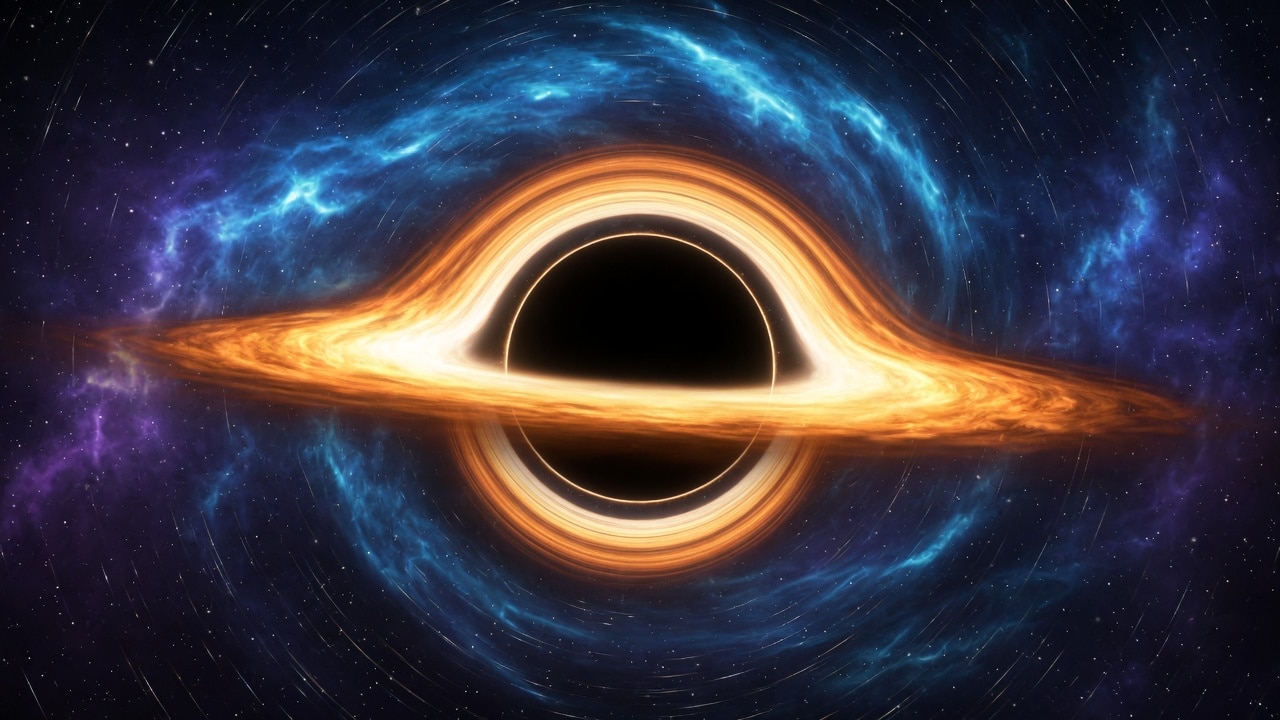
There is one problem. The two theories are incompatible. They speak different mathematical languages and return meaningless answers precisely where they meet: inside black holes, and in the first instant of the Big Bang. For a century the finest minds on the planet have tried to marry them. Einstein spent the last thirty years of his life on the attempt and failed. String theory, loop quantum gravity, the proposal that gravity is not a fundamental force at all but a statistical effect like the pressure of a gas — dozens of approaches, and not one has won.
Whoever finally joins these theories will answer questions that take the breath away. What came before the beginning? What lies inside a black hole? And what, precisely, is time?
CERN on the open questions of fundamental physics, and the Stanford Encyclopedia of Philosophy entry on quantum gravity.
Time: The Prime Suspect

Here is a question that sounds like a child’s: what is time? And here is the answer modern physics gives — brace yourself: we do not know, and we are not certain it exists.
Relativity has already taken away the universal “now.” Two observers in different states of motion will disagree about which events are simultaneous, and both will be correct. For a photon travelling from a distant galaxy, there is no time whatsoever: ten billion years of travel by our clocks, and zero by its own. Light does not experience time at all.
The physicist Carlo Rovelli, one of the architects of loop quantum gravity, goes further. Perhaps at the fundamental level the variable of time is not needed at all. Time may turn out to be not the foundation of the world but something that emerges at our coarse scale — the way temperature emerges from the motion of molecules, though a single molecule has no temperature. Past, present and future may be properties of the reader rather than of the book.
This is not mysticism. It is the frontier of physics, and it admits with full honesty that one of the most basic categories of human experience remains unexplained.
Stanford Encyclopedia of Philosophy on being and becoming in modern physics; Carlo Rovelli, The Order of Time (Riverhead, 2018).
The Hardest Problem There Is

Now for a mystery beside which dark matter looks modest. It is not in deep space. It is reading these lines.
Science understands reasonably well what the brain does: how neurons transmit signals, which regions handle which functions, how learning rewires connections. But there is a question before which neuroscience spreads its hands, and it has an official name — the hard problem of consciousness. Why is any of this electrochemistry accompanied by experience? Why is there something it is like to see red, to feel pain, to know peace? A computer processes information, and as far as we can tell nobody is home inside it. Inside you, somebody is. Why?
The honest answer, as of 2026: unknown. And this is no minor gap. It is a hole in the foundation of the entire worldview — serious enough that respected philosophers and physicists now entertain ideas that would recently have been called heresy. Panpsychism proposes that consciousness is a fundamental property of matter, like charge or mass. A century ago William James and Henri Bergson suggested the brain might not generate consciousness at all but filter it — a reducing valve admitting only what survival requires. These hypotheses are not proven. But they are argued seriously in academic journals, because nobody holds a proven alternative.
Science can narrate the first three minutes of the universe and cannot explain why anything matters to you.
Stanford Encyclopedia of Philosophy on consciousness and on panpsychism; David Chalmers named the hard problem in Facing Up to the Problem of Consciousness (1995).
The World You Have Never Seen

There is a discovery every reader can verify on themselves, and it overturns the notion of “reality” more reliably than any fiction.
You have never seen the world. Your brain sits locked in the darkness of the skull and receives only electrical impulses from receptors. From these fragments it continuously builds a model — predicting, filling in, completing. The neuroscientist Anil Seth calls perception a “controlled hallucination”: the brain hallucinates the world, and the senses merely correct the hallucination. The blind spot in your eye is painted over so smoothly that you have never once noticed it. The edges of this page look sharp to you, though the retina physically cannot deliver sharpness there. Your brain drew it in.
Now multiply that by every living thing. The biologist Jakob von Uexküll introduced the concept of the Umwelt — the perceptual world proper to each species. A bat builds its world from echoes. A bird sees the Earth’s magnetic field. A mantis shrimp looks through twelve types of colour receptor against our three, living among colours for which we have no names. A dog reads scent the way we read text. One landscape — and millions of different worlds, one for each kind of perceiving apparatus.
Half a century ago the philosopher Thomas Nagel asked a question science has still not answered: what is it like to be a bat? We do not know, and perhaps we cannot know in principle. Each of us is sealed inside our own Umwelt. And then comes the question at the border of science and vertigo: what is the world like in itself, before any perception? Physics holds pieces of the answer — fields, symmetries, equations. The full answer belongs to no one.
Anil Seth’s TED talk, Your brain hallucinates your conscious reality; Thomas Nagel, What Is It Like to Be a Bat?, The Philosophical Review, 1974.
States in Which the World Looks Different

If perception is an adjustable model, it should have other settings. It does.
People across every culture and era describe states in which the familiar picture of the world shifts: the sense of time dissolves, the boundary between self and world thins, and an extraordinary clarity arrives — a “direct knowing” quite unlike ordinary reasoning. Buddhist monks have trained such states for millennia. William James collected hundreds of accounts as early as 1902 and identified their common features, including that quality of unshakable certainty. The author of these lines once experienced such a state himself — in an ordinary early-morning taxi, under quiet music, after months of punishing work — and can confirm that James’s descriptions are accurate down to the details.
What does science know about this today? A great deal, and remarkably little at once. Such states are real and reproducible: scanners record a reorganisation of large-scale brain networks, and in experienced meditators the states are more stable — meaning the capacity can be trained like a muscle. The triggering conditions are known too: deep relaxation following stress, isolation from stimuli, rhythm. But why these states are experienced as they are — with all their depth, their stillness, their sense of touching the essence of things — runs straight back into the hard problem of consciousness. The mechanics are visible. The mystery of the experience remains a mystery.
Here runs the honest border. Science has no grounds to claim that in such states a person receives information unavailable to the senses; such claims have been tested for over a century without a reliable result. But science can no longer dismiss these states with a wave of the hand either. They are a genuine window into the architecture of consciousness, and the best laboratories in the world now study meditators as seriously as colliders study particles.
Between “this is magic” and “this is nonsense” lies a third road — “this is unexplored territory.” That is the road real science travels.
William James, The Varieties of Religious Experience (1902), free at Project Gutenberg; the Center for Healthy Minds at the University of Wisconsin–Madison on the neuroscience of contemplative practice.
The Unfinished List

Would you like to feel the scale of the unknown? Here is a fraction of the questions that have no answer in 2026.
- 01 What the other ninety-five percent of the universe is made of.
- 02 What came “before” the Big Bang — and whether the question even means anything.
- 03 Why there is something rather than nothing.
- 04 How to join the quantum world with gravity.
- 05 Whether time exists at the fundamental level.
- 06 Why matter experiences itself — the hard problem of consciousness.
- 07 How chemistry became the first living thing.
- 08 Whether we are alone.
- 09 What sleep is — why the brain disconnects us from the world for a third of our lives, and why we die without it.
- 10 How general anaesthesia works: we switch off consciousness in millions of people every day without fully understanding what it is we are switching off.
Every item is a question about foundations, not a footnote. And the list has a property more important than anything else about it: it is growing. Every large answer reveals questions that were previously invisible. A century ago nobody asked about dark energy; we did not know enough to form the question. Knowledge does not shrink mystery. It makes mystery visible. The island of knowledge expands — and its shoreline, the border with the ocean of the unknown, expands along with it.
We Are Living at the Very Beginning
The closing thought of this investigation is neither “science is weak” nor “science is all-powerful.” It is something else entirely.
Established: ordinary matter accounts for about five percent of the universe; relativity and quantum mechanics remain irreconcilable after a century; time is not absolute and may not be fundamental; perception is a model built by the brain rather than a window onto the world; altered states of consciousness are real, measurable and trainable.
Unknown: what the remaining ninety-five percent is; why experience accompanies matter at all; what the world is like in itself, before any perceiving apparatus renders it.
We are not at the end of the history of understanding but in its opening chapters. The questions a reader asks looking up at the night sky, or looking inward at their own consciousness, are not the naive questions of an amateur. They are the same questions the finest physicists, neuroscientists and philosophers on the planet are working on right now — and to which they have no answer yet.
Ask the Next Question
Every article on this site has a comment field beneath it, and it is there for something better than applause.
If you have read this far, you are the kind of reader who does not stop at the edge of the map. So use that field for what it was built for: ask the question this article did not answer. What is it about time that will not let you sleep? Which of the ten unanswered questions above would you want opened up first? What did you experience yourself that no explanation has ever fitted?
Reader questions do not vanish into a comment thread here. They become assignments. The best of them will shape future investigations in this series — and some will be put directly to specialists, because this publication runs in-depth interviews on exactly these frontiers. A question asked well by one reader can turn into an entire piece read by thousands.
The horizon is open. Tell me where you want to sail.
This investigation drew the outline of the blank spaces. What follows goes into them, one at a time.
- NASA — Dark Matter: what it is, how it was detected, why it remains unidentified
- NASA — Dark Energy: the accelerating expansion of the universe
- NASA — Building Blocks of the Universe: the composition budget
- CERN — open questions in fundamental physics
- Stanford Encyclopedia of Philosophy — Quantum Gravity
- Stanford Encyclopedia of Philosophy — Being and Becoming in Modern Physics
- Stanford Encyclopedia of Philosophy — Consciousness
- Stanford Encyclopedia of Philosophy — Panpsychism
- Anil Seth, TED — Your brain hallucinates your conscious reality
- William James (1902) — The Varieties of Religious Experience, full text
- Center for Healthy Minds, University of Wisconsin–Madison — neuroscience of contemplative practice
- Further reading: Carlo Rovelli, The Order of Time (2018) · Anil Seth, Being You (2021) · David Chalmers, Facing Up to the Problem of Consciousness (1995) · Thomas Nagel, What Is It Like to Be a Bat? (1974) · Jakob von Uexküll, A Foray into the Worlds of Animals and Humans (1934)
- DAY Solis — Science archive: Singularity Mind and more
This article describes the state of scientific knowledge as of July 2026 and deliberately marks the boundary between what is established, what is disputed among researchers, and what remains unknown. Where a claim is contested, it is identified as such. Corrections and substantiated objections from readers are welcome and will be published.
© 2026 DAY · All rights reserved · daysolis.com
If this investigation was useful to you — support independent journalism
☕ Buy me a coffee