THE LIQUID
ORGAN
Everything science knows about blood in 2026 — and what doctors rarely say out loud.
You think you know what blood is. Red fluid in your veins. Four types. Draw a vial, get a result. But the science of 2026 tells a fundamentally different story. Blood is an organ. It behaves unlike any other liquid on the planet. Its history spans hundreds of millions of years of evolution. And it continues to surprise researchers — from its own microbiome to behavior that breaks the basic laws of physics.
THE ORGAN YOU DON’T THINK ABOUT
By every formal criterion, blood qualifies as an organ. The only liquid one.
When a doctor says “organs,” you picture the heart, liver, kidneys — something with clear borders you can point to on an anatomical chart. Blood almost never makes that list. That is a serious conceptual failure of medical education.
By every formal criterion, blood qualifies as an organ. It is composed of specialized cells with precise functions. It has its own production facility — the red bone marrow. It performs systemic physiological tasks across the entire body. It operates under hormonal and neural regulation. There is only one difference: it is a liquid organ. The only one of its kind. The U.S. National Library of Medicine documents this functional definition in its standard hematology references — yet it rarely appears in the curriculum of an introductory anatomy course.
Vessels per Adult
Made per Second
Red Cell Lives
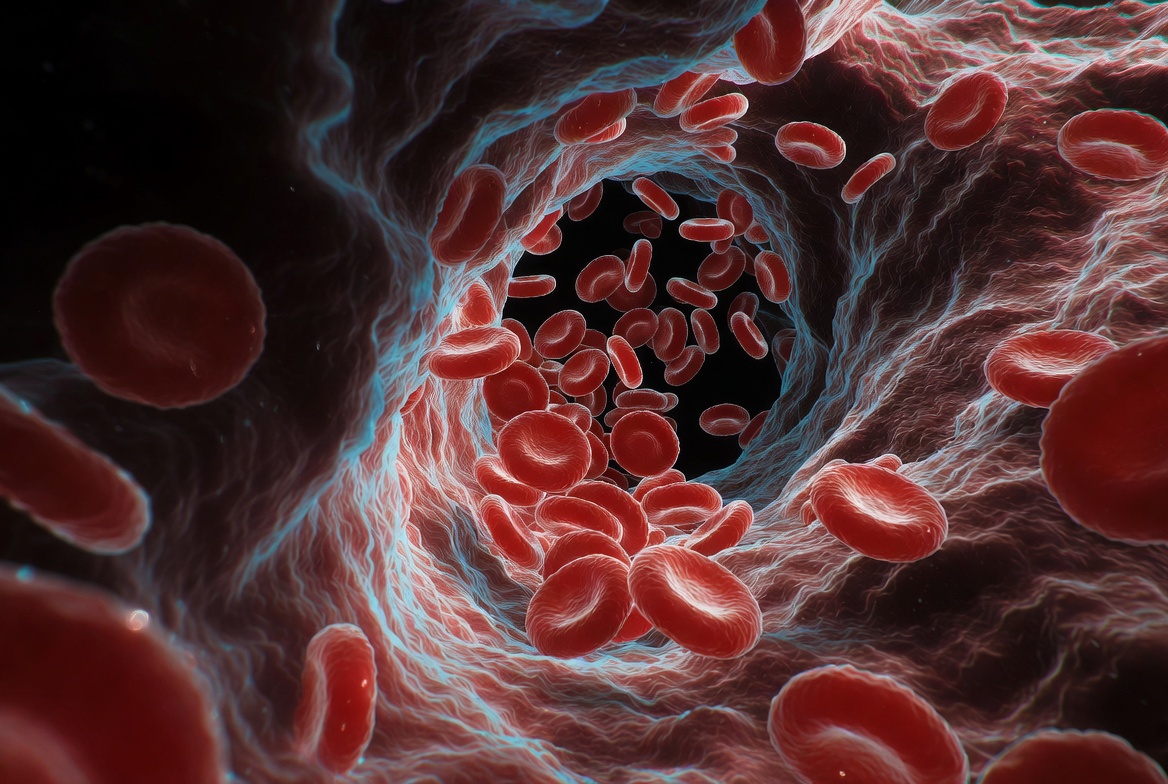
An adult carries 5 to 6 liters of blood — roughly 7 to 8 percent of total body weight. The combined length of the vascular network reaches approximately 100,000 kilometers: two and a half times around the Earth at the equator. Every second, the red bone marrow produces 2 to 3 million new red blood cells. Each one lives exactly 120 days before the spleen breaks it down in a process that never stops.
The functions of blood as an organ extend far beyond oxygen transport. It provides immune defense through white blood cells and antibodies. It controls bleeding through platelets and the clotting cascade. It regulates body temperature by redistributing heat between organs. It functions as an endocrine carrier, shuttling hormones to their target tissues. It maintains blood pH within a razor-thin range — accurate to hundredths of a unit. And it runs continuous detoxification, carrying metabolic waste products to the liver and kidneys. All of this simultaneously. All from one organ.
THE PHYSICS BLOOD REFUSES TO FOLLOW
A non-Newtonian fluid with memory — and one of the open problems of biomechanics
Most fluids obey Newton’s law: apply equal pressure, get equal viscosity. Water in a pipe behaves predictably — in a thin capillary or a wide channel. Blood does not.
Blood is a non-Newtonian fluid with thixotropic properties. Its viscosity shifts depending on flow speed, vessel diameter, and even the amount of time the blood has been at rest. In large arteries where flow is fast, blood behaves almost like a normal fluid. In tiny capillaries where flow slows to a near-crawl, its viscosity rises sharply. The Physics of Fluids review series has covered this for more than a decade, but practical modeling of the effect remains a moving target.
The viscoelastic behavior of blood is driven primarily by the mechanical properties of red blood cells. These cells can deform — they literally change shape to squeeze through capillaries smaller in diameter than the cells themselves. That elasticity is what makes blood what it is: a fluid that flows and simultaneously “remembers” its previous state.
A review published in Physics of Fluids in July 2025 noted that understanding blood as a complex rheological system remains one of the most pressing open problems in biomechanics. Standard models still fail to accurately describe blood behavior in branching vascular networks — precisely the locations where most strokes and thrombotic events originate.
Medicine still does not fully understand the physics of the fluid moving through your veins right now.
WHAT COLOR IS BLOOD — AND WHAT WOULD IT LOOK LIKE ON MARS
Red is one of several evolutionary answers to a single problem

First misconception: blood is not blue. It has never been blue. Venous blood is dark crimson — the color hemoglobin takes on after releasing its oxygen to body tissues. The myth of “blue blood in veins” was born from the way veins appear bluish beneath the skin, a perceptual effect caused by how different wavelengths of light penetrate and reflect through tissue.
The second — and deeper — misconception concerns the actual source of blood’s red color. Most people assume blood is red because of iron. That is imprecise. The red color is produced by the porphyrin group of the hemoglobin molecule — an organic ring structure to which the iron atom is bound. The porphyrin absorbs specific wavelengths of light. Iron influences the fine shading of color through electronic transitions in the molecule, but it is not the primary source of the red.
In an atmosphere with different chemistry, a living organism might evolve a different oxygen-transport molecule. Nature has already built those systems here on Earth:
The conclusion is startling: red blood is not the universal standard of life. It is one of several evolutionary solutions to a single problem. On a planet with different atmospheric chemistry, human blood could have been blue, green, or clear. Astrobiologists at NASA’s Astrobiology Program use exactly this reasoning when modeling what oxygen-carrying chemistry alien life might plausibly evolve.
BLOOD THROUGH EVOLUTION: FROM INSECTS TO NEANDERTHALS
400 million years of the same molecule — with surprising detours
Insects: Life Without Blood
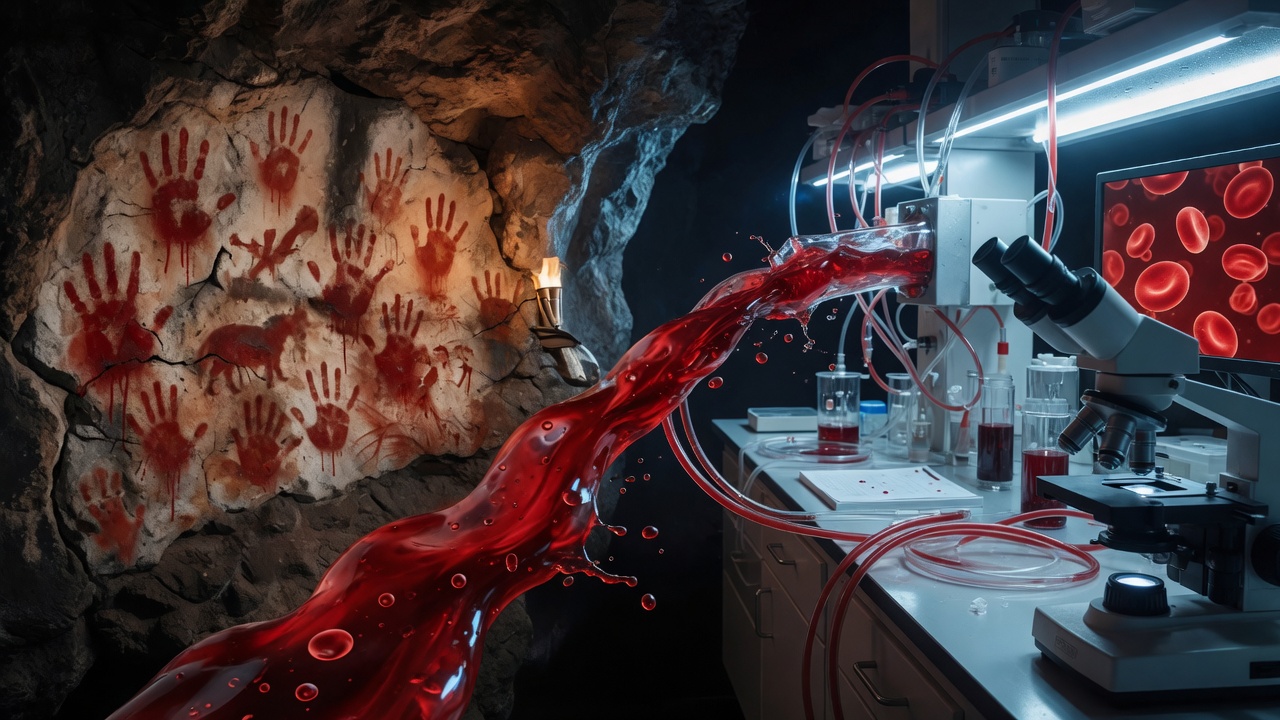
Insects have no blood in the vertebrate sense. Instead, they circulate hemolymph, a fluid that bathes organs directly without a closed vascular system. Oxygen is delivered through the tracheal system — a branching network of tubes that reach directly into tissues. This is a fundamentally different architecture of life — and it has worked for more than 400 million years.
Fish, Amphibians, Reptiles: Red Blood Cells With a Nucleus
In fish, amphibians, and reptiles, red blood cells contain a nucleus — unlike the red blood cells of mammals. A nucleated cell is a less efficient oxygen carrier: the nucleus occupies space that could otherwise be packed with hemoglobin. Mammals sacrificed the nucleus in exchange for maximum hemoglobin loading — one of the key evolutionary steps that made high-metabolism warm-bloodedness possible.
Neanderthals and Denisovans: The Blood of Our Relatives
Genomic analysis of three Neanderthal individuals and one Denisovan — who lived between 100,000 and 40,000 years ago — overturned a long-standing assumption that Neanderthals were exclusively blood type O. The ancient hominins showed the full range of ABO variability known in modern humans. Even more striking, researchers found a unique Rh allele in Neanderthals that is absent in living people — with the notable exception of a small number of Aboriginal Australians and Papuans. The most plausible explanation is cross-species interbreeding. The full study, by Condemi and colleagues, was published in PLOS ONE.
A second finding proved equally unexpected. The ABO alleles in Neanderthals and Denisovans carried variants shared with modern Sub-Saharan African populations — direct genetic evidence of the African origins of these species. Some “Neanderthal” ABO gene variants still circulate in living Europeans and Southeast Asians today, preserved by interbreeding and balancing selection across hundreds of thousands of years.
ABO and the History of Civilization
The ABO system emerged more than 20 million years ago. Type O is the evolutionarily oldest. It was the dominant type among hunter-gatherers and remains dominant among Indigenous peoples of the Americas — populations that experienced little outside genetic mixing. Type A grew more common as agriculture and urban civilization spread, likely because carriers held an advantage against certain epidemic diseases. Types B and AB are linked to Eurasian migration patterns.
| Blood Type | Historical Origin | Lower Risk | Higher Risk |
|---|---|---|---|
| O | Hunter-gatherers, oldest | Thrombosis, malaria | Cholera, trauma hemorrhage |
| A | Agriculture & epidemics | Cholera | Stomach cancer, cardiovascular disease, plague |
| B | Eurasian migrations | — | E. coli infections |
| AB | Recent mixing, rarest | — | Cognitive decline (some studies) |
BREAKTHROUGHS 2025–2026: WHAT SCIENCE JUST DISCOVERED
CRISPR, liquid biopsy, artificial blood, and a microbiome no one believed existed
Blood Is Not Sterile
For decades, medicine treated healthy blood as absolutely sterile. It was a foundational postulate of the field. That assumption is now under serious challenge.
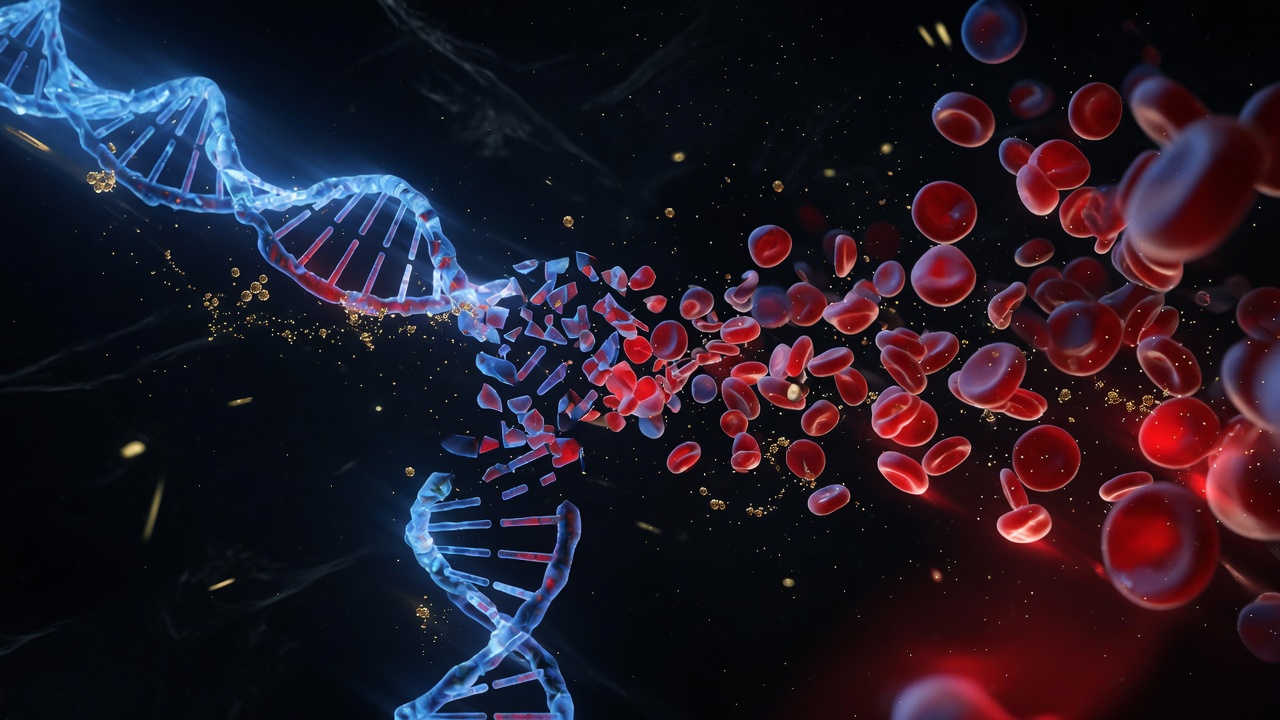
Studies published in 2025 in Frontiers in Cellular and Infection Microbiology and the FEBS Journal detected genetic material from microorganisms in the blood of healthy individuals — primarily originating from gut and oral flora. The mechanism is called atopobiosis: microbes pass through biological barriers into the bloodstream in living form or as fragments. Researchers have documented associations between disruptions to this “blood microbiome” and diseases of the nervous system, cardiovascular system, inflammatory conditions, and cancer.
The concept remains contested. Some scientists argue the findings reflect sample contamination. But the data continue to accumulate. If the blood microbiome proves to be a genuine physiological phenomenon, it would reshape the understanding of systemic inflammation, atherosclerosis, and a range of neurodegenerative diseases.
Liquid Biopsy and CRISPR: One Blood Draw Instead of Surgery
One of the most consequential medical advances of the past two years is unfolding inside blood. Liquid biopsy — the detection of tumor DNA circulating in the bloodstream — makes it possible to identify cancer before symptoms appear and without any surgical intervention.
First published online in August 2025, a study in Advanced Materials from Korean researchers described MUTE-Seq: a method that uses an engineered high-fidelity CRISPR enzyme to detect cancer mutations present at vanishingly low concentrations in blood. The method functions as a noise-reduction system — it strips away the background signal of normal DNA, making tumor cell signals detectable where previous technologies were effectively blind.
Separately, a study published in the journal Cells in October 2025 described CRISPR/Cas12 and Cas13 platforms capable of detecting specific cancer biomarkers in blood with accuracy beyond the reach of standard assays. According to a review in Biomedicines published January 2026, liquid biopsy is moving toward multimodal frameworks — simultaneously reading tumor DNA, circulating tumor cells, and extracellular vesicles from a single blood draw.
The near-term prospect: cancer screening becomes an annual blood test. No tissue biopsy. No surgery. No waiting for symptoms.
Artificial Blood: No Longer Fiction
In August 2025, Japan launched the world’s first clinical trials of a universal artificial blood product in human volunteers. In parallel, the University of Maryland is running a $46.4 million program funded by DARPA to develop a freeze-dried synthetic whole-blood substitute that stores at room temperature and can be administered to a wounded soldier within 30 minutes of injury.
A review published in Annals of Blood in March 2026 documented that researchers can now produce red blood cells from induced pluripotent stem cells — approximately 4,600 cells from a single stem cell. The biological barrier has been cleared. The remaining obstacle is cost and manufacturing scale. When that problem is solved, blood transfusion will no longer depend on donors. Entirely.
Blood Responds to Magnetic Fields
Studies on the physical parameters of blood as a non-Newtonian fluid documented a striking effect: exposure to a high static magnetic field increases blood viscosity. The mechanism involves the alignment of hemoglobin molecules and changes in red blood cell membrane mechanics under magnetic torque. This raises open questions about the hemodynamic effects of the powerful MRI magnetic fields used in clinical practice — and points toward future applications in magnetically guided blood flow control.
Blood Type and Personality: The Japanese Theory Does Not Hold
Since the 1920s, Japan has maintained the concept of ketsueki-gata — the belief that blood type determines personality and ability. Type A: meticulous perfectionists. Type B: creative egotists. Type O: natural leaders. Type AB: unpredictable geniuses. The theory took such deep root in Japanese culture that employers used it in hiring decisions and matchmaking agencies used it to pair couples.
Large-scale meta-analyses covering tens of thousands of participants have found no statistically significant connection between blood type and personality traits or cognitive abilities. What the data show instead is a textbook self-fulfilling prophecy: people who are told from childhood that they are “typical B” come to behave in line with social expectations — not blood biochemistry.
Blood type affects disease risk. It does not shape character.
WHAT THIS MEANS FOR YOU
Blood is the most underestimated organ in the human body. We submit to blood draws, scan the numbers, and never stop to consider that those numbers describe a living, evolving, physically unique system — one that emerged hundreds of millions of years ago, survived the Neanderthals and Denisovans, flowed through the veins of the first humans who walked out of Africa, and is still not fully understood by science.
It does not obey Newton’s laws. It is possibly not sterile. It carries genetic traces of our interbreeding with species that no longer exist. It will soon be manufactured at industrial scale. And right now, a single drop of it, analyzed by a CRISPR sensor, can find cancer before cancer finds you.
If This Changed How You See Blood
Three books that go deeper into the science, history, and strange economics of the body’s only liquid organ — from natural history to the rise of the liquid biopsy.
Nine Pints
From ancient bloodletting to the modern liquid biopsy — the same arc this article traces. Named to Bill Gates’ summer reading list.
Five Quarts
A personal and natural history of blood — from Galen and Leeuwenhoek’s first microscope to the biology of blood typing and disease.
Blood: An Epic History of Medicine and Commerce
The four-century saga of how human blood became a commodity “dearer than oil.” Winner of the Los Angeles Times Book Prize.
- StatPearls / NCBI Bookshelf — “Physiology, Blood” — U.S. National Library of Medicine
- Physics of Fluids — Garg et al., “Emerging perspectives in non-Newtonian fluid dynamics,” 37(7):071401 (July 2025)
- NASA Astrobiology Program — Alternative biochemistries and oxygen transport on other worlds
- PLOS ONE — Condemi et al., “Blood groups of Neandertals and Denisova decrypted” (2021)
- Frontiers in Cellular and Infection Microbiology — Atopobiosis and the blood microbiome (2025)
- FEBS Journal — Microbial genetic material in the blood of healthy individuals (2025)
- Advanced Materials — Ye et al., “MUTE-Seq: ultrasensitive detection of low-frequency mutations in cfDNA” (online August 2025)
- Cells — Slattery et al., “CRISPR-Powered Liquid Biopsies in Cancer Diagnostics,” 14(19):1539 (October 2025)
- Biomedicines — “Liquid Biopsy in Early Screening of Cancers,” 14(1):158 (January 2026)
- Annals of Blood — Red blood cell production from induced pluripotent stem cells (review, March 2026)
- Science (AAAS) — DARPA’s $46.4M freeze-dried whole-blood substitute program
- University of Maryland School of Medicine — Bio-synthetic whole-blood / ErythroMer research
- DAY Solis — Tech Intelligence archive: more on the science transforming medicine, biology, and the human body
© 2026 DAY · All rights reserved · daysolis.com
If this investigation was useful to you — support independent journalism
☕ Buy me a coffee