THE MAN WHO
NEVER EXISTED
A Psycho-Emotional Profile of Vladimir Putin — Behind the Image Machine
This is not a clinical diagnosis. It is investigative journalism built on primary sources: documented testimony from people who knew Putin personally, video evidence from public appearances, internal communications obtained by independent media, and academic psychological profiling. Every claim is attributed. Every fact is sourced. Where something is analytical interpretation, it is presented as such.
THE BOY IN THE COURTYARD
Three Levels of Formation
Before the Kremlin. Before the KGB. Before the poisonings and the Arctic colonies and the long empty tables. There was a thin, pale, unremarkable boy in post-war Leningrad. Look at the surviving photographs. He stands at the edge of group shots, taking up as little space as possible, rarely smiling. This is the starting point. Not a hero. Not a fighter. A child learning to survive in conditions that offered very little margin for error.
Putin was born in 1952 into material hardship that was, even by Soviet standards, severe. His family shared a single room in a crumbling communal apartment with two other families — no hot water, no bathtub, barely any heat. His father, seriously wounded in the war, worked in a factory. His mother nearly starved to death during the Nazi siege of Leningrad and had already lost two children before Putin was born. His parents were not absent by choice. They were absent because survival consumed everything.
The boy grew up in the communal courtyard below the apartment — a dvor, the particular Russian institution of the working-class communal yard, dominated in that era by drunken adults, petty criminality, and the law of the stronger. He was small. He was poor. He was frequently bullied.
▸ Newsweek: 'Portrait of the Young Vladimir Putin' · Psychology Today, Dr. Nina Cerfolio, Mount Sinai, April 2024 · Masha Gessen, 'The Man Without a Face' · PACEs Connection, January 2023
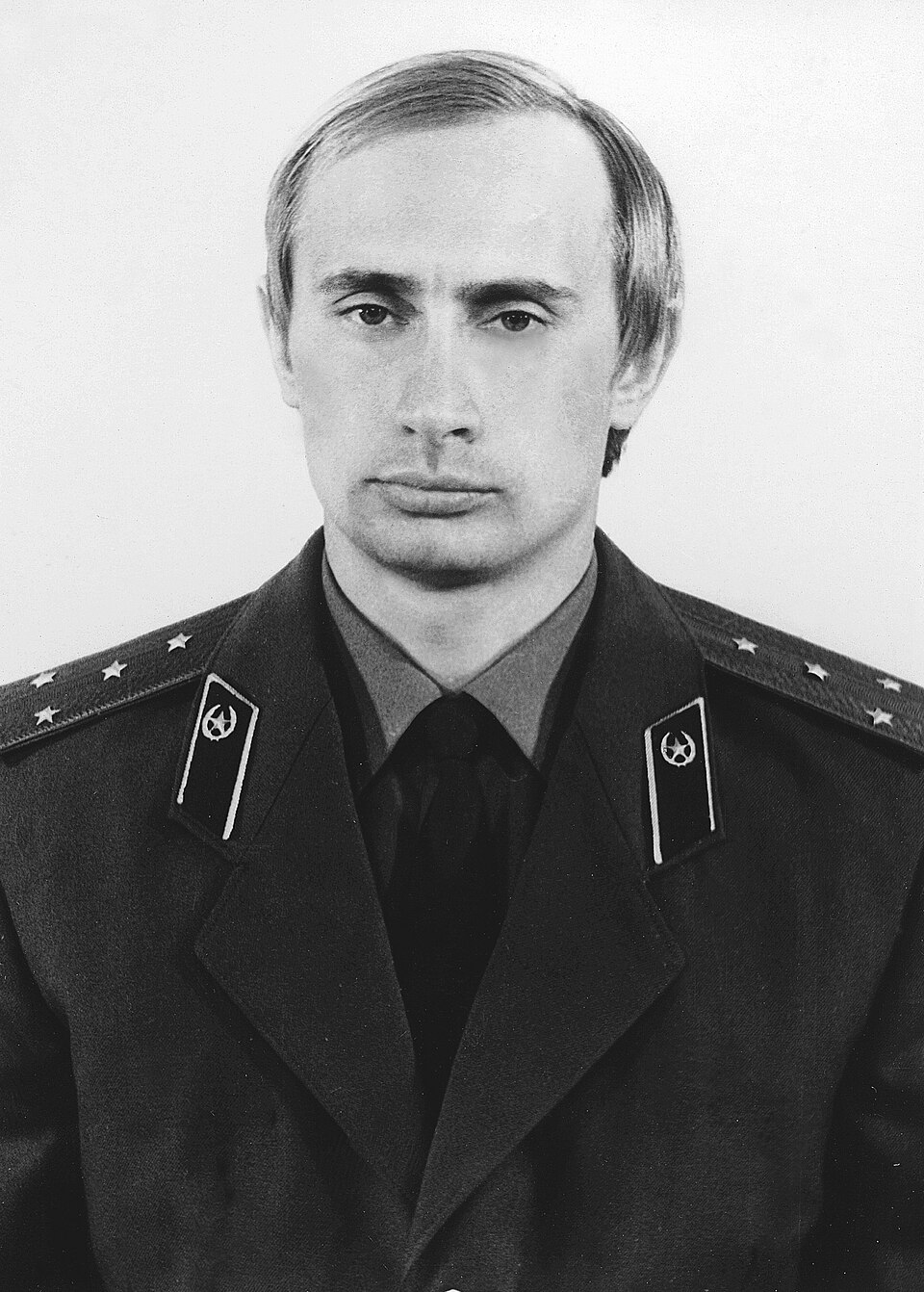
Vladimir Putin in KGB uniform. Source: Wikimedia Commons · kremlin.ru · CC BY 4.0
There is an officially authorized account of young Putin as someone who "jumped at anyone who offended him — scratched, bit, pulled out hair, anything to avoid humiliation." This quote appears in the book First Person — an authorized biography assembled from interviews Putin personally agreed to and controlled. A source chosen by the subject to tell his own story is not a biography. It is a managed narrative.
Independent journalists and authors who have studied Putin's childhood — including Masha Gessen, Julia Ioffe, and Philip Short — describe not a fighter but a survivor. Someone who learned to read the room. Someone who understood, early and instinctively, that in a courtyard governed by physical hierarchy, the safest position is not confrontation but alignment.
This is the behavioral template that runs through Putin's entire career. Sobchak was his protector in St. Petersburg. Berezovsky and the Yeltsin family were his protectors in Moscow. He borrowed their weight, executed their assignments, and sheltered behind their power — until he had accumulated enough of his own to no longer need them. Then, one by one, he discarded them or destroyed them.
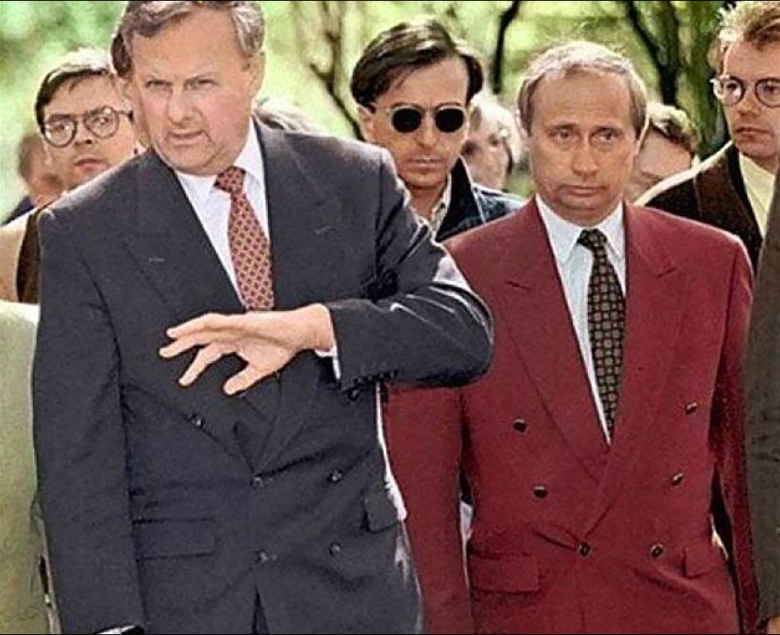
Putin and Sobchak, St. Petersburg, early 1990s. Putin (right, in burgundy jacket) positioned slightly behind his patron — the geometry of borrowed power. Source: Wikimedia Commons · CC BY 4.0
Here is a critical analytical error that must be corrected: the pattern of acting through others, of leaving no fingerprints, of engineering outcomes that cannot be legally attributed — this is not a psychological quirk that developed in a Leningrad courtyard. This is a trained professional skill.
Putin spent fifteen years inside the KGB, an institution whose operational doctrine was built on precisely this principle. Deniability is not a side effect of Soviet intelligence work. It is the central design requirement. Operations are structured so that attribution is impossible. Responsibility is distributed across chains of intermediaries. The outcome is engineered; the evidence is managed; the perpetrator remains invisible.
Internal FSB correspondence published through human rights organization Gulagu.net contains a revealing self-assessment by an anonymous FSB officer: Putin has "narcissistic disorders, possibly due to childhood complexes," and deliberately surrounds himself with people who psychologically resemble those who once had power over him — over whom he now has total power.
▸ Global Defense Corp / The Sun Online: 'Leaked FSB document', April 2023 · Gulagu.net
The complete picture requires holding both levels simultaneously. The emotional raw material — the need for a powerful protector, the accumulated humiliations, the instinct to retaliate only from a position of safety and superiority — comes from the courtyard. The operational methodology — the untraceable chains of action, the managed deniability, the patient timing — comes from the KGB.
What makes Putin specifically dangerous is not either element alone. It is their combination. The emotional drive of someone who has spent a lifetime settling scores from childhood. The professional competence of someone trained by one of history's most sophisticated covert organizations. The accumulated power of someone who now controls a nuclear state.
THE MAN WHO WAS CHOSEN — NOT BORN
The Skuratov Affair and the Audition That Won Everything
The conventional story of Vladimir Putin is one of a cold KGB professional who rose through merit and seized power through strength of character. This story is false. Putin did not rise. He was installed. And the reasons he was installed reveal more about his psychology than any biography ever could.
By late 1998, Boris Yeltsin's inner circle — known in Russia simply as "the Family" — faced an existential threat. Yuri Skuratov, Russia's Prosecutor General, was closing in on corruption at the highest levels of the Kremlin. The Family needed Skuratov gone — and they needed someone to do the dirty work. That person was Vladimir Putin, then director of the FSB.
"Putin, as people from Yeltsin's inner circle say, was responsible for ensuring that Skuratov quietly left the Prosecutor General's office and did not 'stir the waters.'"
— Journalist Pavel Sheremet, citing sources from Yeltsin's inner circle
On the night of March 17–18, 1999, Russian state television broadcast a grainy video of a man "resembling the Prosecutor General" in a compromising sexual encounter. The tape had been delivered anonymously to the newsroom. Within days, Putin and Interior Minister Stepashin held a joint press conference confirming the tape's authenticity. The operation was clean. Skuratov was removed. Putin left no fingerprints.
Skuratov later published a book titled Putin — Executor of Evil Will, in which he argued that Putin acted as an instrument of the Yeltsin family's fear. The book's title is itself a psychological verdict: not a mastermind, but an executor.
SELECTED FOR MANAGEABILITY — NOT STRENGTH
What Pugachev Witnessed from the Inside
Sergei Pugachev is not a neutral observer. He is a former Russian billionaire, former Senator, and — by his own account — one of the architects of Putin's rise. He knew Putin personally from 1996 to 2012. After falling out with the Kremlin and losing his assets, he gave a five-and-a-half-hour interview to journalist Dmitry Gordon, filmed in France.
What Pugachev describes is not a strongman. It is someone almost structurally incapable of independent decision-making.
Pugachev describes a specific conversational pattern: Putin consistently structures meetings so that decisions arrive already formed. He hears the recommendation, agrees or disagrees at the margins — but the intellectual work is done by someone else. This is not laziness. It is a system. A man who never makes decisions can never be held responsible for them.
"'Do I really have to read all of this?' — 'Yes, Volodya, this is a foundational matter.' — 'Well, I'll read it later. Tell me what it means.'"
— Sergei Pugachev, reconstructing a conversation with Putin, interview with Dmitry Gordon
To the Financial Times and Time, Pugachev was equally direct: Putin does not think strategically. He lives in the present. He does not understand economics. He loves good news. This is the profile of someone selected not for capability but for controllability.
▸ Gordon UA: 'Pugachev: Putin voobshche ne prinimayet resheniy' · Radio Svoboda analysis, October 2021 · RBC: November 2014 · Financial Times, 2015
THE SIGNATURE THAT WAS NEVER HIS
A Lifetime of Managed Deniability
Long before Putin became president, those who worked alongside him in St. Petersburg noticed something consistent: he avoided putting his name on anything that could later be used against him. During his years as a deputy to Mayor Anatoly Sobchak, colleagues observed that Putin was reluctant to sign documents unilaterally. He preferred multiple signatures on sensitive authorizations — not out of collegial spirit, but to diffuse personal accountability.
This pattern did not disappear when Putin gained power. It scaled. By the time of the full-scale invasion of Ukraine in February 2022, multiple senior Russian generals reportedly learned the operation was underway only at the last moment — the decision was compartmentalized not for operational security alone, but because Putin's structure requires that accountability always remain diffuse.
BEHIND CLOSED DOORS
What Witnesses Describe
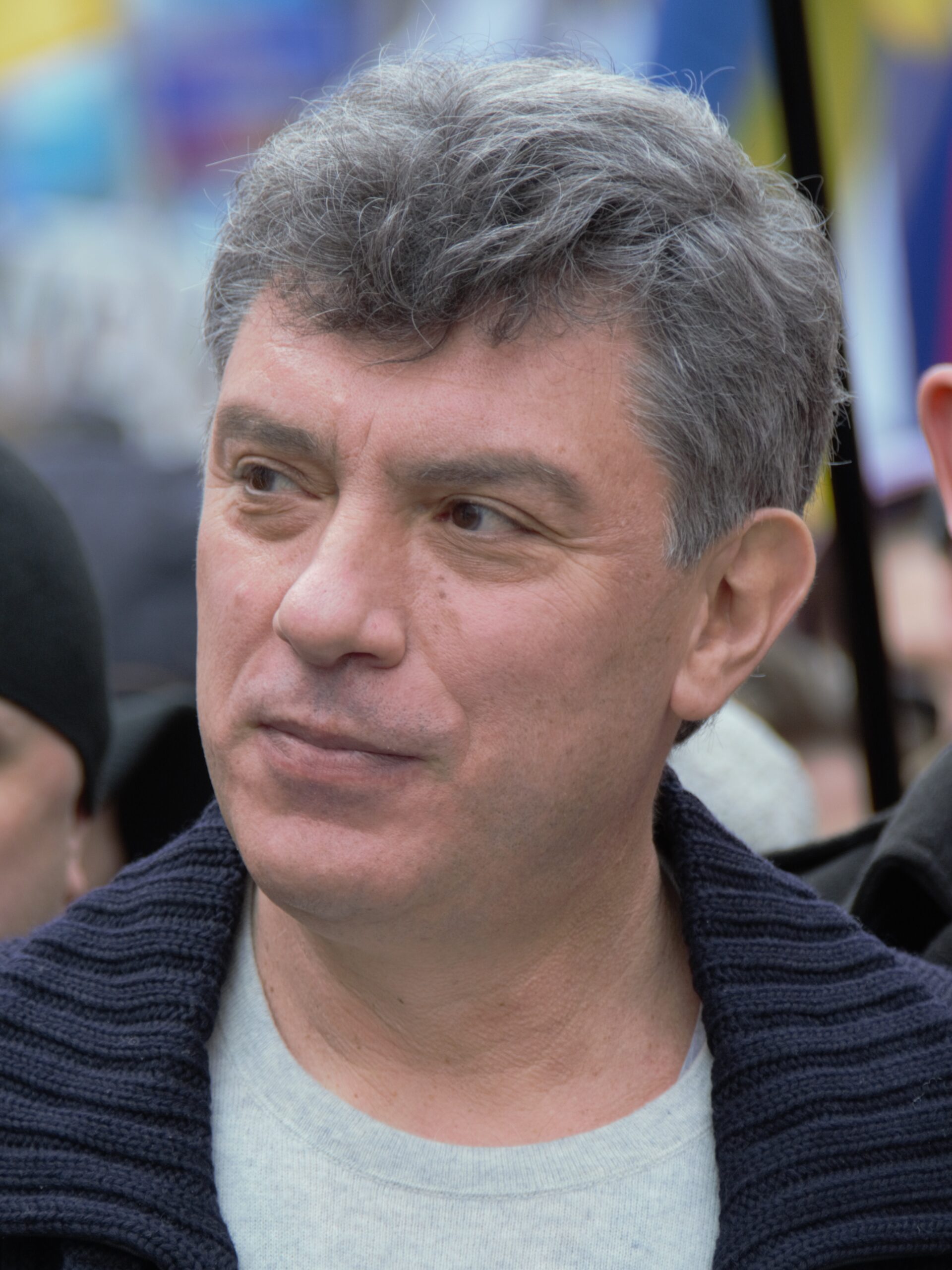
Boris Nemtsov at an opposition rally, 2014. He was shot four times near the Kremlin walls on February 27, 2015. Source: Wikimedia Commons · CC BY-SA 4.0
Boris Nemtsov, Russia's former Deputy Prime Minister and one of the country's most prominent opposition figures, knew Putin in the years when both moved through the same corridors of power. In his final interview with the Financial Times — recorded days before his assassination in February 2015 — Nemtsov was direct:
"Putin is completely amoral. He is Leviathan. Putin is much more dangerous than the Soviets ever were. In the Soviet Union at least there was a system — decisions were made in the Politburo. Now it is just him. Around him are rich and weak people. There is no one left who could influence him."
— Boris Nemtsov, Financial Times, February 2015
The cost of this honesty was Nemtsov's life. He was shot four times on the Bolshoy Moskvoretsky Bridge on February 27, 2015 — 200 meters from the Kremlin walls. The executors were convicted. The organizer was never officially identified. The investigation refused to subpoena Ramzan Kadyrov for questioning, despite overwhelming circumstantial evidence connecting the chain of command to Chechnya.
THE ARCHITECTURE OF REVENGE
Documented Cases
Putin's vindictiveness is not a personality quirk. It is a governing mechanism. The message sent through each act of personal revenge is received by everyone watching: dissent has consequences that are specific, prolonged, and personal.
Nemtsov was arrested at a peaceful, legally authorized demonstration and sentenced to 15 days administrative detention. According to a January 2011 report in Novaya Gazeta, Nemtsov himself reported that a Moldovan man with active, open-form tuberculosis was deliberately placed in his cell. Open-form tuberculosis is highly contagious, airborne.
The decisive detail: the moment Nemtsov was released, the infected man was immediately transferred to quarantine. If the placement was accidental, the sick man would have been discovered during routine intake — not removed the moment Nemtsov left. Someone placed a contagious tuberculosis patient in that cell deliberately.
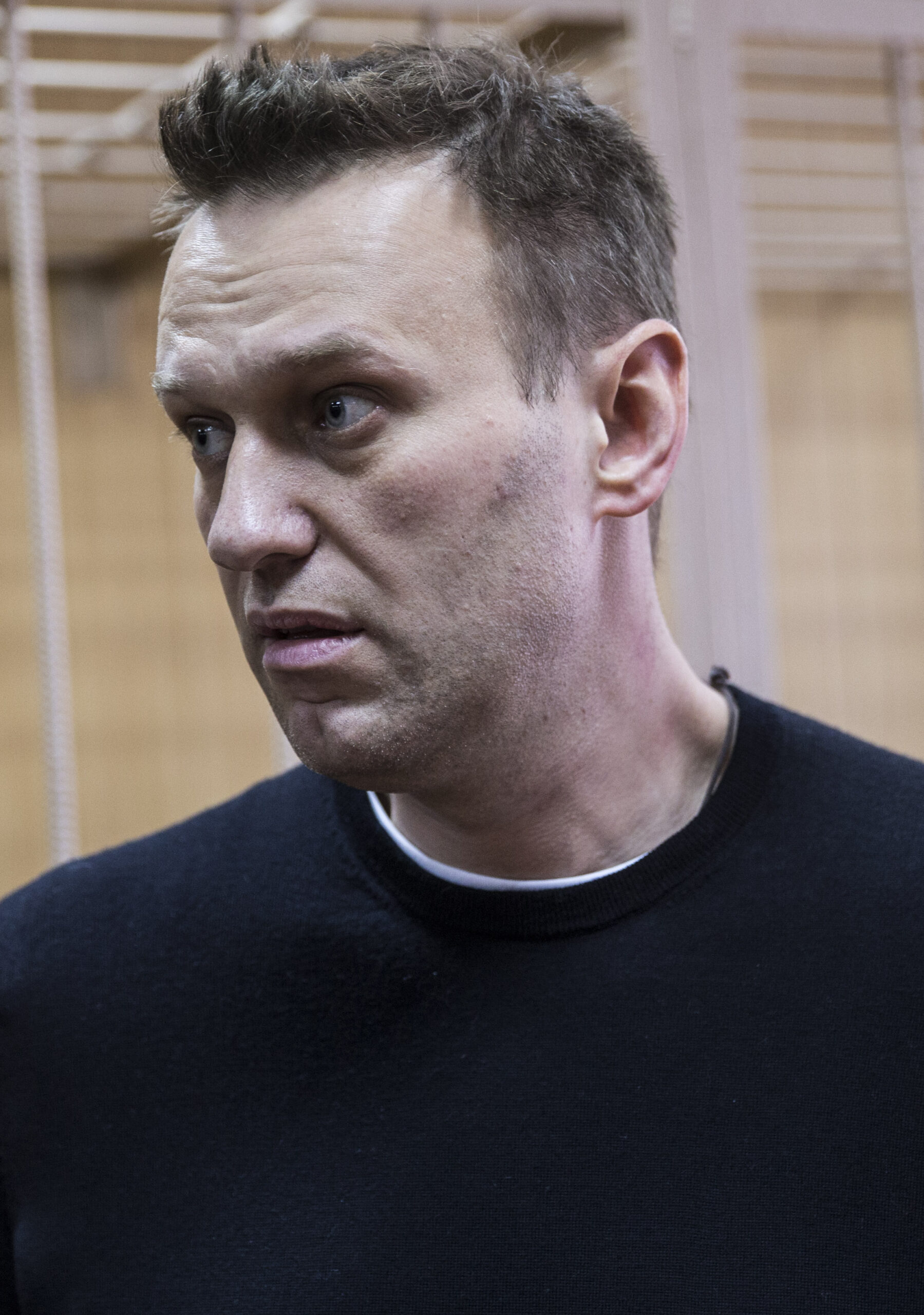
Alexei Navalny in court, 2017. He survived a nerve agent assassination attempt in 2020 and died in an Arctic colony in February 2024. Source: Wikimedia Commons · CC BY-SA 4.0
The documentation of what was done to Alexei Navalny in Russian detention is among the most complete records of systematic, state-directed torture in the modern era. It was not improvised. It was designed.
In March 2021, Navalny's attorney Olga Mikhailova reported that he had been deprived of continuous sleep for two weeks: guards entered his cell every hour throughout the night, shining flashlights in his face and announcing "a check of Alexei Navalny, prone to escape." The UN's Istanbul Protocol on torture explicitly identifies sleep deprivation as torture. Navalny was sent to punitive solitary confinement 27 times. The last time was two days before his death.
In 2024, Meduza obtained access to internal communications from staff at Correctional Colony No. 6. The correspondence showed that staff were consciously creating unbearable conditions and attempting to cover their tracks. Navalny did not die of natural causes in any meaningful sense. He was systematically broken until his body failed.
▸ Novaya Gazeta: 'Novaya provokatsiya v otnoshenii Nemtsova', January 2011 · Meduza: March 2021 · Meduza: internal Colony No. 6 correspondence, October 21, 2024
THE CLOSEST VICTIM
What Happened at Home
The most intimate evidence of Putin's psychology comes from inside his own home — and it was not Lyudmila who chose to reveal it. The man who witnessed it did.
Sergei Pugachev describes an evening he spent with Putin and Lyudmila at their home. The men were drinking. Lyudmila quietly asked Pugachev not to pour more — "please, don't." Putin overrode her and insisted they continue. When Putin eventually left the room, Lyudmila broke down in tears.
"Don't let him drink. You don't understand what kind of sadist he is. When he drinks — he starts pinching me, pressing me, showing judo moves on me. I spend the next week covered in bruises."
— Lyudmila Putin, as quoted by Sergei Pugachev, interview with Dmitry Gordon, 2022
Two details matter here beyond the obvious. First: Pugachev was present. This is not hearsay about hearsay. He witnessed Lyudmila's distress directly. Second: the instrument of abuse was judo — the same martial art that Putin's image machine spent decades presenting as evidence of discipline and strength. In the privacy of his home, with his wife as the only available target, it became a tool for causing pain to someone who could not defend herself.
Maria Maksagova — a Russian opera singer and former member of the State Duma from Putin's own United Russia party — confirmed Pugachev's account independently. The German federal intelligence service BND documented a parallel account from Putin's KGB posting in Dresden: an agent who befriended Lyudmila reported that she told her directly that her husband "resorted to domestic violence and had many sexual relationships."
Alcohol does not create personality. It removes the mask from what is already there. Clinical psychologists are unambiguous on this point: what a person does when disinhibited is not a deviation from their norm — it is their norm, briefly unguarded.
▸ Gordon UA: Pugachev interview, 2021–2022 · Confirmed by Maria Maksagova in separate interview · Daily Mail / German media, citing BND intelligence dossier, 2011
THE BODY THAT CANNOT LIE
When the Image Machine Loses Control
Image management is among the most sophisticated operations of the Putin administration. The shirtless horseback photographs. The judo throws. The controlled press conferences. The walk — that particular rolling, right-arm-restrained gait that body language analysts spent years analyzing. Research suggests the walk reflects military parade training, not organic confidence. In either case, it is performed.
But bodies lie badly when their owner is not in control. There is a category of public Putin moments that cannot be managed — captured on video before image handlers can intervene. They occur in the presence of attractive women in semi-formal public settings. The pattern is consistent: Putin reddens. His gaze becomes mobile — dropping to his shoes, to his hands, to middle distance. His mouth tightens. The shoulders pull slightly inward. This is the body of a man who has not developed the resources to simply be present with another person without managing them.
WHAT ACADEMICS CONCLUDE
The Dog, the Table, and the Architecture of Intimidation
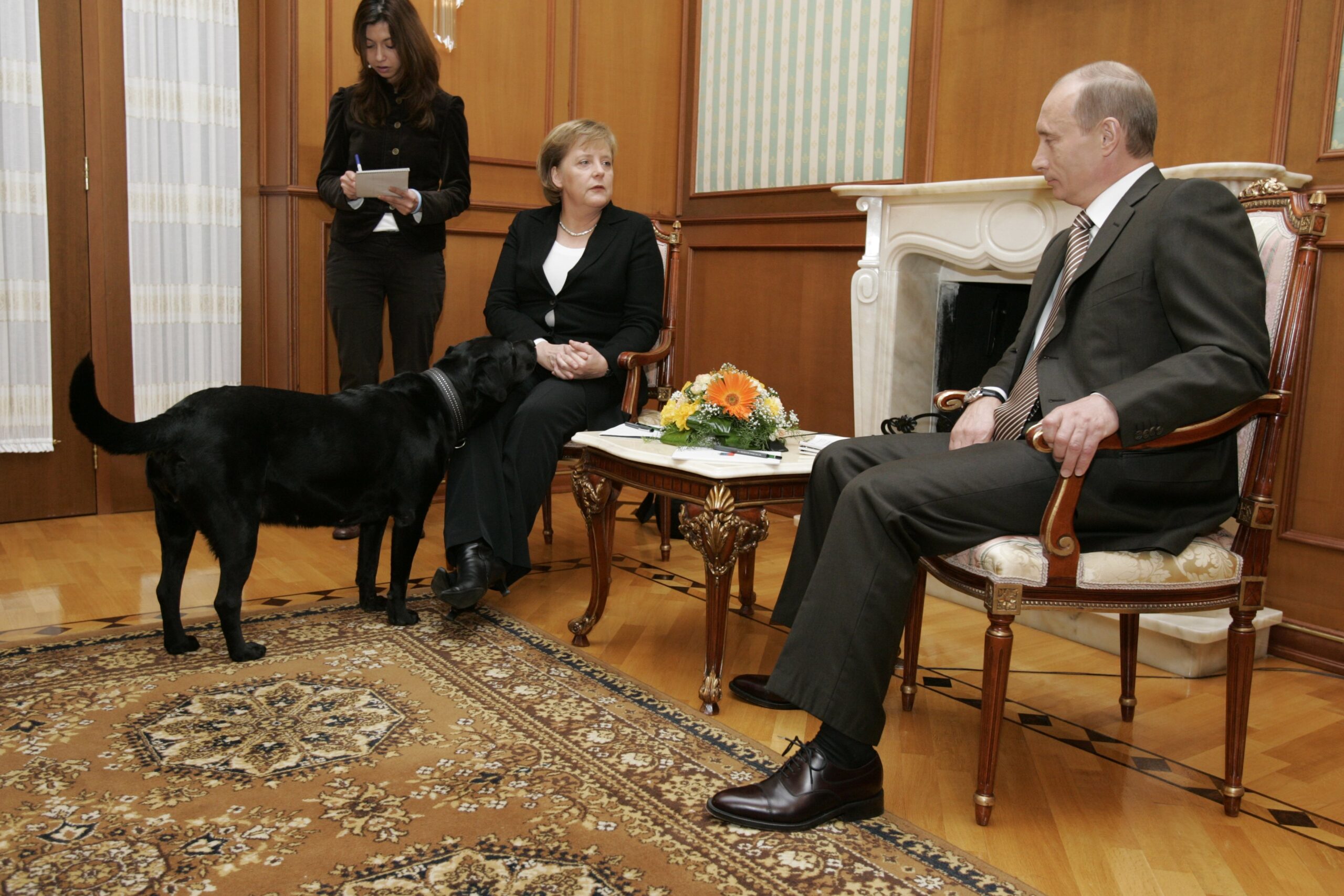
Sochi, January 21, 2007 — Putin's Labrador Konni approaches Angela Merkel, who has a documented fear of dogs. Putin was informed in advance. Source: Wikimedia Commons · kremlin.ru · CC BY 4.0
Multiple academic psychologists have produced formal profiles of Putin's personality structure. The most cited in English-language literature is Aubrey Immelman of Saint John's University, Minnesota, whose Unit for the Study of Personality in Politics published analyses from 2017 through 2022. His findings identify a dominant pattern combining ambitious-exploitative (narcissistic) and dominant-aggressive (paranoid) traits. Crucially, the narcissistic structure he identifies is compensatory — the image of strength exists precisely because the underlying experience is not one of strength.
A genuinely confident leader does not need to humiliate subordinates in private while projecting calm in public. A genuinely confident person does not weaponize a known phobia against a world leader — as Putin did when he brought his black Labrador to his 2007 meeting with Angela Merkel, despite knowing she had a documented fear of dogs after a childhood bite. Merkel's own memoirs describe this as a deliberate power play. Putin sat back and watched her discomfort with visible satisfaction.
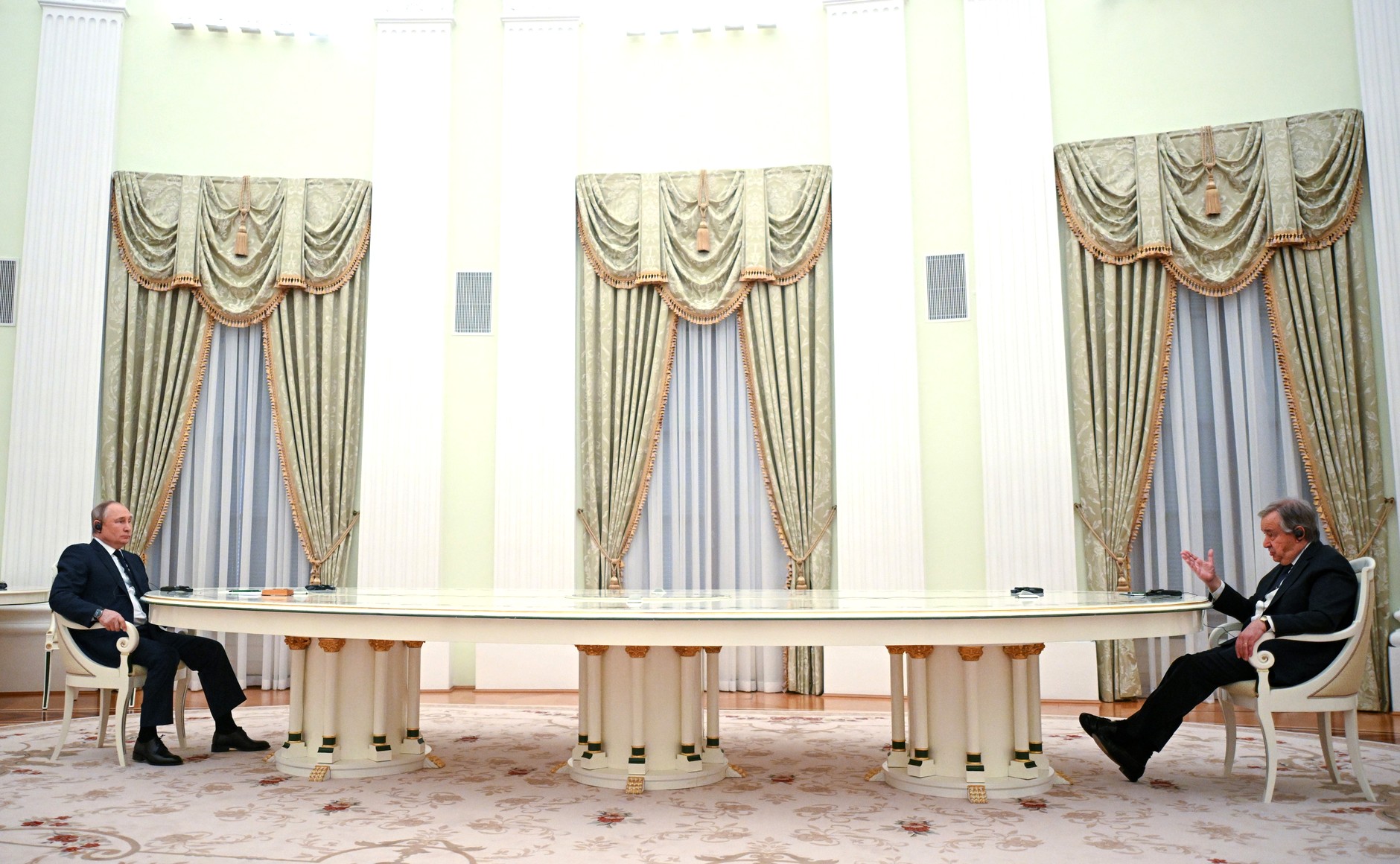
Putin and UN Secretary General Guterres, April 26, 2022 — separated by meters of empty table. Not COVID hygiene. The physical expression of a man who has spent decades expecting betrayal. Source: Wikimedia Commons · kremlin.ru · CC BY 4.0
The paranoia is equally functional. The famous long tables of the COVID era — Putin seated ten meters from his own ministers — were not only about hygiene. They were the physical expression of a man who has spent decades expecting betrayal, and who manages this expectation through architecture.
CONCLUSION — THE INSTALLED MAN
The Full Picture
Vladimir Putin is not what his image machine has spent twenty-five years claiming he is.
He is not a strategic mastermind — he does not read foundational documents and prefers decisions to arrive pre-formed. He is not a man of physical courage — every act of apparent toughness is staged in controlled conditions with no actual risk. He is not in command of his emotions — witnesses to closed meetings describe a man who screams at subordinates. He is not decisive — he is suggestible, shaped by the last person to speak to him.
What he is, is a man who was selected for a job he was never meant to grow into. The Yeltsin family needed a loyal executor who would not investigate them, not threaten them, and take careful aim at their enemies without leaving evidence. Putin was that man. He passed his audition in the Skuratov affair.
And then something went wrong — or right, depending on your perspective. The man chosen for manageability accumulated enough power, over enough years, to no longer be manageable.
Pugachev — the man who helped put him there — watched his own assets expropriated, survived multiple assassination attempts, and now lives under police protection in Nice, France.
Nemtsov — who called him amoral in public — was shot four times near the Kremlin.
Navalny — who documented Putin's corruption and survived a nerve agent assassination attempt — was processed through Russia's prison system for three years until he died in an Arctic colony, sent to punitive isolation 27 times, the last two days before his death.
The pattern is not complicated. It is just very, very expensive — for everyone except the man at the center of it.
- Masha Gessen — The Man Without a Face: The Unlikely Rise of Vladimir PutinPenguin Random House
- Psychology Today — Dr. Nina Cerfolio, Mount Sinaipsychologytoday.com, April 2024
- Newsweek — Portrait of the Young Vladimir Putinnewsweek.com
- Gulagu.net — Leaked FSB internal correspondencegulagu.net, April 2023
- Gordon UA — Pugachev interview seriesgordon.ua, 2021–2022
- Financial Times — Pugachev on Putin's decision-makingft.com, 2015
- Novaya Gazeta — Nemtsov tuberculosis cell reportnovayagazeta.ru, January 2011
- Meduza — Navalny sleep deprivation documentationmeduza.io, March 2021
- Meduza — Colony No. 6 internal correspondencemeduza.io, October 21, 2024
- Vedomosti — Nemtsov Financial Times interview (posthumous)vedomosti.ru, March 2015
- Aubrey Immelman — Unit for the Study of Personality in PoliticsSt. John's University, Minnesota, 2017–2022
- Angela Merkel — Freedom. Memories 1954–2021 (memoir)On the Konni incident, 2024
Leaders. Unmasked. · © 2026 DAY · All rights reserved · daysolis.com