XDAY FILES  ·  Investigative Series

WHY EUROPE
SAID NO

A Full Investigation: From Legal Arguments to Putin's Trojan Horse

US NATO EU classified summit table

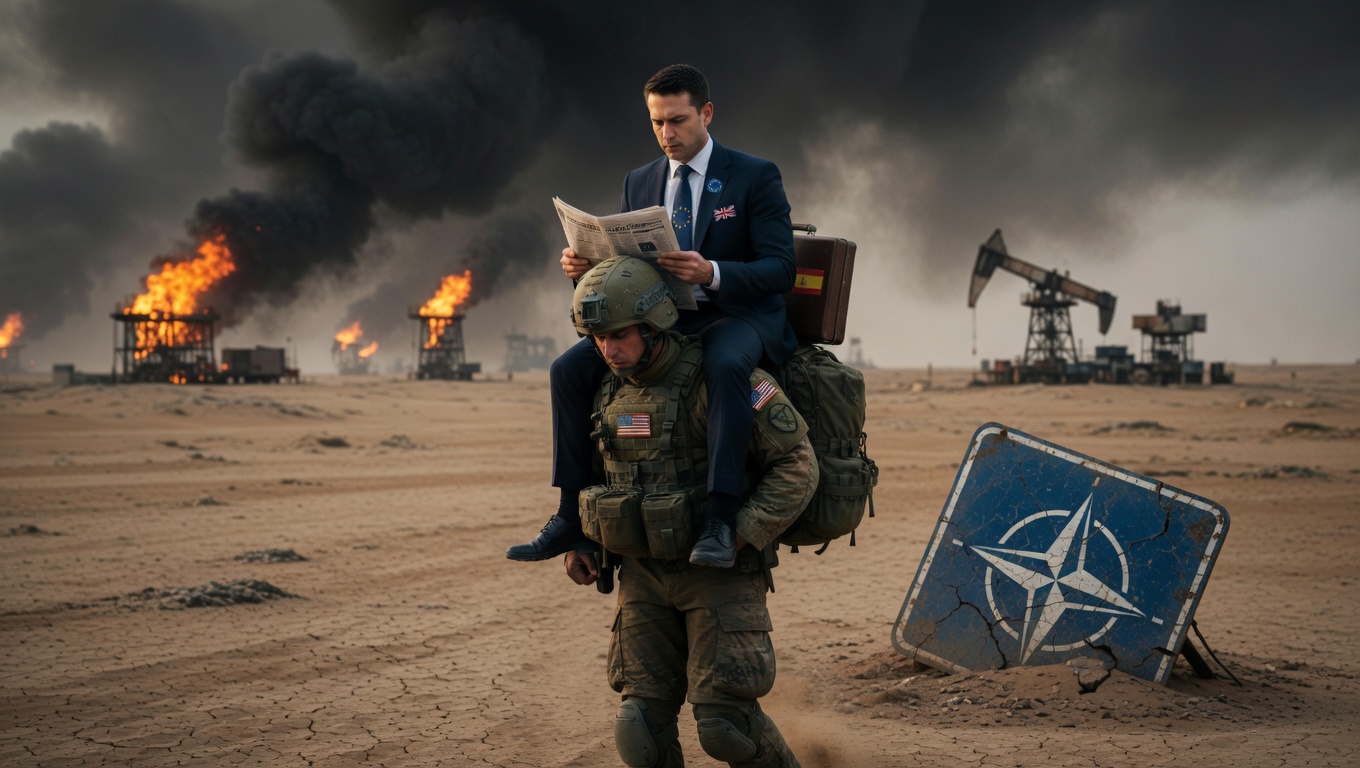
Spain closed its airspace to U.S. jets. Italy denied landing rights at its Sicilian base. Poland refused to redeploy its Patriot batteries to the Middle East. Trump calls his allies cowards. Hegseth questions NATO's future. Rubio talks of reconsidering the alliance itself.

Every major outlet is covering the "no." None of them are explaining it.

The answer is not one thing. It is eight. Each one heavier than the last. But before examining Europe's position, we need to honestly understand America's. Because serious journalism begins not with accusation — but with understanding.

Part I

TRUMP'S LOGIC

Why He Did It Exactly This Way

Stop judging Trump for a moment. Try thinking in his terms. That is not the same as agreeing with him. It means understanding the mechanics of his decision. He had a logic. Debatable, contradicted at points by his own intelligence agencies — but a logic.

Argument One
The Window Was Closing

In his February 28 address, Trump said Iran had been attempting to rebuild its nuclear program following the summer 2025 strikes. Tehran, he argued, had rejected every opportunity to renounce its nuclear ambitions and was instead building a massive ballistic missile stockpile — one that could soon threaten U.S. forces abroad and allies across Europe.

From Washington's perspective, a nuclear Iran is not a future threat. It is a deadline.

"If we didn't hit within two weeks, they would've had a nuclear weapon," Trump told congressional leaders on March 4. That figure is disputed by many experts. But it was the logic driving the White House: delay equals a nuclear Iran.

Argument Two
Consultation Means Leaks

Military operations lose the element of surprise in direct proportion to the number of people briefed. That is not a Trump invention. It is a basic principle of operational security.

The administration's position was blunt: Iran was not negotiating — it was stalling, replenishing missile stockpiles and restarting its nuclear ambitions. Every week spent consulting allies was another week for Tehran to disperse assets and harden targets.

Trump's doctrine is maximum pressure through unpredictability. That is not a flaw in his style. It is a deliberate strategy. An enemy that knows when you will strike is ready for the strike.

Argument Three
The Iraq Precedent

In 2003, the United States spent months assembling a "coalition of the willing." The result was a war the world had condemned before the first bomb fell. In Trump's inner circle, lengthy consultations do not add legitimacy. They produce leaks, political bargaining, and time for the adversary to prepare.

Argument Four
Europe Would Have Said No Anyway

Trump identified this paradox himself: virtually every NATO ally had privately agreed with the logic and legitimacy of striking Iran's nuclear program. None were willing to act on it when asked to share the burden.

Former U.S. Ambassador to NATO Ivo Daalder acknowledged there "was a way to bring our NATO allies into the discussion." But the president, he said, "decided to do none of that" — not with Congress, not with the American people, not with the allies. That is a legitimate criticism. Trump reads it differently: not as arrogance, but as the decisiveness he considers a strategic asset.

Argument Five
Hormuz Is Everyone's Problem

"The countries of the world that do receive oil through the Hormuz Strait must take care of that passage," Trump said on April 1. "They must cherish it. They must grab it and cherish it."

This is not rhetoric. It is doctrine. The United States produces its own oil. Europe, Japan, and South Korea are critically dependent on Hormuz. If you depend on the route more than the country that cleared it — in Trump's view, you should be guarding it.

Where Trump's Logic Breaks Down

Honesty requires going further.

The Washington Post documented that as the war unfolded, the administration cycled through shifting rationales — regime change, preemption, nuclear threat, missile threat. A position that changes every week signals the absence of a coherent strategy from the start.

⚠ Intelligence Contradiction

IAEA Director Rafael Grossi stated on March 3 that the agency had "no evidence of Iran building a nuclear bomb." U.S. intelligence had assessed as recently as 2025 that Iran had no active nuclear weapons program.

Trump moved fast. Fast and right are not the same thing.

NATO summit round table with international flags
Part II

EUROPE'S RESPONSE

Seven Official Reasons for the Refusal

Presented with a war as a fait accompli, America's European allies responded with one word. Nie. Non. Rifiuto. No. The media report on that "no" every day. They do not report its reasons. There are seven. Each one is substantial on its own.

1
Legal Deadlock: This War Has No Legal Basis

This is the foundation. Everything else rests on it.

"One key issue for European countries is the issue of legality," said Kamil Zwolski, a fellow on terrorism and conflict studies at RUSI. "What Europeans mean when they say that this war has no legal basis is that the United Nations has not approved it — there was no resolution. They also mean that this is not a war of self-defense, because there was no evidence of imminent attack of Iran against the US or Israel. At the minimum, what they also mean is that this war was not agreed by NATO allies. They were not consulted."

According to SIPRI, the attacks on Iran were initiated against a state party to the Nuclear Non-Proliferation Treaty — a country with an "inalienable right" to peaceful nuclear energy. The U.S. decision to join, as an NPT depositary state, undermines the entire non-proliferation architecture. European governments have spent decades building their identity around international law and multilateralism. Joining this operation would mean abandoning that foundation — not politically, but legally.

2
NATO Is Not What Trump Thinks It Is

German Chancellor Friedrich Merz stated flatly that the conflict has "nothing to do with NATO." NATO is "an alliance for the defense of territory" and "the mandate to deploy NATO is lacking."

British Prime Minister Keir Starmer was equally direct: "Let me be clear: that won't be, and it's never been envisioned to be, a NATO mission."

Article 5 of the NATO Charter covers collective self-defense when a member state is attacked. The U.S.-Israeli war against Iran is an offensive operation launched without consulting allies. Trump's demand that they join it under the NATO banner is a fundamental reinterpretation of the alliance — as an instrument of American foreign policy. Europe refuses that reinterpretation.

3
Ukraine Comes First

For most European governments, Ukraine remains the central geopolitical priority. The Iran conflict creates both opportunities and risks. Iran has been a key supplier of drones to Russia — a war forcing Tehran to redirect resources could reduce that support. But the war has also driven up energy prices, boosting Russia's export revenues.

Polish Defense Minister Wladyslaw Kosiniak-Kamysz put it plainly: "Our Patriot batteries are used to protect Polish airspace and NATO's eastern flank. Nothing is changing in this regard."

For Warsaw, Vilnius, or Tallinn, moving air defense systems to the Persian Gulf means leaving their own borders with Russia exposed. No Iranian threat makes that trade acceptable.

4
Energy Suicide

Iran blockaded the Strait of Hormuz. Roughly one-fifth of global oil shipments pass through it. European natural gas prices doubled within 24 hours. Trump demanded allies send warships to reopen the strait. His logic: if you depend on the route, you defend it.

From the outset, European countries faced direct Iranian strikes on their territory, energy inflation, threats to their economic prosperity, risks of terrorism, and the potential for another destabilizing wave of mass migration — for a war they were pulled into against their will, without even being warned it was coming.

Why should Europe bear military costs for a war it did not start?

Strait of Hormuz map oil shipping route
5
Domestic Politics: Public Opinion as a Hard Wall

Italian state broadcaster RAI reported that the American plan was communicated while the aircraft were already in flight. Checks revealed these were not routine logistical flights and therefore not covered by the existing treaty with Italy.

Giorgia Meloni is a Trump political ally. Her government still denied the request. Outside the Sigonella base in Sicily, police held back demonstrators protesting U.S. and Israeli strikes. No European leader can politically sustain open support for a war that most of their citizens oppose.

Anti-war protests in Europe Hands Off Iran
6
Trust Is Broken — And Not Only With Trump

Trump identified the paradox himself: virtually every NATO ally had privately agreed with the logic of striking Iran's nuclear program. None were willing to share the burden when it mattered.

"The damage done — to habits of consultation, to assumptions of shared purpose, to the basic expectation that allies inform one another before going to war — is real."
— Senior European Diplomat · GLOBSEC

Europe was not warned. It was presented with a fait accompli. That is not a momentary failure. It is a systemic breach.

7
A Precedent More Dangerous Than Iran

This is perhaps the deepest of the official reasons — the one politicians whisper and journalists rarely write.

"We were the ones that were for multilateralism, for international law," said international affairs scholar Nathalie Tocci. "That ambiguity is basically another nail in the coffin of our credibility."

SIPRI concluded that the U.S.-Israeli attacks on Iranian nuclear sites amount to aggression that violates international law. The contrast with European leaders' swift condemnation of Russia for attacking civilian nuclear infrastructure in Ukraine in 2022 is impossible to ignore.

If Europe supports this war — or silently provides bases and airspace — it permanently surrenders the moral authority to speak about international law, sovereignty, and the prohibition of aggression. This is not only about Iran. It is about Putin, watching carefully. About the Global South, drawing conclusions. About the next crisis, in which Europe's words will carry no weight at all.

Trojan Horse in European city night
Part III

THE HIDDEN REASON

The Demographic Time Bomb and Putin's Trojan Horse

This is not item eight on a list. This is a separate investigation within the investigation. What follows is not just another argument from European governments. It is a strategic operation prepared over decades. And it worked.

This is the final reason. The heaviest one. And the most suppressed — because naming it publicly is politically impossible.

On March 7, more than 50,000 people marched in London against the strikes. Following the assassination of Khamenei, senior ayatollahs issued a fatwa for jihad against America — calling vengeance "the religious duty of all Muslims in the world."

European leaders read intelligence reports. They know their countries are home to tens of millions of people with deep cultural and religious ties to the Muslim world. Joining a war against Iran could ignite their streets — not someday, but immediately. None of them say this publicly, because saying it means admitting that thirty years of demographic change have limited the foreign policy sovereignty of their own states.

Did this happen on its own — or did someone engineer it?
The question no one is asking

The answer has been documented by American think tanks, military institutes, and intelligence services for years. Nobody is assembling the pieces in public.

The Gerasimov Doctrine: Migration as a Weapon

Russian military theorists have long considered migration a weapon of war below the threshold of open conflict. Their writings explicitly discuss how mass Islamic immigration creates destabilizing effects and demographic changes in Western societies — effects designed to strike at NATO's capacity to function.

General Gerasimov formulated the doctrine of new-generation warfare in which non-military instruments are valued at four to one over military ones. Strategically engineered migration — across three continents, directed toward Europe — is one of its central tools. This is not a conspiracy theory. It is a documented doctrine, with names, dates, and specific operations on record.

Concrete Operations: Wagner, GRU, Frontex

Russian and Belarusian intelligence services, working alongside human traffickers, stripped migrants of their passports and directed them toward the borders of neighboring states. Italy directly blamed the Wagner Group for organizing waves of migration across the Mediterranean — from Niger, Burkina Faso, Mali, and the Central African Republic, where Wagner and the GRU operate actively.

Documents analyzed by Frontex show that Africa Corps units actively collaborate with local militias involved in human trafficking. Departures from the Cyrenaican coast increased 65% precisely during moments of peak diplomatic tension between the EU and the Kremlin over sanctions. A coincidence? No. It is a schedule.

Analysis by the Henry Jackson Society found that migration spikes statistically coincide with moments of Russian geopolitical pressure on the West. These are not humanitarian accidents. They are acts of statecraft. The real weapon is not the migrants — it is the societal fracture their arrival provokes inside European democracies.

On the Humanitarian Argument — Honestly

Some will say: this was cultural exchange, aid to developing nations, the humanitarian duty of wealthy Europe. There is a grain of truth in that — under one condition. A controlled, filtered, managed flow of migration with proper screening is a genuine instrument of development and mutual enrichment. Postwar Germany was built in part by Turkish guest workers — and it worked, as long as the flow was bounded and managed.

What happened in Europe between 2015 and the early 2020s was something entirely different. Uncontrolled. Unfiltered. An avalanche through open borders.

Documented Finding

"Russia uses a playbook of provocation and disinformation: facilitating migration flows and amplifying incidents through state media to fuel outrage and erode trust in institutions. The real weapon is not the migrants — it is the societal reaction within European societies."

— Raimar Wagner, German analyst · Friedrich Naumann Foundation

Cambridge University Press researchers documented six strategic goals Russia pursues through migration operations: pressuring EU sanctions policy, warning countries against joining NATO, and ultimately — undermining Western belief in its own values and destroying the West's credibility internationally.

Among corrupted officials, ideological fellow travelers, and simply naive politicians who opened borders out of sincere compassion — without seeing the full picture — the result was identical. The Trojan Horse did not enter European cities on a tank. It entered on a wave of compassion.

In 2026, that horse stands inside the fortress. Silent. Invisible. And it is one of the central reasons why European leaders cannot support America in the war against Iran — even when they want to.

Putin did not pull the trigger. He opened the gates — and waited patiently. He got what he waited for.
XDAY FILES analysis
Part IV

THE WAY BACK

Five Scenarios — and the One That Makes Sense

The rupture between America and Europe is not fatal. But it requires concrete steps — not declarations. Here are the scenarios, ranked by honesty, not optimism.

Scenario A
"Drift" — The Worst Outcome

The United States exits the Hormuz crisis without a clear result. Iran retains control of the strait. Europe locks in its course toward strategic autonomy. NATO becomes a negotiating club without military substance. Russia wins twice — through oil revenues and through the collapse of Western unity.

CFR analyst Richard Haass described Trump's emerging doctrine as an inversion of the Pottery Barn rule: "We broke it, but you own it." The U.S. started the war. Europe is being asked to clean it up. If this pattern holds, the transatlantic alliance loses its meaning for both sides.

Probability under current trajectory: HIGH
Scenario B
"Freeze" — Status Quo With a Mask of Peace

The parties avoid open conflict but stop trusting each other on anything strategic. Europe funds NATO. The U.S. keeps troops on the eastern flank. No real dialogue exists. This is not peace. It is managed dissolution.

For Russia, this is ideal. For China, equally so.

Scenario C
"European Pivot" — Autonomy Without Washington

Experts are already discussing the activation of Article 42.7 of the EU Treaty — a mutual defense mechanism among EU members that functions as NATO's Article 5, but without the United States. Europe builds parallel command structures and increases defense spending. NATO formally survives but fractures into a European track and an American track.

This protects Europe from Washington's unpredictability. It weakens the collective West against Russia and China. A half-victory for everyone — which means a full victory for neither.

Scenario D
"Hormuz Summit" — The First Bridge

Prime Minister Starmer announced an international summit to restore maritime security in the Strait of Hormuz. Thirty-five countries have signed a joint statement committing to work toward that goal.

This is the only constructive initiative currently on the table. It does not resolve the underlying contradictions. But it creates a shared task — not about Iran, not about law, not about NATO, but about a specific waterway. Small shared tasks rebuild trust faster than grand declarations.

Scenario E · Recommended
"New Architecture" — The Only Real Path Forward

This is the hardest path. It is also the only one that addresses causes rather than symptoms. The core idea: the U.S. and Europe agree on a mandatory consultation format before any military operations outside NATO territory. Not a European veto over American action — but a required 72-hour notification with an intelligence briefing for a narrow, vetted group of allies. In return, Europe commits to concrete burden-sharing — not in the Persian Gulf, but on the eastern flank and in Africa.

This is where the work must begin
What Needs to Happen Now
1

The Starmer Hormuz summit must become a permanent mechanism — a "Global Maritime Security Contact Group" with American and European co-chairmanship, not a one-time diplomatic event.

2

The United States should establish a closed intelligence channel along the lines of a "Five Eyes Plus" format — limited to 5 or 6 allies with verified, proven information security cultures: the United Kingdom, Poland, Norway, and potentially France at a restricted level.

3

Europe must formally increase military spending on the eastern flank to a level that takes a measurable share of the burden of defending Poland and the Baltic states off the United States.

4

Both sides should jointly launch a new diplomatic platform on Iran — engaging whatever government emerges from this conflict. France, Germany, and the United Kingdom were the architects of the JCPOA nuclear deal in 2015, the most significant achievement of European foreign policy in decades.

Moscow Kremlin dark storm clouds
Conclusion

There is no fundamental incompatibility of values between Washington and Brussels. There is a crisis of procedure, a crisis of trust, and a crisis of mutual respect for sovereign decisions.

Trump was right: a nuclear Iran is unacceptable. Europe was right: wars launched without consultation destroy alliances. Both are correct. Both are losing from the current rupture.

The only one who benefits from it sits in the Kremlin. And that is precisely why this rupture must be closed.
Sources

Bloomberg · Washington Post · CNN · PBS NewsHour · Axios · NBC News · CBS News · AP · GLOBSEC · CFR · Carnegie Endowment · SIPRI · Bulletin of Atomic Scientists · Democracy Now! · Middle East Eye · Al Jazeera · Euronews · White House · Hoover Institution · West Point Modern War Institute · FDD · Henry Jackson Society · Heritage Foundation · Friedrich Naumann Foundation · Cambridge University Press / European Journal of International Security · Frontex · Council of the EU / EEAS

Follow XDAY for more investigations Geopolitics · Power · Intelligence · Science
@XDAYSolis
XDAY FILES  ·  Investigative Series  ·  @XDAYSolis
© 2026 DAY · All rights reserved  ·  daysolis.com

1 thought on “WHY EUROPE SAID NO”

  1. A rare example of truly high-quality political analysis: honest, balanced, and grounded in sources. The situation is presented clearly, the underlying causes are examined, and the possible next steps are outlined—decisions that may largely determine the future of peaceful coexistence for people across several continents.

Leave a Comment

Your email address will not be published. Required fields are marked *

Scroll to Top