
THE POWER
OF TWO
Part Two — Seven Stories: Behind Every Genius, a Team. Apple, SpaceX, Microsoft, Google, Pixar, Reyes Holdings, and The Beatles — what happens when you actually look behind the face on the cover.
In Part One we examined the data. Studies from Wharton and Harvard, reports from Carta and First Round Capital, the academic work of Noam Wasserman and Joshua Wolf Shenk — all point in the same direction: durable success is, in the overwhelming majority of cases, built not by a solo operator but by a pair, a trio, or a tight cluster of key collaborators.
Now we move from statistics to specifics. Seven stories — from the worlds of technology, space, traditional business, animation, and music. Each has its own context, but the underlying narrative is the same: the person whose name is known around the world has never worked in solitude. Behind them stood at least one equally significant — but less visible — partner.
The Engineer, the Marketer, and the Icon
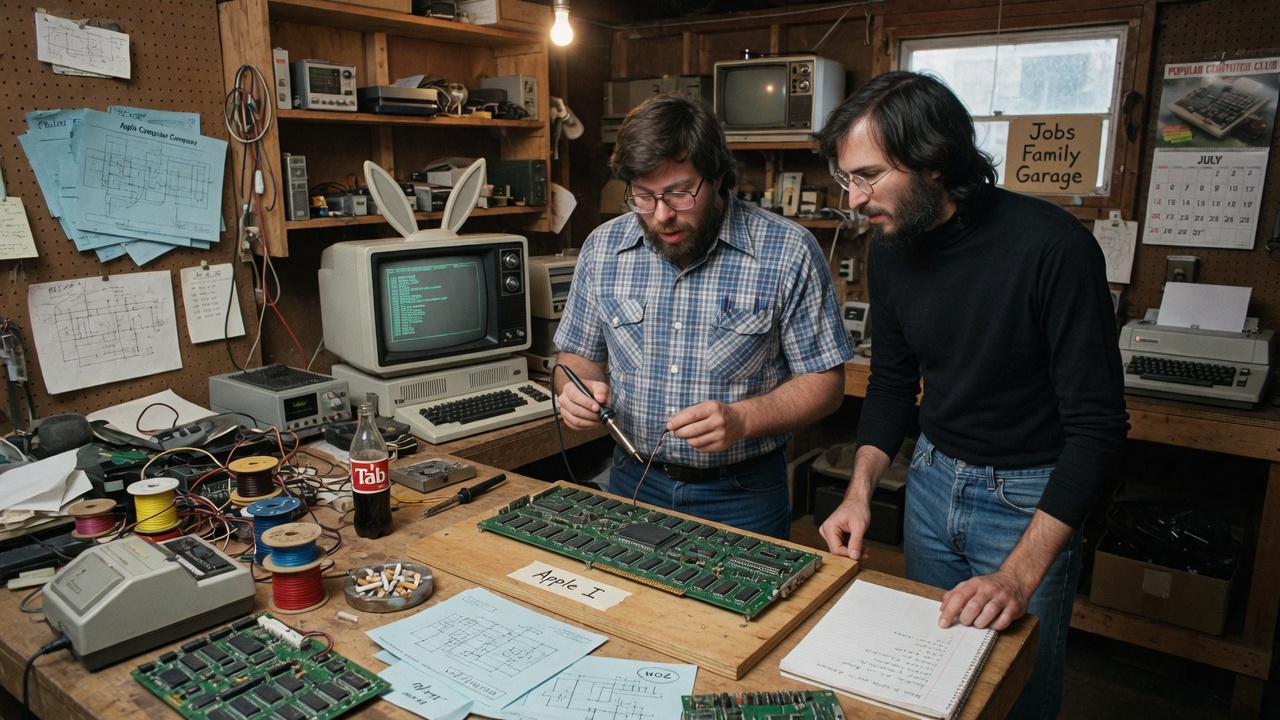
In the popular mind, Apple is Steve Jobs. The black turtleneck, the perfectionism, the legendary keynotes. But if you unroll the documents from 1976–1977, Apple Computer Company turns out to have been founded not by one or even two people, but by four — each of them indispensable.
The first Apple was designed and hand-built by Steve Wozniak. Not by Jobs. Wozniak was an engineer of the highest order, the only person in Silicon Valley at the time who could single-handedly design a personal computer. The Apple II, released in 1977 and the foundation of the company’s first decade, was also designed entirely by Wozniak.
The third founder was Ronald Wayne — a senior colleague of Jobs’s at Atari who drew up the partnership documents and designed the first logo. He sold his stake for $800 just twelve days in. Today that stake would be worth more than $100 billion.
But Wozniak and Jobs together were not enough. In January 1977 Mike Markkula joined the company — a former director of marketing at Intel who became, in effect, Apple’s third founder. Markkula invested $250,000 of his own money, wrote the business plan, and brought in the first CEO, Mike Scott, who guided the company through the difficult scaling years of 1977–1981 all the way to its IPO. Without Markkula and Scott, Apple would have remained a hobbyist club. Without Wozniak, there would have been no product at all.
This is a four-cornered structure, not a lone hero with his face on the cover of every magazine.
Vision and Execution
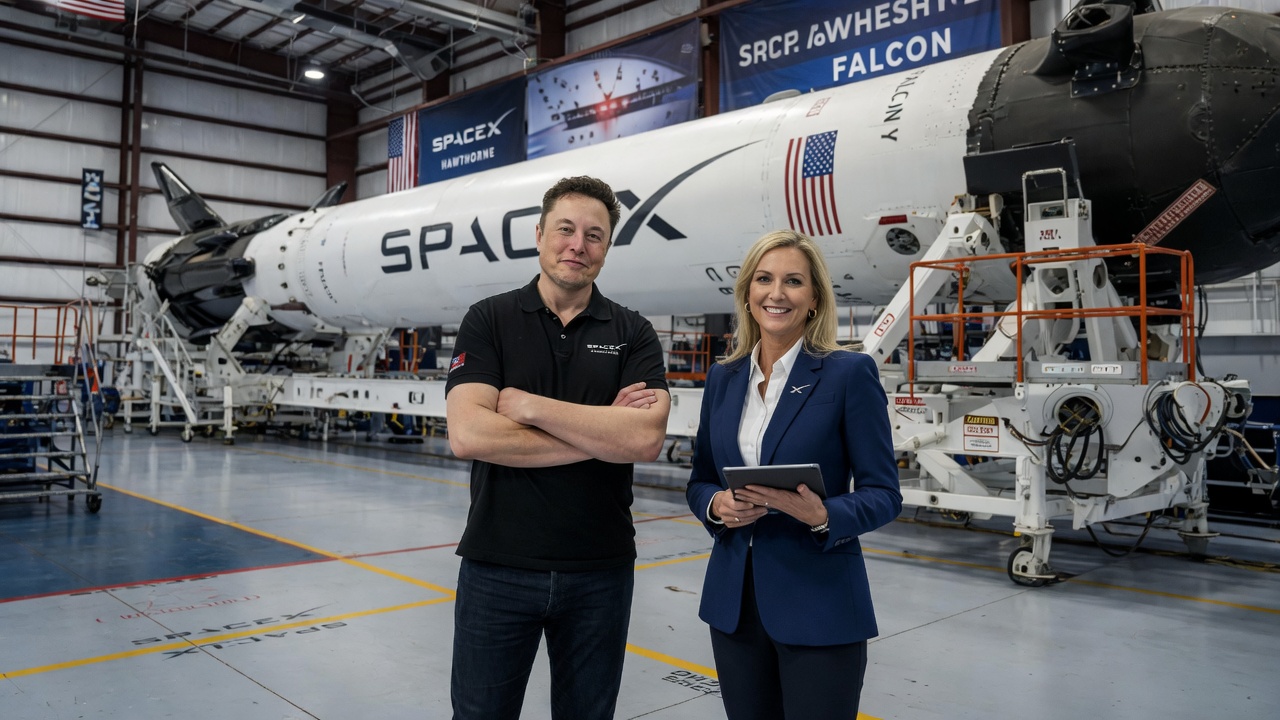
If you had to pick the modern icon of the “lone genius,” most people would say Elon Musk without hesitation. Legally, SpaceX really was founded by one person: in March 2002, Musk incorporated the company with $100 million of his own money from the sale of PayPal. But “founded alone” and “worked alone” are far from the same thing.
In that same 2002, Musk hired Tom Mueller — a former TRW engineer and the chief designer of the rocket engines. Without Mueller, the Falcon rockets would not exist. Mueller worked at SpaceX for eighteen years, until 2020. That same year saw the arrival of Chris Thompson (Boeing, McDonnell Douglas), responsible for airframes and docking systems, and Hans Koenigsmann (Microcosm), who took on avionics. And — most important — in August 2002, the eleventh employee through the door was Gwynne Shotwell.
In 2008, Shotwell became SpaceX’s president and chief operating officer. Since then, she has been the one negotiating with NASA, closing commercial contracts, managing 13,000 employees, and keeping the company on the ground while Musk handles everything else.
Inside the aerospace industry, Musk and Shotwell are referred to by first name, like rock stars — Elon and Gwynne. That is a rare privilege in an otherwise impersonal field. And that privilege belongs to two people, not one.
A Friendship That Began in High School
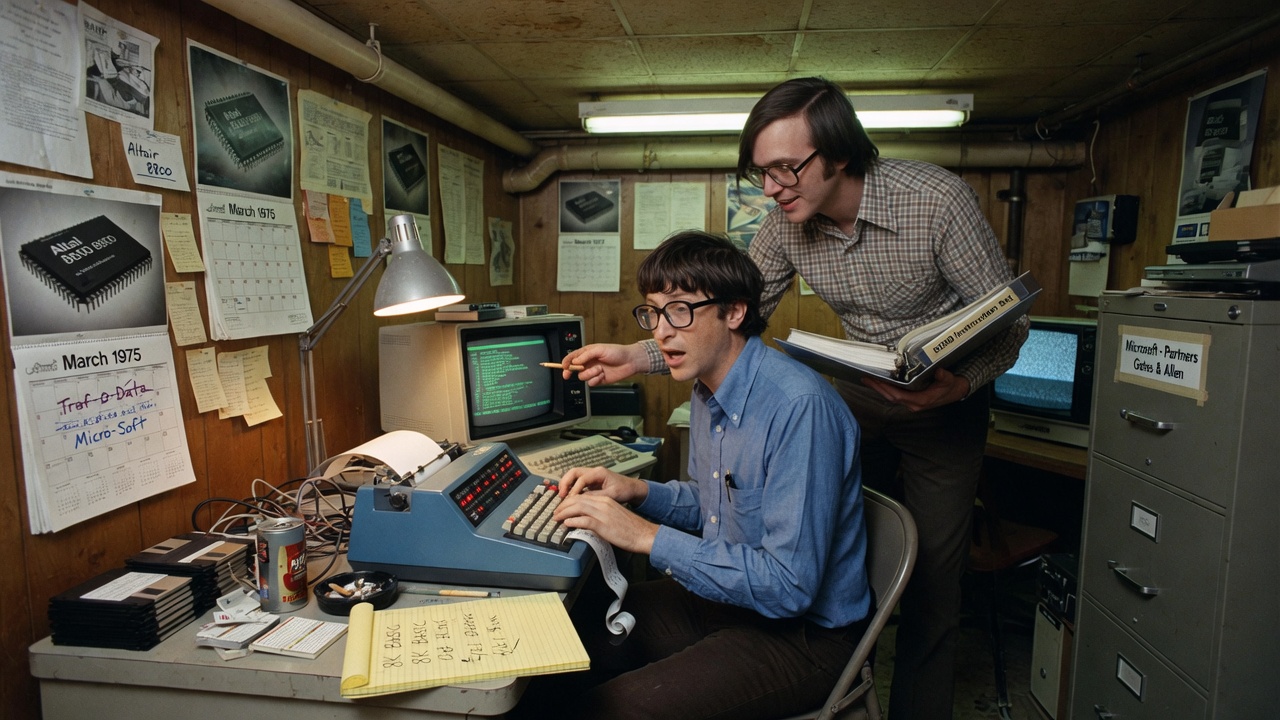
Microsoft is perhaps the cleanest example of a pair in the history of the technology business. Bill Gates and Paul Allen met at the Lakeside School in Seattle in 1968. Gates was 12, Allen was 14. Both were obsessed with the “computers” of the time — closet-sized machines for which the school rented remote access.
The decisive moment in Microsoft’s history came in the winter of 1974. Allen, by then a Washington State dropout working in Boston, saw the new Altair 8800 microcomputer on the cover of Popular Electronics. He grabbed the magazine, rushed to Gates — then a student at Harvard — and said: “Here’s the computer we’ve been waiting for.”
It was Allen who saw the future. Gates built that future. In June 1975, both dropped out and founded Microsoft.
In his memoir Idea Man, Allen describes their working dynamic with striking candor: he generated ideas; Gates picked them apart methodically — so often that working with Gates was sometimes “like hell.” But it was precisely that productive friction — the very thing Shenk in Powers of Two identifies as the foundation of great creative pairs — that gave the world MS-DOS, Windows, and the personal computer industry as we know it.
Allen stepped back from operations in 1983 after a diagnosis of Hodgkin’s lymphoma. By then, the foundation was already in place. And it had been laid by two friends from high school, not by one.
Two Graduate Students and a Mathematical Idea
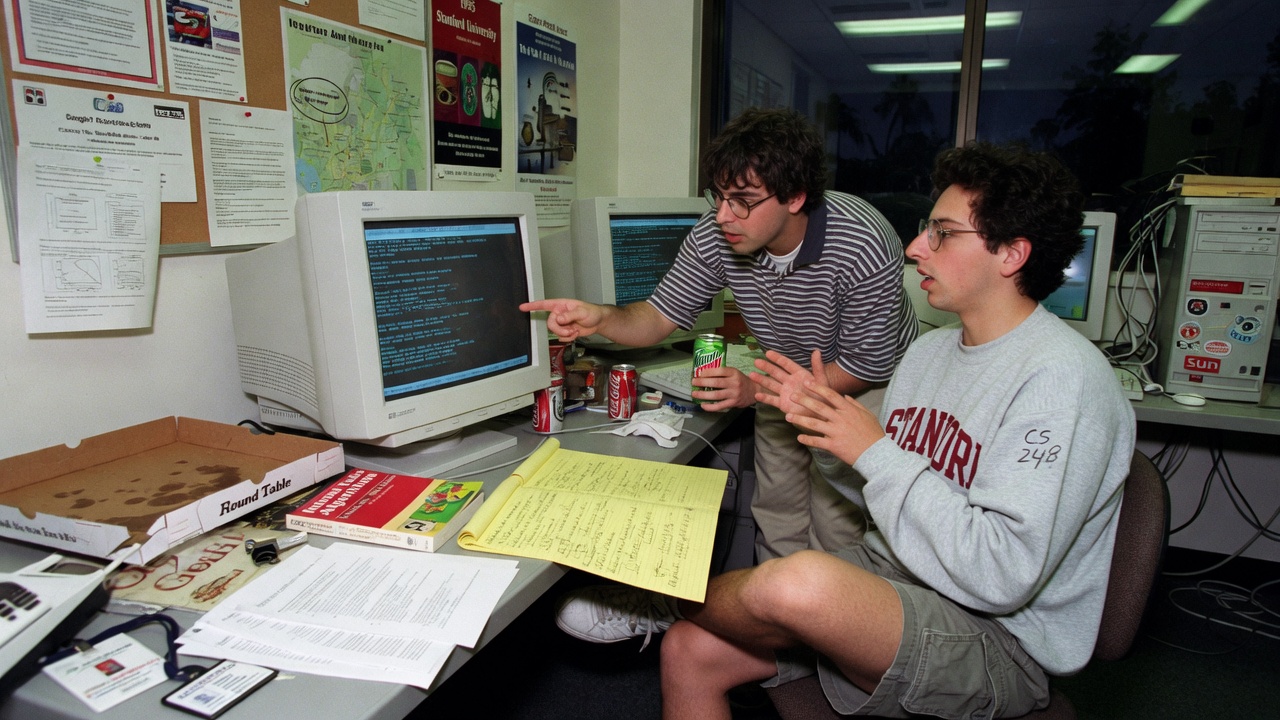
Google’s story begins not with a company but with a meeting. In 1995 at Stanford, a new computer-science graduate student, Larry Page, was looking for someone to give him a tour of campus. The tour was led by another graduate student, a year ahead of him — Sergey Brin. By both their accounts, they immediately disagreed about almost everything. And immediately understood that they had to work together.
A few months later they began a project under the working title BackRub — an attempt to build a new search algorithm that ranked web pages not by keyword match but by the number and quality of pages linking to them. They called this idea PageRank. It is a mathematical construct, and it required two kinds of thinking: deep algorithmic insight (Brin was stronger in mathematics) and systemic, product-oriented thinking (Page had a better feel for overall architecture).
PageRank was born precisely in the gap between those two minds. In September 1998, three years after they met, Google Inc. was officially incorporated. Page and Brin signed the founding documents as equal co-founders — fifty-fifty, no hierarchy.
That symmetry held for twenty years. When they restructured the company into the Alphabet holding in 2015, Page became CEO of Alphabet and Brin its president. When they both stepped down from operational roles in 2019, they did so together, on the same day, handing the wheel to Sundar Pichai. Google is a pair. Not a lone founder with a friend in the wings.
A Triangle of Equals
Pixar is the only company on our list founded not by a pair but by a triangle. And that is exactly what makes it interesting: it shows how a small collective of equals operates, not a dyad.
In 1986, Ed Catmull, a PhD in computer science from the University of Utah, was running the loss-making computer-graphics division at Lucasfilm. George Lucas was ready to sell it, and the buyer was Steve Jobs — recently fired from his own Apple and looking for a new project. Jobs paid $5 million and put another $5 million into development. Catmull and Jobs were soon joined by John Lasseter — a former Disney animator who had a rare combination of qualities: a deep understanding of classical animation and a genuine interest in computer graphics. A fourth crucial figure was Alvy Ray Smith, co-founder and the company’s first technical visionary.
In his book Creativity, Inc. (2014), Catmull describes in detail the working method he named the “Braintrust” — a system of collective editing in which Pixar directors show their films to their peers, who in turn provide brutally honest but constructive feedback. The Braintrust principle: no one, not even the most gifted director, can bring a film to perfection alone. Everyone needs the view of equally smart colleagues willing to say “this isn’t working.”
If Pixar had been run as the cult of a single genius, there would have been no Toy Story, no Monsters, Inc., no Up. There would have been one or two good films — and then failures. Pixar instead released fourteen films in a row that opened at number one at the box office. That record rests on a collective system of feedback, not on individual genius.
A Quiet Empire Built by Two Brothers
Most of the cases in this article are companies whose founders’ faces appear on the covers of Time and Forbes. But the most telling story may be one you have never heard.
In 1976, two brothers — J. Christopher Reyes (age 23) and Michael Jude Reyes (age 21) — with backing from their father Joseph, bought a small Schlitz beer distributorship in Spartanburg, South Carolina, for $740,000. They had five trucks, five routes, and fewer than fifteen employees.
By 2025, those two brothers had built Reyes Holdings into the sixth-largest privately held company in the United States. Annual revenue: $44 billion. More than 36,000 employees worldwide. Operations across 18 countries: North, Central, and South America, Europe, the Middle East, and the Asia-Pacific. The company consists of three major divisions: Reyes Beverage Group (the largest beer distributor in the U.S., shipping 320 million cases a year), The Martin-Brower Company (McDonald’s largest global distributor, serving 20,000 restaurants in 19 countries), and Reyes Coca-Cola Bottling. Among its operating units is Premium Distributors of Virginia, based in Chantilly, which joined the group in 1988.
Both brothers are billionaires. Both still serve as co-chairmen of the holding. Both are essentially unknown to the general public. No black turtlenecks, no TED talks, no tweets. Just fifty years of joint work, a clear division of responsibilities, and mutual trust.
The Reyes case is especially valuable because it answers the obvious objection: “All this works only in the tech sector, where you need different competencies.” Beverage distribution is a business of relatively low technological complexity. And yet: still a pair. Two brothers, not one.
And if anyone protests that brothers are a “family” phenomenon rather than a true team, recall another pair: Warren Buffett and Charlie Munger. Not relatives. Partners. Half a century of joint work. Berkshire Hathaway is the same story as Reyes Holdings — only in finance.
A Pair Wrapped in a Team
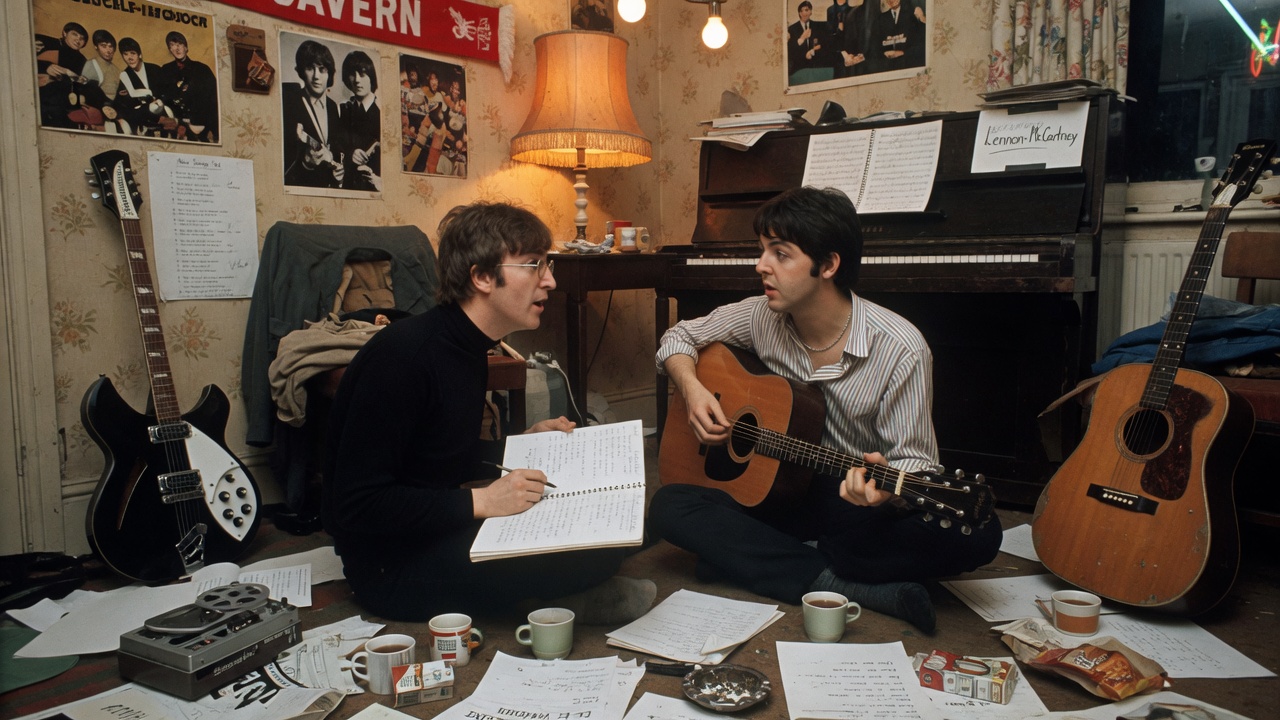
We return to where we began — the church courtyard in Liverpool on July 6, 1957. By the time The Beatles released their first single, “Love Me Do,” in 1962, there was no longer a pair behind them but a full team: four musicians, a producer, and a manager. And every one of those six people was essential.
The heart of the band was the pair John Lennon and Paul McCartney. By an agreement struck at the very beginning, all their songs — regardless of who actually did the writing — were credited “Lennon–McCartney.” This legal decision, as Shenk argues in Powers of Two, turned their work into a genuinely joint product — so much so that many songs still cannot be reliably attributed to one author.
But the pair, too, was not enough. George Martin — the EMI producer everyone called the “fifth Beatle” — defined the sonic identity of the band. It was Martin who suggested that their albums be built around Lennon–McCartney songs. It was Martin who brought a string quartet into the studio for “Eleanor Rigby.” It was Martin who pulled off the impossible — recording and splicing two different versions of “Strawberry Fields Forever” in different keys and tempos.
Brian Epstein — the manager who discovered The Beatles at the Cavern Club in Liverpool and shaped their career until his death in 1967 at the age of 32. Without Epstein, there would have been no contract with EMI. Without EMI, no Martin. Without Martin, no Sgt. Pepper’s.
The Beatles were not four lads from Liverpool. They were at least six people, every one of them indispensable. And when a researcher of popular music opens up any other great band — Queen, Pink Floyd, Led Zeppelin, ABBA — the same structure appears: a core of two to four musicians plus a producer, plus a manager, plus a recording engineer. No one, however gifted, records a great album alone.
WHAT WE HAVE JUST SEEN
Seven stories, seven industries, seven eras. And one common pattern.
In each case, the public narrative has, over time, compressed this structure into a single face. Jobs. Musk. Gates. Lennon. We simplify not because we are misinformed, but because a single face is easier to remember, easier to sell, easier to romanticize. The myth of the lone genius is not a description of reality but a way of packaging it.
The reality is different. The reality is pairs, trios, and tight collectives. The reality is the “productive friction” between different ways of thinking. The reality is years of joint work in which no individual participant could have reached the same outcome alone.
Find Your Second.
If you are building a business, find a second. If you are making art, find a partner for dialogue. If you are trying to explain someone’s success, look not for a single hero but for the pair or team behind their shoulder.
With a probability close to certainty, they are there.
Empire Architects
This two-part article is the manifesto of a new column on daysolis.com — a weekly series of in-depth journalistic investigations into how the greatest American companies were actually built. About the pairs, trios, and collectives hidden behind the faces on the covers.
In the coming weeks: detailed histories of Apple, SpaceX, Microsoft, Google, Pixar, Reyes Holdings, and The Beatles. Each in full, with archival material, participant quotes, and analysis of the key decisions.
The data behind these seven stories: Wasserman’s 10,000-founder Harvard study, First Round Capital’s 10-Year Project, Carta’s 2025 ownership data, and the academic case for why pairs win.
For readers who want to verify the seven case studies — or to track the figures behind them — these are the primary public sources. All free, all open.
Some links below are affiliate links: if you click through and make a purchase, we may earn a small commission at no extra cost to you — it helps keep Empire Architects coming.
-
📖 Joshua Wolf Shenk — Powers of TwoThe intellectual foundation of this entire two-part investigation. Shenk’s framework of the creative dyad is the lens through which all seven case studies were written.
-
📖 Walter Isaacson — Steve JobsThe authorized biography — essential for both the Apple and Pixar case studies. Isaacson is unusually clear-eyed about how much Jobs depended on Wozniak, Markkula, Catmull, and Lasseter.
-
📖 Steve Wozniak — iWoz: Computer Geek to Cult IconThe engineer’s own account of building the Apple I and II by hand. The single best corrective to the Jobs-as-sole-genius myth, told by the man who actually built the machine.
-
📖 Paul Allen — Idea Man: A Memoir by the Cofounder of MicrosoftThe “idea man” of the Gates–Allen pair tells his side. The candid passages on productive friction with Gates are exactly the dynamic Shenk’s research predicts.
-
📖 Ed Catmull — Creativity, Inc.The definitive text on Pixar’s “Braintrust” — the collective-feedback system that proves no director, however gifted, finishes a film alone. A management classic.
-
📖 Eric Berger — Liftoff: The Desperate Early Days That Launched SpaceXThe best-reported account of SpaceX’s founding team — Mueller, Thompson, Koenigsmann, Shotwell. Berger makes unmistakable that the “solo founder” was surrounded by indispensable people.
- Walter Isaacson · Steve Jobs · Simon & Schuster, 2011
- Steve Wozniak · iWoz: Computer Geek to Cult Icon · W. W. Norton, 2006
- Paul Allen · Idea Man: A Memoir by the Cofounder of Microsoft · Portfolio, 2011
- Ed Catmull · Creativity, Inc. · Random House, 2014
- Eric Berger · Liftoff: Elon Musk and the Desperate Early Days That Launched SpaceX · William Morrow, 2021
- Joshua Wolf Shenk · Powers of Two · HarperOne, 2014
- Reyes Holdings · Official corporate materials and Wikipedia
- The Beatles Bible · Rolling Stone · Fast Company
- Forbes Real-Time Billionaires · 2025 data on Reyes Holdings revenue
How America’s Greatest Fortunes Were Actually Built · © 2026 DAY · All rights reserved · daysolis.com
If this investigation was useful to you — support independent journalism
☕ Buy me a coffee