
McDONALD’S
The Real Estate Empire
The Two Brothers Who Invented Fast Food, the Salesman Who Took the Credit, and the Hidden Business That Was Never Really About Hamburgers
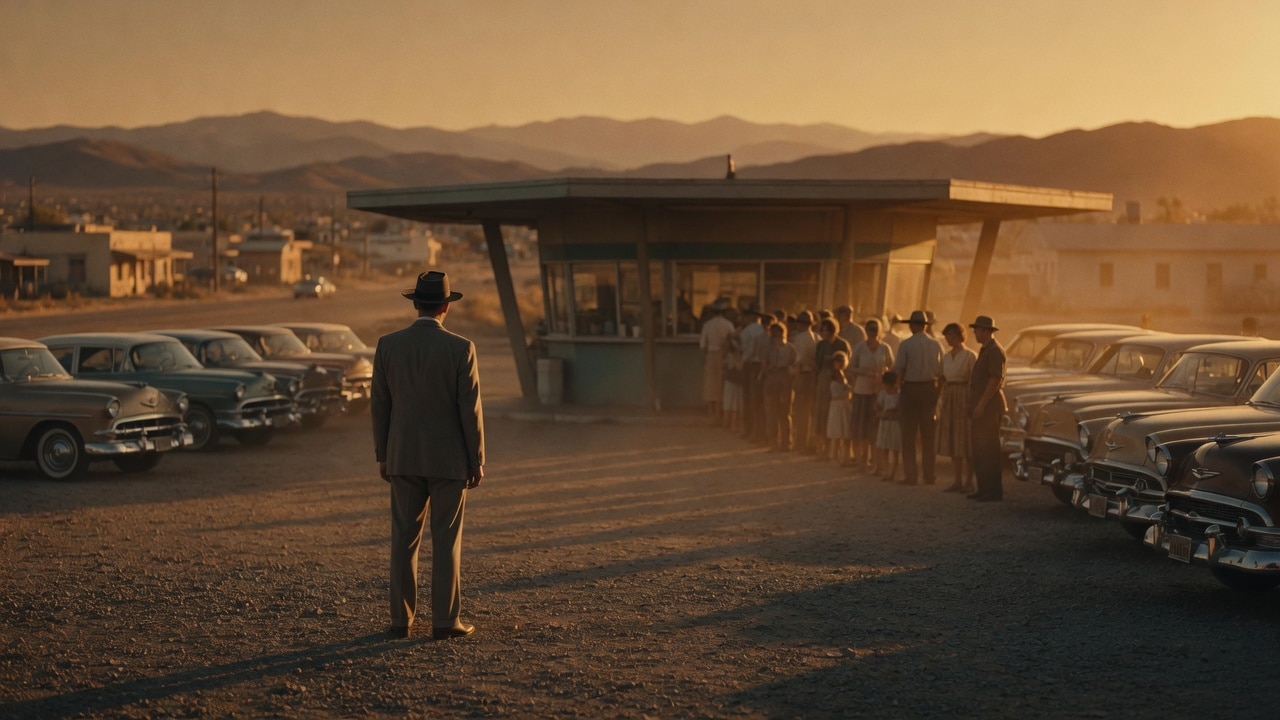
A summer afternoon in 1954. San Bernardino, California — a dusty working-class town an hour east of Los Angeles, on old Route 66. Eisenhower is in the White House, the Korean War is freshly over, America is moving to the suburbs and falling in love with the automobile, and rock ‘n’ roll is about to break. In the gravel lot of a strange, almost octagonal hamburger stand, a fifty-two-year-old traveling salesman from Chicago stands and does not believe his eyes: more than a hundred people are lined up at the window, and each one is served in thirty seconds.
The salesman’s name is Ray Kroc. He has not come for lunch. He sells milkshake mixers, and he wants to understand why one small roadside stand needs eight of his machines at once — devices that each blend forty milkshakes at a time.
What Kroc saw that day would reshape the global food industry. But he did not invent this business. Two brothers did — two men whose name the whole world now knows, though almost no one remembers the men themselves. This is the story of how.
Ask anyone who stands behind their fries, behind their child’s Happy Meal, behind the burger that became a unit of economic measurement, and you will get two names: the McDonald brothers. Ask who actually grew rich on it, and the answer is different. And ask what business McDonald’s is really in — and almost no one answers correctly.
The reader will notice that the illustrations accompanying this piece are not documentary photographs of McDonald’s restaurants, staff, or family members. This is an editorial decision rooted in legal caution.
Why we don’t use stock photography or brand imagery. McDonald’s is one of the most aggressively protected trademarks on earth. Photographs of branded restaurants, the golden arches, or named individuals carry documented risks for independent journalism — copyright assertions, license revocations, and right-of-publicity claims.
What we did instead. Every illustration here was generated using artificial intelligence specifically for Empire Architects, and deliberately contains no logos or brand marks. Each image is paired with a precise search query pointing to the real subject — the real town, the real restaurant, the real era — so readers who want documentary photographs can locate them through licensed sources such as AP Images, Getty, the Library of Congress, or company press kits.
Every factual claim in this piece is sourced and verified. The illustrations are atmospheric. The reporting is documentary.
THE TWO BROTHERS WHO BUILT A KITCHEN
To understand McDonald’s, you have to understand two men the corporation has all but erased from its own mythology.
Richard (“Dick”) and Maurice (“Mac”) McDonald were born in Manchester, New Hampshire, to Irish-Catholic immigrant parents. They grew up poor, moved to California during the Great Depression chasing a better life, tried the movie business — and failed. Then they stumbled into roadside food. In 1940 they opened a drive-in for motorists in San Bernardino.
At first it was an ordinary drive-in: a big menu, roller-skating carhops, china plates that were endlessly broken and stolen. But the brothers noticed a detail that would one day upend an entire industry: almost all the profit came from hamburgers. The expensive dishes sold rarely and demanded far more labor, and the place was turning into a teenage hangout — driving families away.

THE ASSEMBLY LINE THAT COST 15 CENTS
In 1948 the brothers took a gamble that would later be called a revolution. They closed a profitable restaurant for several months, gutted the kitchen, and launched what they named the Speedee Service System.
The idea was almost insolently simple. Inspired by Henry Ford’s assembly line, the brothers turned the kitchen into a production line. The menu was cut to nine of the most profitable items: a 15-cent hamburger, a cheeseburger, soft drinks, milk, coffee, chips, a slice of pie. No waiters — you ordered at the counter and collected it there. No customization: every hamburger came the same way — ketchup, mustard, onion, two pickles. Want it different? Wait separately. Each of a dozen workers handled exactly one operation.
The result: a customer served in thirty seconds. By the standards of 1948, that was unheard of.
This is the moment fast food, in the modern sense, was born. The brothers even began selling franchises — about ten were operating by the time Kroc arrived. But they had no desire to expand beyond their region: scale frightened them, and they feared losing control of quality. They were restaurateurs, not empire-builders. And it was precisely that caution that let a third man into the story.
THE SALESMAN WITH NOTHING TO LOSE
Ray Kroc was the brothers’ opposite. By his early fifties he had played piano in dance bands, sold paper cups and milkshake mixers — and gotten rich at none of it. But he could recognize someone else’s idea. As he later put it, he had enough experience to tell a real idea from a fake one.
Kroc persuaded the brothers to make him their franchising agent. In April 1955 he opened his own restaurant in Des Plaines, Illinois — the ninth McDonald’s overall. That is the date the corporation now treats as its founding, and Kroc as its founder.
It is a slippery framing. Kroc invented neither the system, nor the menu, nor even the golden arches — the brothers designed all of it. But there was a catch that nearly killed the whole enterprise: the contract was so favorable to the brothers that Kroc himself was left with a meager 1.4% of franchisee sales — while carrying the cost of training and quality control. He opened aggressively, took on debt, and barely scraped by. The business grew; the money did not.

THE REAL SECRET: “YOU’RE NOT IN THE HAMBURGER BUSINESS”
Rescue arrived in 1956 in the form of a financier named Harry Sonneborn, a former Tastee-Freez executive. He looked at Kroc’s model and instantly saw both the flaw and the solution that would change the company forever.
The logic was this. Instead of begging franchisees for a sliver of burger revenue, McDonald’s should itself buy or lease the land and buildings, then sublease them to the restaurant operators. That produces steady rent — regardless of how any single location performs. And it hands the company an immense lever of control: fail to meet standards, and you lose your lease.
In 1956 Sonneborn created a separate entity — Franchise Realty Corporation. It bought land across America, mortgaged it, and passed the cost to franchisees with a 20–40% markup. The cash-flow problem vanished. By 1960 some 200 restaurants were operating, and system-wide revenue reached $56 million.
The company historian John Love put it bluntly in McDonald’s: Behind the Arches: what turned McDonald’s into a money machine was not Kroc, not the brothers, and not the popularity of the burgers — it was Sonneborn’s little-known realty company. Sonneborn himself nearly admitted as much: the company sells 15-cent hamburgers, he said, only because they are the best source of the rent its tenants pay.

Tens of thousands of restaurants around the world are, in effect, a single vast rental portfolio — paid for in french fries.
THE HANDSHAKE WORTH BILLIONS
By 1961 Kroc’s relationship with the brothers had collapsed entirely. He resolved to buy the company outright — name and all. The brothers named their price: $2.7 million (around $27 million today). A million each after taxes — a fortune for the era.
When he heard the figure, Kroc later said, he nearly dropped the phone. He didn’t have the money; he had to borrow against that same real estate. But he believed he was buying the one thing that mattered: the name.
By the McDonald family’s account, on top of the $2.7 million the brothers negotiated a perpetual royalty — 0.5% of all future McDonald’s sales. But Kroc’s lawyers said a royalty clause would make the buyout loan impossible, so it was struck from the contract and left as a verbal “gentleman’s agreement.” Handshakes are not enforceable. By various estimates, that half-percent would today be worth hundreds of millions of dollars a year to the brothers’ heirs. Not one cent was ever paid.
The final humiliation was the fate of their original restaurant. Under the deal, the McDonald’s name went to Kroc — so the brothers renamed their San Bernardino location “The Big M.” Kroc responded by opening a brand-new McDonald’s a block away and, within a few years, drove the creators of the brand out of business.
The brothers insisted they had no regrets. “The taxes were killing us. We weren’t getting any younger,” Richard said years later. Three houses, a garage full of Cadillacs, not a cent of debt — and no yachts on the Riviera, which, he said, was never his style.
THE REPLICATION MACHINE
With full control, Kroc built the very thing the brothers had feared: a system that could open thousands of identical restaurants without losing quality. His philosophy fit into four letters — QSC&V: Quality, Service, Cleanliness, Value.
To drill those standards into franchisees and managers, Hamburger University opened in 1961 — a corporate training center awarding a “degree” in “hamburgerology.” It sounds like a joke, but it is a deadly serious instrument: it is this obsession with standardization that lets a Big Mac in Moscow taste the same as a Big Mac in Chicago. Its campuses today run in the U.S., Tokyo, London, Sydney, Munich, São Paulo, and Shanghai.
In parallel came the legendary supply chain that would make McDonald’s the world’s largest buyer of beef and one of the largest of potatoes. Supplier relationships were built to last decades — sometimes on a single handshake. The logistics backbone for McDonald’s in the United States runs through Martin Brower, the dedicated supply-chain company now owned by Reyes Holdings — the subject of Empire Architects No. 1. (As we will see in Part II, this web of trust has a darker side, too.)
THE CLOWN, THE BIG MAC, AND THE TOY IN A BOX
McDonald’s conquered the world not only through logistics but through marketing that largely wrote the rules for the entire industry.
1963 — a clown named Ronald McDonald appears on television (first played by future weatherman Willard Scott). For the first time, the brand systematically targets children.
1968 — the menu adds the Big Mac, invented by Pittsburgh franchisee Jim Delligatti. The two-story burger would become so universal a symbol that The Economist created the Big Mac Index — a tongue-in-cheek but genuinely useful way to compare the purchasing power of world currencies by the price of a single burger.
1975 — the first drive-thru window opens in Sierra Vista, Arizona, beside a military base where soldiers in uniform were barred from leaving their cars.
1979 — the Happy Meal launches: food plus a toy in a branded box. McDonald’s would become the largest distributor of toys on earth.

THE SHADOW SIDE: THE COST OF EMPIRE
When the system defeats its own creators
An honest portrait of McDonald’s cannot end at the golden arches. The machine has its costs — and the first is written into its own mythology.
A man who invented neither the product, nor the process, nor the logo entered history as the “founder.” The men who invented all of it were bought out for a sum that looks trivial today, pushed out of the business that bears their name, and very nearly erased from the corporate legend. The company dates its founding to 1955 — the year Kroc opened his restaurant — rather than 1940 or 1948, when the brothers created the thing Kroc would later merely scale.
How thoroughly the company is willing to forget its own beginning shows in a single detail. On the site of that very first restaurant in San Bernardino stands today an unofficial “Original McDonald’s Museum” — the largest collection of pre-Kroc brand history anywhere, assembled not by the corporation but by an outside enthusiast who bought the lot in 1998. McDonald’s Corporation never backed the museum — and, in fact, took legal action against it over trademark use. A corporation that does not honor its own past tried to forbid the museum of that past, too.
The same logic of control that built the empire has, for decades, generated friction on the other side of the counter as well. Sonneborn’s real estate model gave the corporation a lever over its franchisees: the operator owns the restaurant, but the company owns the ground beneath it. That guarantees standards — and simultaneously makes the franchisee structurally dependent. Disputes between franchisees and the corporation, and questions of worker pay and automation, have followed McDonald’s throughout its history and remain live today.
None of this was illegal. Kroc operated within a contract he himself signed; the brothers agreed to the sale freely and said publicly they had no regrets. McDonald’s was built strictly within the rules — the only question is that those rules let a man with ambition and a system beat the men with the idea. In business, as Kroc liked to say, the winner is not the one with the idea, but the one who sees it through.
A SCALE THAT IS HARD TO GRASP
Today’s numbers feel almost abstract. McDonald’s operates in more than 119 countries; its restaurant count passed 45,000 in 2025, and over 90% are franchisee-owned. Each day it serves roughly 69 million people — more than the population of most countries on earth. In the United States alone there are more McDonald’s restaurants than there are hospitals.
It is a public company (ticker MCD on the New York Stock Exchange), a member of the Dow Jones and S&P 500, with annual revenue around $27 billion and net profit above $8 billion. The brand bends nimbly to local taste: McSpicy across Asia, a vegetarian menu in India, different McFlurry flavors by country.

THREE IDEAS, ONE EMPIRE
The story of McDonald’s is a rare case in which success cannot be reduced to a single genius. There are at least three distinct ideas here, layered on top of one another.
The McDonald brothers invented the product and the process — the assembly-line kitchen, the narrow menu, the speed; fast food itself. Ray Kroc added the ambition and the replication system — franchising, the QSC&V standards, Hamburger University, marketing. And Harry Sonneborn devised the financial engine — the real estate model that let the company earn even when a single burger earned almost nothing.
Remove any one of the three and the empire never happens. The cautious brothers would have stayed a successful local stand. Kroc, without Sonneborn’s model, would have gone broke on his own ambition. And Sonneborn, without the brothers’ product and Kroc’s drive, would have had nothing to lease.
The flip side of the global success: what McDonald’s burgers and nuggets are actually made of, why the internet has believed “toxic food” hoaxes for decades, how the company fights back — and which quality scandals were entirely real.
Some links below are affiliate links: if you click through and make a purchase, we may earn a small commission at no extra cost to you — it helps keep Empire Architects coming.
-
🎬 The Founder (2016)Dir. John Lee Hancock, with Michael Keaton as Kroc — a dramatized but surprisingly faithful version of this article: the San Bernardino lot, the brothers, Sonneborn, and the real estate twist.
-
📖 Ray Kroc — Grinding It Out: The Making of McDonald’sKroc’s own autobiography — valuable precisely for how he chooses to tell the story of the brothers.
-
📖 John F. Love — McDonald’s: Behind the ArchesThe definitive business history — and the source of Sonneborn’s “real estate secret.”
-
📖 Lisa Napoli — Ray & JoanOn Kroc, the McDonald’s fortune, and where it all eventually went.
- PBS SoCal — “The Real McDonald’s: The San Bernardino Origins of a Fast Food Empire”
- CBS News — “The Real ‘Founder'”
- The Wall Street Journal (1991) — interview with Richard McDonald (source of the “taxes were killing us” and Riviera quotes; cited via secondary coverage)
- Marketplace — interview with Lisa Napoli on the McDonald’s fortune
- History.com — “How McDonald’s Became Fast Food’s Biggest Success Story”
- The Motley Fool — “The Clever Way McDonald’s Makes Money” (the real estate model)
- Encyclopædia Britannica — “Big Mac Index”
- Atlas Obscura — “Unofficial McDonald’s Museum,” San Bernardino
- John F. Love — McDonald’s: Behind the Arches (1986/1995)
- McDonald’s Corporation — official company history
- Wikipedia — McDonald’s; History of McDonald’s; Richard and Maurice McDonald; Harry Sonneborn
- Statista & company filings — McDonald’s restaurant, country, and revenue figures, 2024–2025
How America’s Greatest Fortunes Were Actually Built · © 2026 DAY · All rights reserved · daysolis.com
If this investigation was useful to you — support independent journalism
☕ Buy me a coffee