WHAT’S INSIDE
The McDonald’s Food Wars
Half a century of “toxic food” hoaxes, a famous lawsuit that never happened, and the very real scandals in between — and how to tell an invented horror from a genuine one.
January 2026. A familiar piece of text is making the rounds on X again — the kind that turns your stomach. The British chef Jamie Oliver, it says, won a lawsuit against McDonald’s and proved its food “unfit for human consumption, because it is highly toxic.” Fatty meat trimmings are “washed” in ammonia; the nuggets are made from eyes, bones, hooves and beaks; and governments around the world are covering it up. The post collects thousands of reposts. The problem: almost none of it is true. And yet there is a real story behind it.
To understand what we actually eat at McDonald’s, you have to learn to tell the two apart — because the company’s history contains both entirely invented horrors and entirely real failures, with expired meat, sick people, and one death.
There are invented horrors here. And there are real failures. This is the story of how to tell them apart.
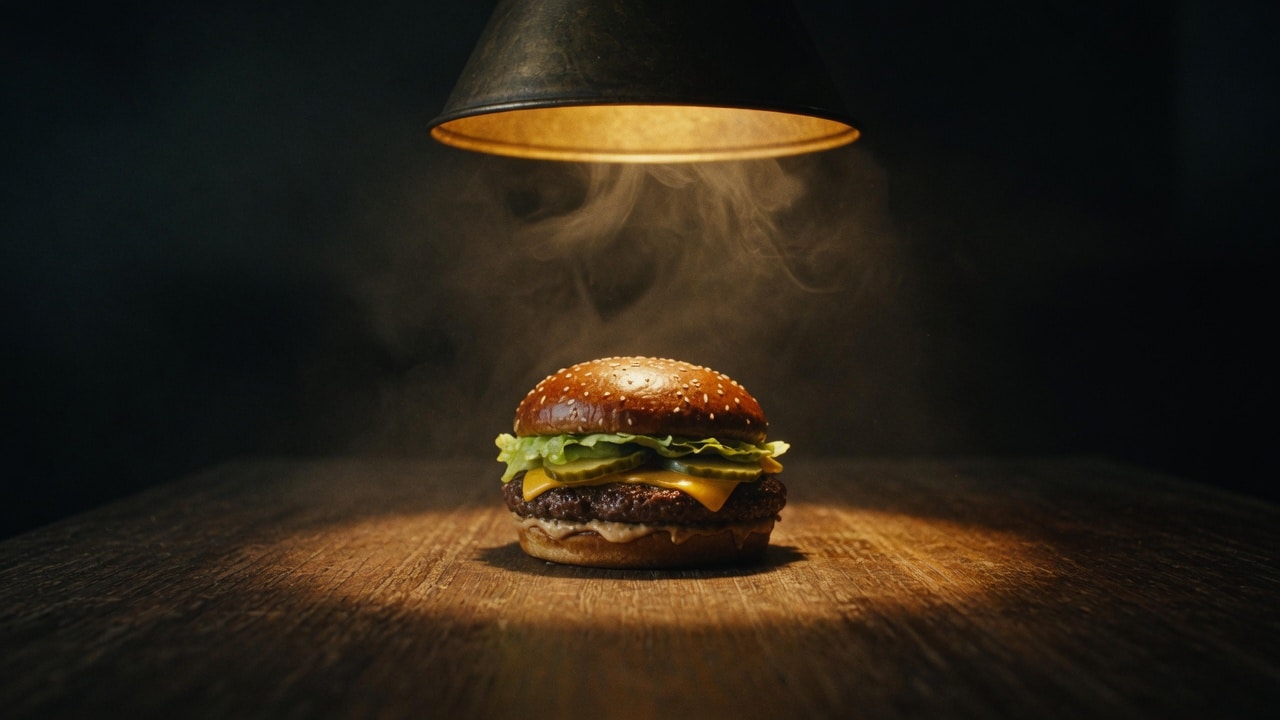
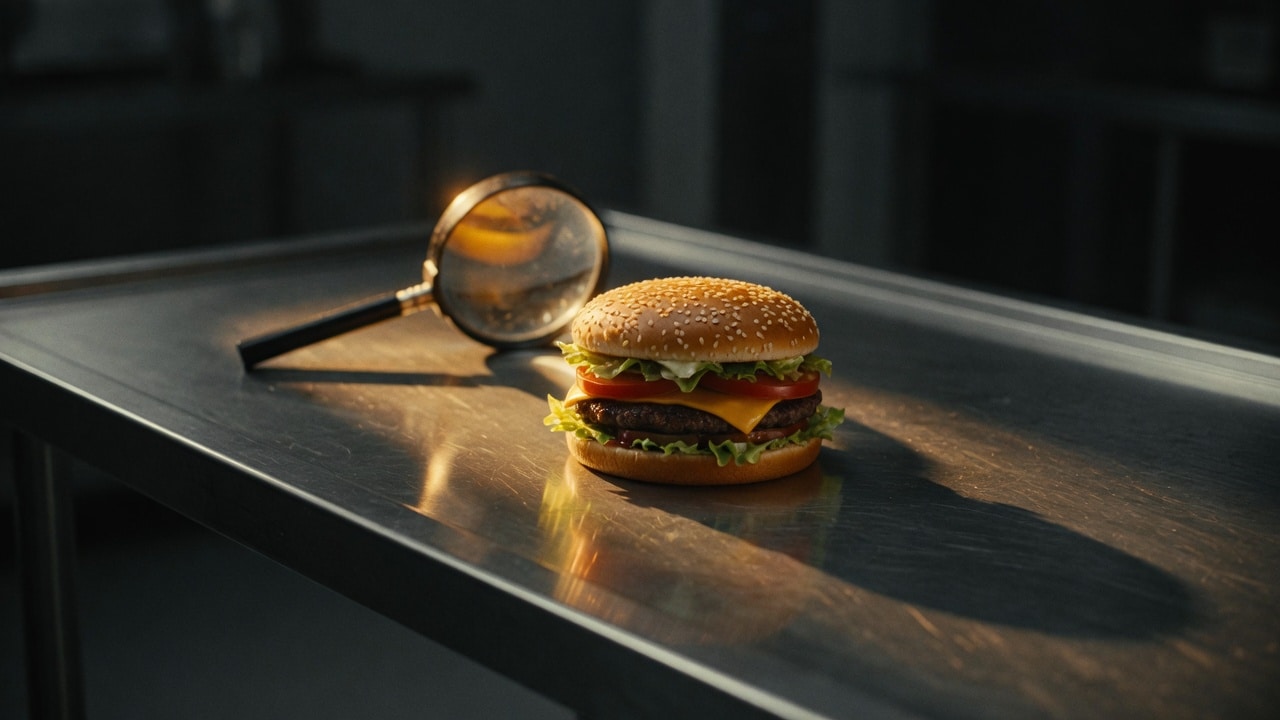
As in Part I, the illustrations here were generated with artificial intelligence specifically for Empire Architects and carry no logos or brand marks. Each is paired with a precise search query pointing to the real source material — FDA and CDC reports, court records, archival news coverage.
Every factual claim in this piece is sourced and verified. The illustrations are atmospheric. The reporting is documentary.
“PINK SLIME” AND THE LAWSUIT THAT NEVER HAPPENED
Start with the most durable myth of all. There was no lawsuit between Jamie Oliver and McDonald’s. Oliver never sued the company, never “won” anything, and no judge ever ruled its food “toxic.” Fact-checkers — Snopes, Africa Check, Ireland’s The Journal, the Gigafact project — have all looked: no court case exists in any database.
What actually happened? In 2011 (not “about eight years ago” — fifteen), Oliver used his TV show Food Revolution to campaign against so-called pink slime. Behind the nickname is a technical product — lean finely textured beef: trimmings sliced from the bone and treated with ammonium hydroxide gas to kill bacteria such as E. coli, then added to ground beef to cut cost.
Here is the central chemistry error in the viral post. The substance is ammonium hydroxide — ammonia dissolved in water — which is an alkali, a base, not the “ammonia acid” or “ammonia hydrogen” of the reposts. It has long been used, legally, across the food industry — in cheeses, baked goods, chocolate — and is classified by the U.S. FDA as “generally recognized as safe” (GRAS).
The same process permitted in the United States is banned in the EU and Canada. That is arguably the most interesting true story in the whole affair: one technology, legal on one side of the Atlantic and prohibited on the other. It’s what the viral post should have been about — but it isn’t as frightening as a “toxic burger.”
Oliver did hold the product up, did call it unfit, and did use the famous line about meat that “would be sold as dog food.” But that was a public television campaign — not a lawsuit, and not a scientific verdict.
And here is the turn the reposts leave out: the campaign worked. By 2011–2012 McDonald’s — and then Burger King and Taco Bell — stopped using pink slime. The company, though, insisted its decision was not linked to Oliver’s campaign or “any particular event.” So “McDonald’s lost a lawsuit and was forced to change the recipe” is wrong twice over: it didn’t lose (there was no case) and it wasn’t forced (it dropped the product on its own). And in the United Kingdom, where Oliver is from, McDonald’s never used the process at all.

THE BURGER THAT DOESN’T ROT
If pink slime is a real story distorted, the next myth is pure physics dressed up as conspiracy.
Every few years a video resurfaces: someone pulls a hamburger out of a cupboard — bought 10, 20, even 24 years ago — and it looks almost new. The sinister conclusion writes itself: it must be full of preservatives if even mold won’t touch it.
The real explanation is duller and more convincing. For food to rot, it needs moisture — without it, bacteria and mold can’t grow. A small, thin patty with a large surface area loses moisture fast: the burger simply dries out — mummifies — before it can mold.
This isn’t a company theory; it’s a reproducible experiment. When bloggers and journalists (Serious Eats and BuzzFeed among them) set a McDonald’s burger beside a homemade one of the same size, both behaved identically: kept dry, neither rotted; sealed in a bag with moisture, both grew mold within a week. It’s geometry and dryness, not chemistry.
The patties, the company adds, are made only from USDA-inspected beef, with no preservatives or fillers — just a little salt and pepper on the grill.

A CATALOGUE OF HORRORS: WORMS, EYES, AND “PINK GOO”
The everlasting burger is only one exhibit in a whole museum of horrors that has haunted McDonald’s for decades.
Worms in the patties. The rumor was born in the late summer of 1978 in the American South — and, tellingly, it was first told about Wendy’s. Then, as urban legends do, it migrated to the biggest player on the field. The myth is economically absurd: earthworms cost more than beef, so adding them would be madness. McDonald’s answered plainly in its campaigns: there are no worms in the beef.
Eyes, bones, and hooves in the nuggets. This is the very claim in the viral post we opened with. At its root is an anonymous photograph of a “pink goo” resembling strawberry ice cream, supposedly extruded into a box. The image has circulated since 2010; its source is unknown; it has nothing to do with McDonald’s nuggets.
So what is actually inside a McNugget? Until 2003, they did contain mechanically separated poultry — a paste made by forcing bone with residual meat through a sieve under pressure. It is a legal, USDA-approved, safe product (and contains no eyes or hooves — only meat a knife can’t reach), but it sounds unappetizing. Since 2003 McDonald’s has used white meat — breast, fillet, and rib meat — seasoned and breaded. There has never been any “pink slime” in the chicken; the myth grew largely out of a confusion between Oliver’s two different campaigns (ammonia beef and pulped chicken) and that anonymous photo.

THE COUNTER-ATTACK: “OUR FOOD. YOUR QUESTIONS.”
For a long time, big corporations preferred silence, on the theory that any answer only feeds the fire. McDonald’s chose the opposite — and it became one of the more interesting case studies in corporate communication.
In 2012 in Canada, then in Australia, and in 2014 in the United States, the chain launched a campaign called Our Food. Your Questions. The idea was radical for its time: the company invited people to ask anything — including the most squeamish, hostile questions — and answered publicly, with photos and video.
The boldest move was filming inside the plants. The former MythBusters host, the engineer Grant Imahara, went to a Cargill plant that makes the patties and asked the foreman, on camera, whether there were “lips and eyeballs” in there — and was told the patties contain only beef trimmings. Nicoletta Stefou, a McDonald’s Canada supply-chain manager, walked a camera through the entire nugget process, held up that very “pink goo” photo, and showed how little the real product resembles it.
Independent experts brought in by CNN confirmed that what the video showed was a genuine production process. The bet was that transparency is cheaper than silence: one factory clip lands harder than a hundred press releases. Launched during a stretch of falling U.S. sales and the rise of “healthier” rivals like Chipotle, the campaign was also a bid to win back millennials. It partly worked — though the survival of those same myths in 2026 shows that no corporation can fully kill a viral horror story.

THE SHADOW SIDE: WHAT WAS TRUE
Expired meat, an outbreak, and one death
It would be dishonest to turn this into a hymn to a slandered corporation. Because alongside the invented horrors, McDonald’s history contains entirely real quality failures — documented, with culprits and consequences. And it is precisely these that are worth setting against the hoaxes, to see the difference between panic and warranted alarm.
Shanghai, 2014. Expired meat. A local broadcaster secretly filmed what was happening at the Shanghai Husi Food plant — a subsidiary of the American giant OSI Group, a longtime supplier to McDonald’s and KFC. The footage showed workers handling meat with bare hands, picking up meat that had fallen on the floor and — worst of all — repackaging expired beef and chicken under new sell-by dates. One employee tossed off a line on camera to the effect that even expired, no one would die from it.
The scandal went global. Shanghai authorities seized more than a thousand tons of product, shut the plant, and detained staff; prison terms and fines followed (OSI’s China units were fined more than $3.6 million in total). McDonald’s and KFC pulled items in Shanghai, Beijing, Hong Kong, and even Japan, where a fifth of local nuggets came from the plant. OSI’s chairman apologized publicly, calling what happened “completely unacceptable.”
McDonald’s and Yum Brands had trusted a supplier with a near-century-old reputation, and inspected it with scheduled, pre-announced audits the plant simply prepared for. There were no permanent inspectors and no cameras on site.

The United States, 2024. An E. coli outbreak. This one isn’t about squeamishness — it’s about life and death. In the autumn of 2024 the FDA, the CDC, and the USDA investigated an outbreak of the dangerous strain E. coli O157:H7 linked to Quarter Pounder burgers. The toll: 104 people sick across 14 states, 34 hospitalized, one dead (an elderly man in Colorado), with several developing a severe complication that can shut down the kidneys.
McDonald’s moved fast: it temporarily pulled the Quarter Pounder from menus in roughly a fifth of U.S. restaurants. Lab tests of the beef patties came back negative — the meat was not the cause. The source turned out to be fresh slivered onions from a single supplier, Taylor Farms, which recalled a batch of yellow onions. By December 2024 the investigation was closed: the threat was over.

The case is telling twice over. On one hand, it is a reminder that the real risks in food service are pathogens and logistics, not mythical “toxins.” On the other, it shows that a modern control system — fast recall, batch traceability, public agency reports — can localize an outbreak in weeks and name the exact ingredient and supplier. Exactly what was missing in Shanghai a decade earlier.
McDonald’s real failures are, overwhelmingly, failures of suppliers and the chain of control — not “poisonous recipes.” In both cases above, the chain’s own food was safe by formulation; the problem was expired raw material and a contaminated third-party ingredient. That doesn’t absolve the corporation of responsibility for who it lets into its supply chain — but it is nothing like what the viral posts scream about.
HOW TO READ FOOD NEWS
Put the two halves of this story together and a simple rule emerges — useful far beyond hamburgers.
A hoax appeals to disgust and conspiracy, cites “a lawsuit that proved everything,” deals in pseudo-scientific terms (“ammonia acid”), and names no dates, no specific cases, no suppliers — and it is remarkably durable: the same text resurfaces every couple of years in a slightly new wrapper.
A real problem looks different: it has a date, a city, a named supplier, a government investigation, a count of victims, a product recall, fines or sentences. You can check it against primary sources — the FDA, the CDC, the USDA, court records.
McDonald’s is a convenient target precisely because of its scale: when 69 million people walk through your doors every day, any rumor instantly finds an audience, and any real mistake touches thousands. So the brand deserves neither naive trust nor blanket suspicion.
How two brothers invented fast food, a milkshake-mixer salesman turned it into a global empire, and the real engine of the business was never the food at all — it was the land beneath it.
Some links below are affiliate links: if you click through and make a purchase, we may earn a small commission at no extra cost to you — it helps keep Empire Architects coming.
-
🎬 Super Size Me (2004)Morgan Spurlock’s month-on-McDonald’s experiment. Methodologically contested, but it set the tone for the entire public debate about fast food and health.
-
📖 Eric Schlosser — Fast Food NationThe definitive investigation into the fast-food industry — the context behind everything in this article.
-
📖 J. Kenji López-Alt — The Food LabThe food scientist whose reproducible experiment explained why a burger “doesn’t rot.” Science instead of panic.
-
📖 Michael Moss — Salt Sugar FatHow food giants engineer flavor — useful for telling genuine questions about the industry from viral scare stories.
- Snopes — “non-decomposing” burger fact-check
- Snopes — worm-meat myth fact-check
- Snopes — mechanically separated meat / “pink slime” nuggets
- Africa Check, The Journal (Ireland), Gigafact — debunks of the Jamie Oliver “lawsuit” claim
- McDonald’s Corporation — “Burger Myths Busted” & “Our Food. Your Questions.”
- NBC News & CBS News — McDonald’s drops “pink slime” (2012); transparency campaign coverage
- FDA — E. coli O157:H7 / onions outbreak investigation (Oct 2024)
- CDC — 2024 E. coli outbreak update; USDA FSIS recall notices
- CNN — Shanghai Husi Food / OSI Group scandal explainer (2014); Reuters, AP, Fortune coverage
How America’s Greatest Fortunes Were Actually Built · © 2026 DAY · All rights reserved · daysolis.com
If this investigation was useful to you — support independent journalism
☕ Buy me a coffee