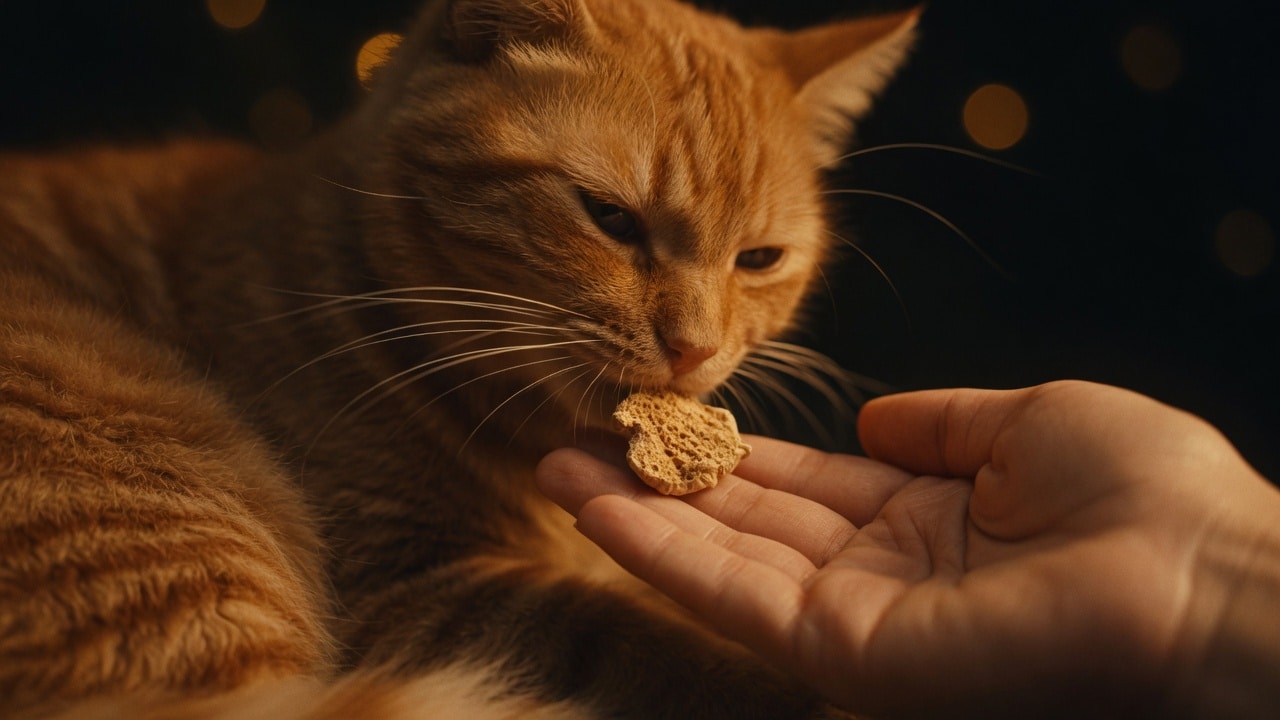

What Your Cat Would Choose
Claws and Peace
How I stopped losing to my cats — and realized they were never fighting me.
When my neighbor first saw the corner of my favorite armchair, she winced and said, “How do you put up with that? I’d have gotten rid of those cats ages ago.”
I said nothing at the time. But if I had answered the way I felt, here is what I would have told her.
Those scratches on my armchair are not damage. They are a signature. They are the mark of a creature that chose to stay. A cat — wild at her core, descended from a solitary hunter who trusted no one for thirty million years — comes to my armchair every single day and leaves her scent, her sign, her I live here. She isn’t marking the furniture. She is marking the home where she feels safe.
You say ruined furniture. I see a lived-in space. You see a cat that “doesn’t understand” something. I see a cat that understands far more: that this territory is hers, and that she is calm enough to say so out loud.
I didn’t say any of that then. But I thought about it through all the time I spent learning to live with my cats without losing either the chair or their trust. Today I want to tell you how it happened — through mistakes, through shredded corners, through weeks of doubt — and how it ended in a peace where everyone is happy.
What scratching is🐾 Do you know what they’re actually doing?
Most people, at this point, make one of three mistakes. Some start resenting the animal. Some turn to declawing — a surgery still legal, sadly, in most U.S. states. And some simply give up and say, “well, that’s just how cats are.”
All three lead to a dead end. Because they start from the wrong question. The question is not how do I make my cat stop scratching. You cannot make a cat stop scratching — it’s like forbidding a person to drink water. It is not a whim or a bad habit; it is a need woven into her very nature. The real question is different: what exactly is she doing when she scratches, and how do I give her a better place to do the same thing?
And she is doing four vital things at once.
She is shedding the old layer of the claw. A cat’s claw grows in layers, like an onion. The old outer sheath must flake away, or it ingrows, inflames, and causes pain. Those tiny translucent cone-shaped “husks” you sometimes find on the floor are not litter. They are shed armor. They are health, lying at your feet.
She is marking territory. A cat has scent glands between the pads of her paws. When she scratches, she leaves not only a visible mark but a scent signature — an invisible this is my place. For a cat, this is how she feels safe in her own home.
She is stretching. Scratching is a full-body stretch — spine, shoulders, toes. Feline yoga. Watch a cat reach to her full height against a vertical surface; that isn’t wallpaper destruction, it’s morning gymnastics.
And, finally, she is regulating her emotions. This is the most important part, and almost no one talks about it.

Emotion🐈 Why a cat is not a “dog in reverse”
I noticed this while watching my own two gingers. A dog, overcome with joy, expresses it loudly: it leaps, wags its whole body, barks, rushes to you. A dog has a loud external channel for emotion.
A cat has no such channel. A cat overflowing with feeling cannot jump and bark — it isn’t in her nature. So she does the only thing she knows how to do. She scratches.
For a cat, scratching is what tail-wagging is for a dog.
It’s a release. The way a small child, seeing their mother, jumps and claps their hands — not because anyone taught them to, but because the joy won’t fit inside. In a cat, that same overflow comes out through the claws. That is exactly why my cats always rushed to the furniture in two moments: when I came home from work, and when they wanted to play. Not out of spite. Not out of mischief. Out of an overflow of feeling for me.
Once I understood that, everything fell into place. To fight it is to punish a cat for loving you. The answer was not to forbid. The answer was to redirect.
What fails⚠️ Why everything I tried failed
Before I found the solution, I went through almost everything the market offers. I’ll be honest about it — because each of my failed attempts can save you money and frustration.
Deterrence. The first thing that occurs to almost everyone is to chase the cat away from the furniture. And it’s the worst thing you can do. Remember that scratching is often tied to stress and emotion? Yelling, water spray, sudden movements only raise anxiety. And anxiety increases scratching. With your own hands you wind up the very cycle you’re trying to break. The professional community of veterinary behaviorists warns plainly: punishment does not work in cat behavior and does harm.
Deterrent sprays. I bought them and sprayed them on the spots where the cats scratched. There was an effect — for a few days. By the end of the week it all came back, and the scratching zone even spread: the cats found new corners, the other end of the sofa, furniture in the next room. A spray masks the symptom but never answers the question of where the cat is supposed to put her need.

Most cheap anti-scratch sprays carry ingredients that are toxic to cats, who metabolize them differently than we do. If any of these are on the label, put it back — whatever the bottle promises:
- Isopropyl alcohol and synthetic fragrance — respiratory irritants.
- Tea tree oil — toxic to cats even in small amounts.
- Citrus oils (limonene, linalool), eucalyptus, pine — toxic and irritating.
A plant-based deterrent with no toxic essential oils — and only as a short-term support, while the post does the real work.
Clear shields and double-sided tape. I’d seen clear protective films for sofa corners online. They work — but I didn’t like them aesthetically, and more to the point, they’re a patch, not a solution. Here’s the key: these have their place, but only as a temporary bridge for two to four weeks, while the cat is being redirected to the right scratching post. Not instead of one.
Clear guards with no plastic smell, or non-toxic tape that’s safe for fabrics — a bridge for the two-to-four weeks of redirecting, nothing more.
Ordinary pet-store scratching posts. And here is the main trap almost everyone falls into. I tried several posts, and the cats ignored them. I had nearly decided my cats “didn’t need a scratching post.” It turned out they did. The posts were simply designed for the human, not the cat: compact, to tuck into a corner; short, so as not to spoil the décor; light, to move around easily. A cat needs exactly the opposite.
Pheromones. I tried pheromone diffusers too. I’ll say it honestly, without overselling: this is the one category with at least some evidence behind it, but the research is mixed. It helps some cats and not others. It is a supporting tool for difficult cases, not a cure-all, and certainly not a substitute for the right environment.
Try it, but don’t expect a miracle — environment and the right post do far more. The classic diffuser is the most studied; the multi-cat formula helps where cats share a home.
The standard🪵 What the right “object” has to be
When I finally read what ethology — the science of animal behavior — has to say, it all became clear. The “right” scratching post has specific, measurable properties.
- Height — at least 80 cm (about 32 in) of vertical surface, so the cat can rise on her hind legs and stretch fully. Most store posts fail right here.
- Stability — it must take the pull of her full weight without wobbling. One tippy scare and she’ll never return to it.
- Material — natural sisal rope, not sisal fabric (cats often reject fabric), and not carpet.
- Angle — about a third of cats prefer horizontal or angled surfaces. Ignored a vertical post? She may want a horizontal one.
- Placement — near where she sleeps, on her route, by a doorway — not hidden in a far corner.
- Number — one post, plus one more for each cat.
The fix✨ What finally worked for me
Once I understood all this, the search took about a week. With the help of artificial intelligence — going through specs and reviews — I looked for the right post: tall, heavy, wrapped in dense natural rope. And when it arrived in the house, the problem simply evaporated.
Not “decreased.” Evaporated. Now, every time my cats are overcome with emotion — when I come home, when they want to play — they run to that post. Not to the sofa. To the post. They don’t touch the furniture at all anymore.
This is the very one I bought for my two gingers — a gold standard among veterinary behaviorists: 81 cm tall, a heavy stable base, dense natural sisal rope. Add a lounge for cats who prefer horizontal, and a tall tree for multi-cat homes.
Also excellent
- Under 60 cm tall — she can’t fully stretch.
- Carpet or sisal fabric instead of rope.
- A light, wobbly base — the single fastest way to lose her trust in it.
And then something happened that I’ll remember forever. One day I noticed, at the base of that post, a few tiny translucent cones — as if someone had scattered amber grains. I didn’t understand at first what they were. And when I did, my chest tightened. They were shed claw sheaths. The old armor my cat had finally been able to cast off — because he now had the right place to do it. His own manicure, designed by nature. The thing he couldn’t do while scratching the sofa, because soft upholstery is no good for it.

Tiny claw husks on the floor. Proof that nature works the way it should when you don’t fight it, but help it.
Trust🤝 The initiative is always yours
Since we’re talking about trust, I have to say one thing I’ve drawn from years of watching — my own cats, and other people’s.
Cats divide the people in a home into those who invest daily and those who invest now and then. With the second kind, they are polite but not trusting. And this isn’t a whim — it’s arithmetic. A cat responds not to good intentions, not to a wish to play, but to initiative shown correctly and consistently.
I often see someone grab a cat once a week, the cat tenses, and the person takes offense: “he doesn’t love me.” Or a child wants the cat to be instantly relaxed and playful — while the cat remembers every past careless moment and keeps her distance. You cannot “make up” lost time with a cat. You cannot come to her demanding love. You can only begin — slowly, calmly, without expecting an immediate return — and keep going steadily.
I clean their litter box, change their water, wash their bowl and their fountain, play with them, talk to them. When I’m unpacking something, they come right over — and I deliberately let them sniff it, show them, share the moment. That’s why they come to me at any hour, like children, and ask for attention. Not because I’m special. Because I’m predictable. A cat’s trust is interest accrued on consistency.
Without fear✂️ Trimming claws without fear

Since we’ve come to claws, we can’t skip the subject that torments so many owners: trimming. “My cat won’t let me” is the most common complaint. And it’s almost never the cat’s fault.
Let me say the main thing first, which will lift the guilt off many: if a cat has the right scratching post and uses it actively, she largely keeps her own claws in shape. Those cones at the base of the post are her manicure. Many active cats need a trim only on the front paws, only every four to six weeks, and some don’t need one for years. A trim genuinely is needed for older cats (8+) who move less, cats with extra toes (polydactyly), cats with splitting or ingrowing claws, and homes with small children or thin-skinned elderly relatives.
Anatomy: what you must not hit. Inside the claw runs the living part — the quick — with a blood vessel and a nerve. In pale claws it shows as a pink stripe inside the clear horn. In dark claws it isn’t visible, and that’s the whole difficulty. You cut only the horny hook of the tip, about 1–2 mm from the point. If in doubt, cut less. A trick: look at the claw from the side, not from above — that often reveals the boundary even on dark claws.
The geometry of the cut. Cut along the claw’s natural curve, not across it. A crosswise cut splits the claw and makes it painful. And never use human or dog clippers — they crush the claw rather than cut it.
Japanese-quality steel, or the professional tool groomers use; for nervous hands, a model with a depth guard that helps you avoid the quick.
Psychology: why the cat struggles. The cat isn’t being difficult. She’s reading a chain of threat signals we give her ourselves: we pick her up when she didn’t choose it; we flip her over or pin her down — the posture of helplessness; we take her paw — one of the most sensitive parts of a cat’s body, her main instrument for sensing the world; we see resistance and tighten our grip, confirming to her that this is an attack. What we call “the cat won’t let me” is, in fact, a chain of our own mistakes read by the cat.
The method that works: desensitization. This isn’t a life hack — it’s a standard behavioral protocol. It takes from a few days to two or three weeks, but afterward the cat doesn’t resist at all. Week one: when she’s relaxed, take her paw for two or three seconds, release, and give a treat — building “paw means tasty.” Week two: add a light press on the pad so one claw extends; release; treat. Week three: let her sniff the clippers, bring them to a claw without clamping; release; treat. Then trim a single claw — not five, one, the longest — treat, and release her. After that, one or two claws per session, a day or two apart.
And here the right treats matter critically: desensitization doesn’t work without strong motivation, and cheap treats often fail to “hook” a cat. What actually hides in those cheap treats — and in the bowls, fountains, and food we offer with the best intentions — is a story in itself, and I told it in Killing With Kindness.
Single-ingredient freeze-dried treats — just chicken, just liver, just fish — with no glycerin, propylene glycol, or “natural flavors.” The strong, real smell is what motivates a cat.
The right holding position. Not on her back, not face-up, not wrapped in a towel — all of these reproduce the posture of prey and increase resistance. The right way: the cat sits with her back to your stomach, facing away from you, with open space in front of her. One hand gently embraces her across the chest, without squeezing; the other works with the paw. And never push it to a fight — if she gets upset, finish on one or two claws. Better to stretch it across three days and keep her trust than to “finish today” and undo months of progress.
First aid if you hit the quick. This happens even to experienced people. It is not a catastrophe. The blood may look like a lot, but the volume is small and there’s no threat to life. The main thing is to stay calm, because the cat reads your state. Stop the bleeding with styptic powder: dip the claw tip in it, light pressure for 5–10 seconds, and it stops almost instantly. No powder on hand? Cornstarch or flour (dust on, press); in a pinch, unscented soap or clean gauze with pressure for two or three minutes. Never use hydrogen peroxide (it interferes with clotting) or alcohol (it stings and frightens her).
Styptic powder stops the bleeding in seconds. It should sit in your kit before the first trim — it costs pennies and saves your nerves.
Then — first aid for the mind, the cat’s and your own. As soon as the bleeding stops, release her and give a treat; don’t try to finish the other claws. The session is over. Come back in a few days, starting again with a simple touch of the paw, to rewrite the fresh unpleasant association. And don’t blame yourself: it’s a technical accident, not a moral failing. The cat isn’t “offended” — she just remembers it was unpleasant, and trust fully recovers if you do things right from here. A vet is needed only if the bleeding won’t stop within 15 minutes even with powder, if the claw is broken off at the base, or if a day or two later there’s swelling and she’s favoring the paw.
For the hardest cases — small children, elderly relatives, a cat with stubborn behavior that can’t be fixed quickly — there are silicone nail caps. I’ll be honest: this is a compromise, not an ideal, and never a substitute for a scratching post. But sometimes they save the situation.
Soft silicone caps — the original brand and a well-made alternative. A compromise for hard situations, never a replacement for the post and a cat’s natural behavior.
The philosophy🌿 Not to train, but to live alongside
I look now at my two gingers as they tear into their post at a run, stretch to their full height, leave tiny amber claws on the floor — and never touch the chair or the sofa. And I understand that I didn’t “win” against them. We were never at war. I simply spent a long time not hearing what they were telling me, and then I heard it.
That, perhaps, is the difference between training an animal and living alongside one. Training begins with “how do I make him stop.” Shared life begins with “what is he trying to tell me.” A cat scratching the furniture isn’t throwing down a challenge. She is showing you her nature — and waiting for you to find a place for that nature.

This friendship between human and cat is far older than we think. It is thousands of years old — so old that there are whole museums devoted to it. I think about that, and the scratches on the old chair stop looking like damage and start looking like a small chapter in a very long story.
Two places that honor the oldest friendship on Earth — one founded by a man who gave his life to cats, one where people come as guests and the cat is the host.
And to my neighbor, I think I would finally answer now. Calmly. That those scratches are the signature of a creature that chose to stay. And that I wouldn’t trade them for any untouched chair in the world.
Science-based, deeply reported writing on the animals we share the planet with — from the toxins hiding in your home to what your cat would actually choose.
Read the Fellow Earthlings seriesDAY has a background in veterinary medicine and experience working in a private clinic, and writes the “Fellow Earthlings” series — science-based writing about the animals we share the planet with. These pieces use only documented facts and real cases — never invented stories.
Transparency: some links above are affiliate links (Amazon Associates). If you buy through them, DAY may earn a small commission at no extra cost to you. It does not influence the choices here — only safe, vetted products consistent with this article’s warnings are recommended. The two museum links are not affiliate links.
Sources
- Scratching behavior, claw anatomy, and feline emotional regulation — Cornell Feline Health Center; International Cat Care; the Merck Veterinary Manual.
- Punishment and reward-based behavior modification — American Veterinary Society of Animal Behavior (AVSAB) position statements.
- Declawing as amputation — positions of the American Association of Feline Practitioners (AAFP) and the AVMA.
- Nail-trim desensitization and low-stress handling — Fear Free; standard veterinary behavior protocols.
- First aid for a cut quick — general veterinary first-aid guidance (Veterinary Partner / VIN).
- Museums — American Museum of the House Cat (Sylva, NC); Cats Museum (EU).
If this investigation was useful to you — support independent journalism
☕ Buy me a coffee