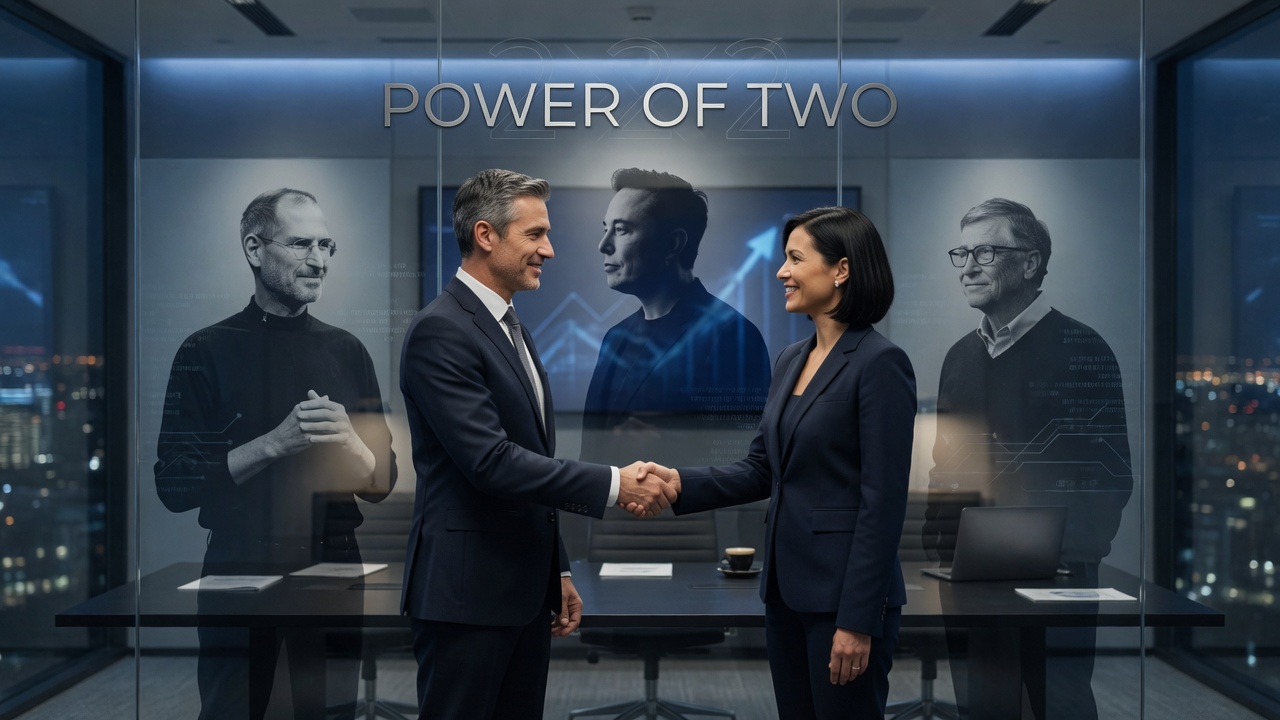

THE POWER
OF TWO
Part One — The Lone Genius Myth and What the Data Actually Show. A church courtyard in Liverpool, the Harvard Business School archives, and the cap table of SpaceX all point to the same conclusion.
July 6, 1957. A church courtyard in a Liverpool suburb. Fifteen-year-old Paul McCartney walks past a small stage where a skiffle group called The Quarrymen is performing. Seventeen-year-old John Lennon, who barely remembers the lyrics, improvises on the fly, twisting a Del-Vikings song into a bluesy variation of his own. McCartney — a boy with a near-photographic memory for lyrics — catches the bluff instantly. He does not laugh. He walks up to Lennon after the set, picks up a guitar, and plays Eddie Cochran, Little Richard, and Carl Perkins flawlessly.
This episode — documented and retold many times over by biographers — was, according to the American researcher Joshua Wolf Shenk, the moment in which all subsequent twentieth-century pop music was born. Not inside Lennon’s head. Not inside McCartney’s. But in the space between them.
The very idea that great art and great business are born precisely in this interpersonal space runs against one of the most stubborn myths of our civilization — the myth of the lone genius. The man who, through sheer will and intellect, creates alone something that changes the world. Edison in his lab. Jobs in his garage. Musk single-handedly storming space.
This piece is an attempt at journalistic investigation: what do the data say about the ratio of solo operators to teams in the great stories of success? And, more importantly, what do we actually mean when we call someone a “solo founder”?
The myth of the solitary creator is exactly that — a myth. The breakthrough is almost always born in the space between two minds.
WHERE THE MYTH COMES FROM
The cult of the lone genius is a relatively recent invention. Before the Romantic era of the early nineteenth century, European culture saw the creator more as a craftsman working inside a guild or a workshop. Leonardo was not a loner but the head of a studio with a dozen assistants. Michelangelo signed contracts with the Pope while drawing on a large team of stonecutters and helpers. The word genius in its modern sense — an individual gift bestowed from above — took hold only in the age of Goethe and Byron.
In twentieth-century American business culture, this mythology was perfected by Thomas Edison. His press operation — effectively the first corporate PR department in history — deliberately built the image of a lone inventor-wizard. In reality, Menlo Park employed dozens of engineers, and most of Edison’s patents were the product of collective laboratory effort. But what was sold to the public was an icon: a solitary man at a lamp.

Silicon Valley inherited this model. First came Bill Hewlett and Dave Packard (though that pairing is less remembered than the garage itself). Then the two Steves in Cupertino. Then Gates, Zuckerberg, Musk. Each new generation of tech companies brought along a new charismatic frontman whose face became synonymous with everything the company produced. “It is much easier to understand a company’s goals and absorb its mission,” writes a Drexel Triangle journalist, “when it is preached through a charismatic Wizard-of-Oz-style frontman.” We love this illusion. It is simpler than the truth.
WHAT THE RESEARCH SAYS
Wasserman, First Round, Carta, Wharton
The most authoritative academic work on this subject is Noam Wasserman’s The Founder’s Dilemmas (Princeton University Press, 2012). Wasserman, a professor at Harvard Business School, spent ten years studying more than 10,000 founders in the U.S. tech and biotech sectors. His central finding is paradoxical: the principal cause of startup failure is neither a bad product nor a wrong market.
This statistic contradicts most entrepreneurs’ intuition. It feels as though companies die because “things did not work out.” Wasserman’s data say something different: companies most often die because the relationships inside the founding team did not work out.
If people are the cause of failure, they are equally the cause of success. This is confirmed by First Round Capital’s “10-Year Project”, one of the most respected analyses in early-stage venture. The data found that companies with multiple co-founders generate revenue 163 percent higher than solo founders. Solo founders also receive seed valuations roughly 25 percent lower on average.
Fresh data from Carta for 2024–2025 add an important nuance. The share of single-founder startups has indeed risen — from 17 percent in 2017 to 35 percent in 2024. But according to the Founder Ownership Report 2025, solo founders accounted for only 14.7 percent of those who closed a venture round that same year. Investors continue to systematically prefer teams.
Carta’s analysts explain this preference as follows: venture capital looks for a “safety net” (in case the lead founder leaves) and “complementary skills” (the typical example being a technical co-founder paired with a commercial one) to lower the risk in early stages. It sounds cynical, but it is a robust empirical pattern across thousands of deals.
There are counter-data, too. The Wharton School, in the study Solo Survivors: Solo Ventures vs. Founding Teams (sample of 3,526 startups), found that solo founders on average survive longer and ultimately show higher revenue. Paul Graham, co-founder of Y Combinator, argues that solo founders are 2.3 times more likely to make it into the top 10 percent of most successful startups than teams of four or more. The data, in other words, do not deliver a clean verdict — and that is the first signal that we need to look more carefully at what exactly we are counting as “solitude.”
THE INVESTOR PARADOX
Why VC bets on pairs and revenue rewards solos
Venture funds show a strong, persistent preference for teams, and the optimum is the pair. According to Startup Valuation Delta for the first half of 2025, 37 percent of all VC investment goes to companies with exactly two founders. Trios receive 25 percent, solos 20 percent, foursomes 12 percent, and only 6 percent goes to teams of five or more.
And yet — here is the paradox — among companies that have reached meaningful revenue (over a million dollars a year), the most common configuration is the solo founder: 42 percent. Two-person teams come in at 33 percent, three-person teams at 15 percent. So the venture market bets on pairs, while revenue data point toward solos. How to reconcile this?
The answer, in all likelihood, lies in a confusion of terms. And this confusion is the central substantive problem in every public conversation about “solo founders.”
THE CENTRAL QUESTION — WHAT DOES “ALONE” MEAN?
When Carta or Startup Valuation Delta records that a startup has “one founder,” this is a legal fact. The incorporation documents list one name. The initial cap table has one row. That fact tells us exactly one thing: at the moment of incorporation, one person was registered as the sole equity holder.
It does not tell us that this person worked alone. It does not tell us that there were no co-creators of the idea, no early employees making decisive contributions, no investor-mentors, no industry advisors, and no co-founders who were formally hired as employees but functioned as partners. Legal solo founding is a bookkeeping construct. Genuine solitude is something else entirely.
This gap between paperwork and reality is best illustrated by SpaceX. In most sources — including Wikipedia, biographical references, and even the company’s own press materials — Elon Musk is listed as the “sole founder.” Legally, this is correct: in March 2002, he incorporated Space Exploration Technologies with $100 million of his own money from the sale of PayPal.
But what does “founded alone” actually mean? Already in 2002, Musk hired Tom Mueller — a former TRW engineer who led the development of the rocket engines. That same year saw the hiring of Chris Thompson from McDonnell Douglas, who handled airframe and docking systems, and Hans Koenigsmann from Microcosm, who took on avionics. And, most importantly, in the same 2002 the team gained Gwynne Shotwell, who became SpaceX’s president and chief operating officer in 2008. Without her, by the unanimous view of industry analysts, the NASA contracts simply would not have happened.
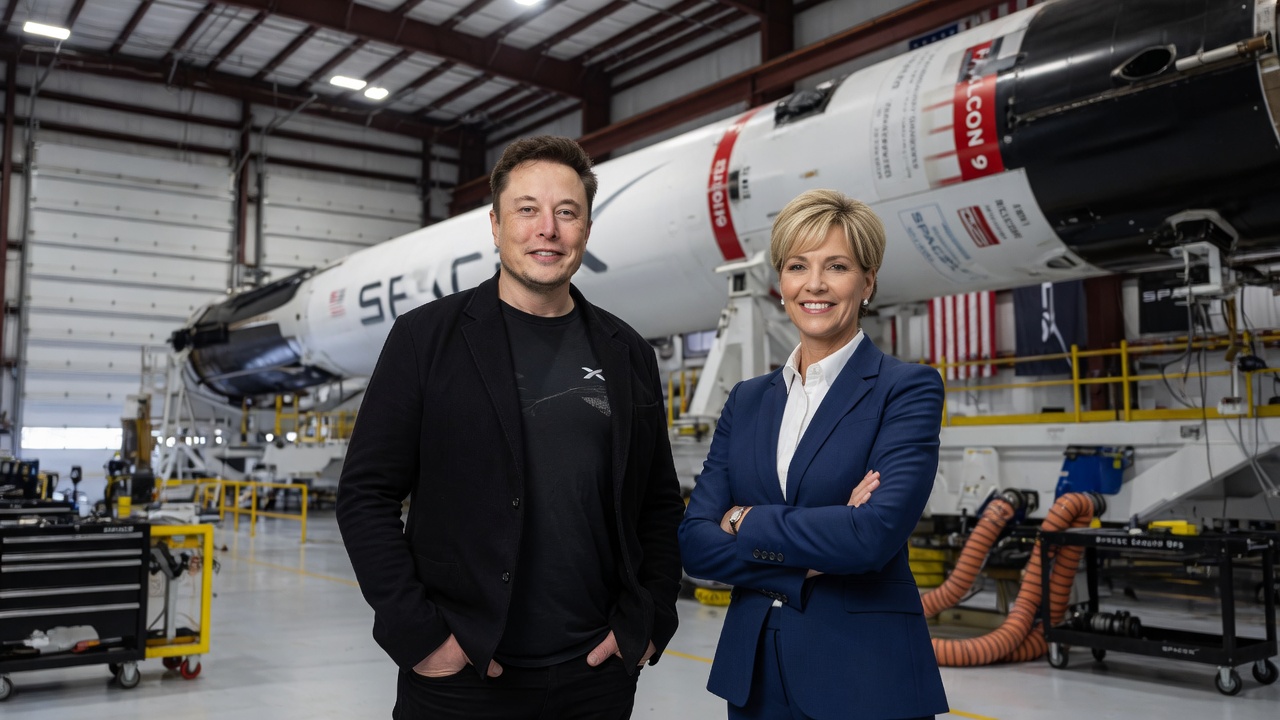
Inside the aerospace industry, Musk and Shotwell are referred to by first name, like rock stars: Elon and Gwynne. If SpaceX is a “solo-founded” company, then the word solo has lost its meaning. It describes the structure of the cap table, not the nature of the creative and entrepreneurial process.
The same logic applies to most companies on the list of “unicorns with a single founder.” According to Failory and other industry trackers, there are indeed roughly 350 unicorns legally founded by one person. Against the total unicorn count (more than 1,200 by mid-2025), that is fewer than 30 percent. In other words, even on the most generous counting method, 70 percent of unicorns are team stories. And this is before accounting for “hidden co-founders” who were legally classified as first employees.
The first full investigation in the Empire Architects column — Reyes Holdings: The $40 Billion Empire You’ve Never Heard Of — is a perfect contemporary illustration of this thesis. J. Christopher and Jude Reyes built America’s sixth-largest privately held company over fifty years as a strict two-mind business. There is no “solo founder” in the story. There is a bond between two brothers — and that bond is the operational engine of the empire.
SHENK AND THE SCIENCE OF PAIRS
Three archetypes of the creative dyad
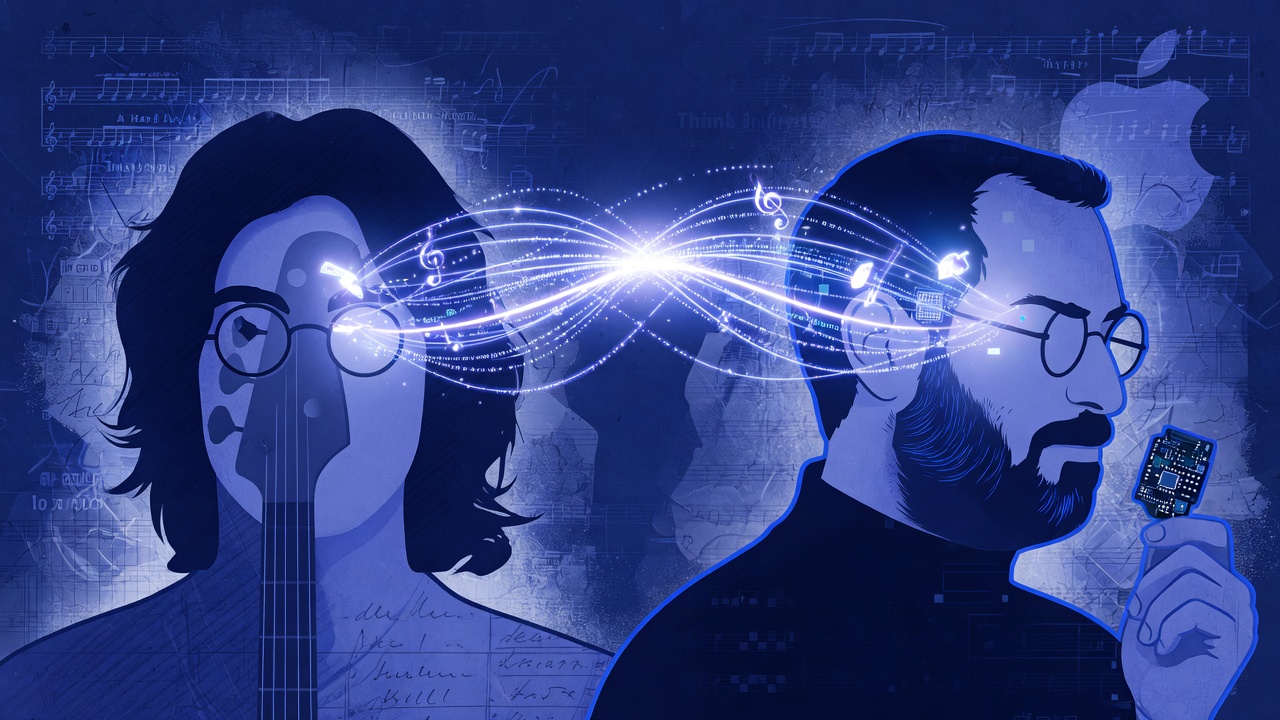
The deepest study of this phenomenon is Joshua Wolf Shenk’s Powers of Two: Finding the Essence of Innovation in Creative Pairs (HarperOne, 2014). Shenk, a writer and journalist, spent several years gathering stories of creative pairs: Lennon and McCartney, Marie and Pierre Curie, Steve Jobs and Steve Wozniak, Warren Buffett and Charlie Munger, James Watson and Francis Crick, Orville and Wilbur Wright, Martin Luther King Jr. and Ralph Abernathy, Sergey Brin and Larry Page, Bill Gates and Paul Allen.
Shenk’s central thesis: creativity is by nature not an individual but a dyadic phenomenon. The creative breakthrough is most often born in the space between two minds, not inside one. Shenk identifies several archetypes of creative pairs:
The sociologist Michael Farrell, in Collaborative Circles, develops this idea further: his research into the creative pairings of Monet and Bazille, Tolkien and Lewis, and dozens of others shows that it is precisely the collision of two unlike characters that creates a “safe space” for radical ideas. In solitude, an idea gets no feedback. In a large group, it is smoothed over by compromise. But in a pair — where trust is at a maximum and friction is productive — ideas reach their peak.
THE AI ERA — TESTING THE MYTH
One argument keeps surfacing in the debates of the past two years: the era of artificial intelligence, the claim goes, nullifies all of these statistics. A single person can now use neural networks to do what previously required a team. Carta records the trend: the share of solo startups is growing. Stories appear — Polymarket, Vercel, Wander — of companies started by a single founder that are already becoming serious players.
This is true — but it is not a refutation of the Power-of-Two thesis, only a delay in testing it. The startups of 2023–2025 have not yet produced a single company on the scale of Apple, Google, or SpaceX measured in terms of long-term influence. When the first such company emerges, journalists will get their chance to look inside and see whether there really is “one person” — or whether, again, there is a pair (or a trio), with part of the work simply delegated to a neural network.
Furthermore, AI is not a co-founder in the human sense. It has no independent vision, no disagreement, no will of its own. It does not generate that productive friction on which great ideas depend. In Shenk’s terms, AI is an excellent “doer” but not an equal “dreamer.” That may be exactly why solo founders with AI have not yet produced a world-changing breakthrough.
WHAT THE DATA ARE TELLING US
Let us draw an interim conclusion before moving on to the detailed case studies in Part Two.
First, the statistics on startups do not deliver an unambiguous victory to either solos or teams. Solo founders on average survive longer and reach stable revenue more often. Teams attract more capital from investors, demonstrate faster growth, and more often become unicorns.
Second, the most robust pattern is the advantage of the two-person team. Paradoxically, pairs turn out to be the sweet spot: they avoid solitude without suffering group chaos. This aligns with both venture practice and academic research on creative collaboration.
Third — and this is perhaps the most important point — the category of “solo founder” in investment analytics describes a legal form, not an actual way of working. Genuine solitude in major success is exceedingly rare. Even the most legendary “lone heroes” of our time turn out, on closer inspection, to be central figures in well-coordinated teams.
And it is to that closer inspection — to the detailed analysis of seven landmark success stories — that we turn in Part Two.

THE SPACE BETWEEN TWO MINDS
The myth of the lone genius is durable because it is simple. It is the founder myth that fits on a magazine cover, in a TED Talk title, on a movie poster. One person. One garage. One mind. The truth is messier and more interesting.
Every dataset we have examined — Wasserman’s 10,000 founders at Harvard Business School, First Round Capital’s 10-Year Project, Carta’s 2025 Ownership Report, Wharton’s 3,526-startup survey — converges on the same conclusion when read carefully: pairs win, and “solo founders” in the legal sense are almost never actually working alone.
Detailed case studies of Apple, SpaceX, Microsoft, Google, Pixar, Reyes Holdings, and The Beatles — what hides behind the facade of our era’s most famous “lone heroes.”
The academic and venture-capital sources behind this investigation — all publicly available for readers who want to verify the data themselves.
Some links below are affiliate links: if you click through and make a purchase, we may earn a small commission at no extra cost to you — it helps keep Empire Architects coming.
-
📖 Joshua Wolf Shenk — Powers of Two: Finding the Essence of Innovation in Creative PairsThe single most important book on this entire subject. Shenk’s case studies — Lennon and McCartney, the Curies, Watson and Crick, Jobs and Wozniak — are the intellectual foundation of this investigation.
-
📖 Noam Wasserman — The Founder’s DilemmasThe decade-long Harvard Business School study of 10,000 founders. The single most-cited academic work on the team dynamics behind startup success and failure.
-
📖 Michael Farrell — Collaborative Circles: Friendship Dynamics and Creative WorkThe sociology of creative pairs — Monet and Bazille, Tolkien and Lewis, dozens more. Farrell’s framework of “productive friction” explains why pairs outperform both solitude and committees.
-
📖 David McCullough — The Wright BrothersThe Pulitzer winner’s portrait of Orville and Wilbur — perhaps the purest example in American history of a Power-of-Two breakthrough. Every chapter is the thesis of this article in narrative form.
-
📖 Walter Isaacson — The InnovatorsIsaacson’s group biography of the computing revolution argues exactly what this article argues: every named “genius” of the digital age had a partner. A useful companion text to Shenk.
- Noam Wasserman · The Founder’s Dilemmas · Princeton University Press, 2012
- Joshua Wolf Shenk · Powers of Two: Finding the Essence of Innovation in Creative Pairs · HarperOne, 2014
- Michael Farrell · Collaborative Circles: Friendship Dynamics and Creative Work · University of Chicago Press, 2001
- Carta · Founder Ownership Report 2025 and Solo Founders Report 2025
- First Round Capital · 10 Year Project
- The Wharton School · Solo Survivors: Solo Ventures vs. Founding Teams
- Startup Valuation Delta · H1 2025
- Harvard Business Review · The Founder’s Dilemma · February 2008
How America’s Greatest Fortunes Were Actually Built · © 2026 DAY · All rights reserved · daysolis.com
If this investigation was useful to you — support independent journalism
☕ Buy me a coffee