

THE DAVOS
PARADOX
Whom to Trust About the Future of Work — the Reports or Your Own Eyes
January 2026. The same conference center. Two diametrically opposed messages about the fate of work. And a trillion dollars riding on which one you believe. First of six investigations in a series on the professions that will survive the transition into the singularity — and those that won’t.
This is the first article in a six-part investigation into which professions will survive civilization’s transition into the singularity — and which will not. The investigation is built on primary sources: reports from the World Economic Forum, PwC, McKinsey, Goldman Sachs, and the International Monetary Fund; data from the Bureau of Labor Statistics and the Stanford AI Index; independent analysis of 180 million job postings; and public statements by the chief executives of AI companies. Every figure is attributed. Where authorial interpretation appears, it is identified as such.
DAVOS, JANUARY 23
At about eleven-thirty on the morning of January 23, 2026, Kristalina Georgieva — managing director of the International Monetary Fund — stepped to a microphone in a conference room in Davos. She was wearing a navy blazer. In front of her sat roughly two hundred people: cabinet ministers, corporate chief executives, journalists from the world’s financial press. The session was titled “Dilemmas Around Growth.”
What Georgieva said over the next forty minutes was quoted by Bloomberg, Reuters, Fortune, Time, and dozens of other outlets.
She said that artificial intelligence is a tsunami hitting the labor market. That in advanced economies, sixty percent of jobs will be affected. That young workers — those just entering the workforce — will bear the brunt. That the middle class, which has always been the backbone of economies like America’s and Europe’s, will inevitably find itself squeezed: between those who reap an AI wage premium and those whose skills lose value altogether.
And to illustrate the point, she cited her own organization. The International Monetary Fund had cut its translator corps from roughly two hundred people down to fifty. That is not a forecast. That is what has already happened inside one of the most institutionally conservative bodies on earth.

“Wake up. AI is for real, and it is transforming our world faster than we are getting a handle on it.”
— Kristalina Georgieva, IMF, Davos, January 2026
On the same day, roughly three blocks from that room, PwC presented the annual edition of its “Global AI Jobs Barometer.” The headline of the presentation — on the slides, in the briefing packets, in the executive interviews with CNBC and the Financial Times — was this: artificial intelligence is making workers more valuable, not less. Productivity in the industries most exposed to AI has grown four times faster than in the rest of the economy. Workers with AI skills earn fifty-six percent more than peers without them. Job postings are growing even in occupations that conventional wisdom has written off as doomed.
Same town. Same days. Same subject. Diametrically opposed conclusions.
Not nuances of interpretation. Not differences in emphasis. Two opposed diagnoses of what is happening, right now, to the world of work.
If you are choosing a career in 2026 — your own, or your child’s — you need to know which of them to believe. Because the answer will determine, in significant part, what reality you will be living in for the next forty years.
IMF / WEF Annual Meeting, Davos, January 23, 2026 · Fortune, “IMF chief warns of AI ‘tsunami’ coming for jobs,” January 23, 2026 · BusinessToday, January 24, 2026 · PwC, “The Fearless Future: 2025 Global AI Jobs Barometer,” June 2025
WHAT “DIVERGE” MEANS — AND WHY IT MATTERS TO YOU
Before deciding who is right, it is worth pausing to see how far apart these forecasts are. Otherwise it is hard to understand why this deserves an entire investigation.
Here are the figures from the major reports published in 2025 and the first half of 2026, on the same single question — the future of work:
Read that list again.
These are not optimists arguing with pessimists. These are people with access to the same primary data, the same economic models, the same labor-market reports — arriving at mutually incompatible conclusions.
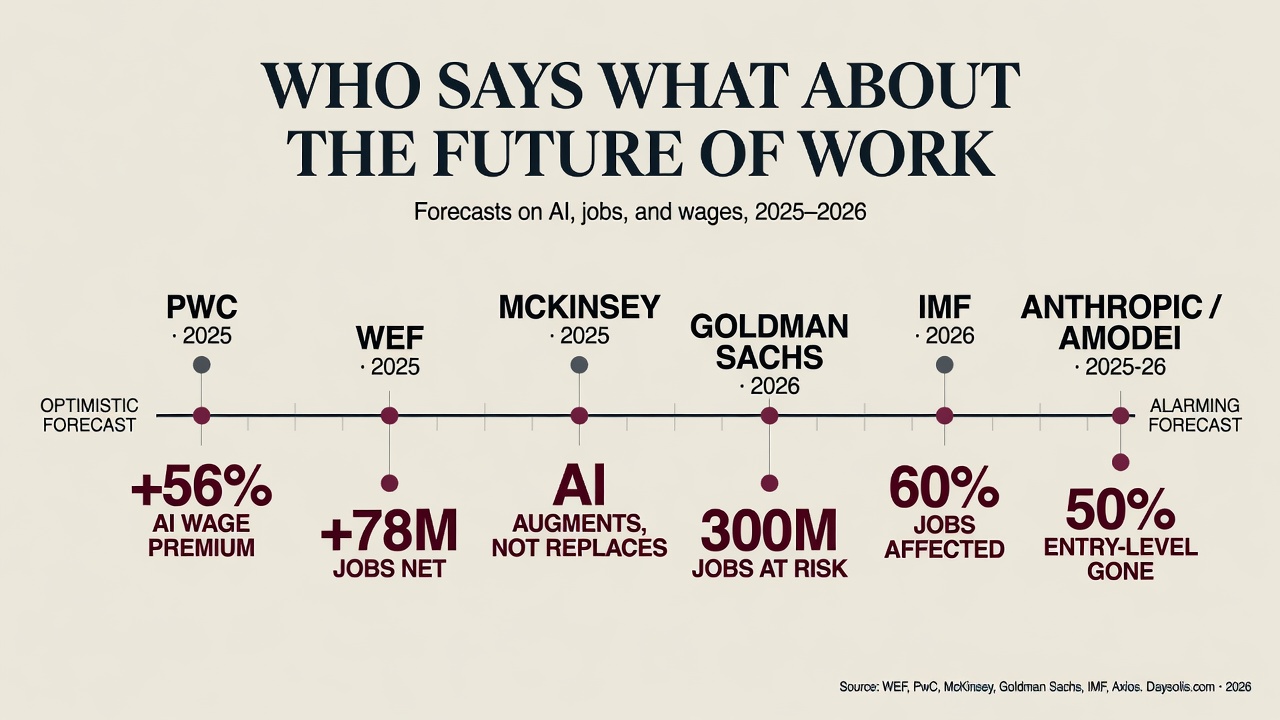
If the WEF is right, you can pick a major because you find it interesting. The market will rebalance itself, and 78 million net new positions will absorb you somewhere.
If Goldman Sachs is right, you need to choose very carefully which 75% of your future occupation’s hours will survive the transition.
If Georgieva is right, your first concern is whether you fall inside the 60% for whom “tsunami” is not a metaphor but a description of the next ten years.
If Amodei is right, half of what is currently considered the entry rung of a white-collar career will simply cease to exist by 2030.
You cannot average these forecasts. Averaging them would be like averaging “the bridge will hold” and “the bridge will collapse” and concluding that the bridge will half-hold.
So the first question for a prospective student in 2026 is not which profession to choose. It is which of these sources to trust, and why. Without that decision, every choice about a career is a lottery ticket.
THE SINGULARITY AS A BACKDROP THAT EXPLAINS THE NOISE
It is worth pausing here for half a minute, because there is something that explains why the fog around this question is so thick.
Civilization is moving into a phase for which we do not yet have a working vocabulary. Some people call it the singularity. Others call it the fourth industrial revolution. Still others call it the age of AI. The names differ; the substance is the same. For the first time in human history, a tool we have built is capable of performing a meaningful share of the work that previously required a human mind.
It is something like the invention of the wheel — but not for the legs. For thinking. And like any instrument of that scale, it does not simply “improve what exists.” It rearranges the underlying structure of how the economy, society, and work are organized.
When transitions of this magnitude occur, commentators have no calibration. There is no historical precedent to lean on. Everyone looks at the same data and sees something different — because no one yet knows which signals matter most. The WEF looks and sees the birth of new industries, as happened with electricity. Goldman Sachs looks and sees labor being replaced by capital, as happened with industrial automation. The IMF sees social risk, as happened with globalization.
Each of these frames is partly correct. None of them describes the whole.
That, incidentally, is good news. If anyone possessed a complete and accurate model of what is happening, they would not be publishing it — they would be using it to become the wealthiest person on the planet. The fact that all the commentators are still arguing tells us that no one has yet figured it out. Which means your own analysis — the analysis of an attentive person reading this investigation — is no worse than theirs. It may even be better, because you have no commercial stake in any particular conclusion.
That commercial stake is the subject of the next section. Because when people disagree about the same set of facts, the first question an investigator asks is the simplest one: who benefits from which answer?
WHO BENEFITS FROM WHICH ANSWER
Serious analysis of any source begins with one question: whose money is behind this publication?
Not in order to indict anyone. In order to calibrate expectations. A man who sells shovels is not your best advisor on whether to dig. That does not make him a liar. It makes him an interested observer — and the observations of an interested party are always worth double-checking against the observations of someone whose paycheck does not turn on the outcome.

PwC — One of the Big Four
PwC’s business model includes a substantial AI-transformation consulting practice. This is a service the firm sells to large corporations for billions of dollars a year. For a client to agree to pay, the client needs to believe one central message: AI is an opportunity to be deployed skillfully, not a threat to be defended against.
The headline thesis of the Global AI Jobs Barometer 2025 — that AI makes workers more valuable — fits that commercial interest perfectly. This does not mean the numbers are fabricated. The numbers are real. It means that, among the available interpretations of real numbers, PwC consistently selects the one that best fits its sales cycle.
Notice simply this: a firm that earns money convincing clients to deploy AI publishes an annual report concluding that AI is good for workers.
This is not an exposé. It is bookkeeping.
McKinsey — The Same, Plus an Irony
McKinsey is the world’s most powerful AI-transformation consultant. Its reports — particularly from the McKinsey Global Institute — are read by cabinet ministers and CEOs. The firm’s headline message over the last two years has been that AI does not replace workers; AI augments them.
Meanwhile, at the Consumer Electronics Show in Las Vegas in early January 2026, Bob Sternfels, McKinsey’s Global Managing Partner, sat down on the All-In podcast and described the firm’s own approach. He calls it the “25 squared” model: McKinsey is growing its client-facing workforce by twenty-five percent while shrinking its non-client-facing workforce by the same amount. Productivity on the non-client-facing side has grown ten percent. AI agents — “personalized digital employees,” in his phrase — now number twenty-five thousand inside the firm, working alongside roughly forty thousand human consultants. Sternfels expects the two figures to be equal by the end of 2026.
Last year, McKinsey saved an estimated 1.5 million hours of search-and-synthesis work — work that had historically been done by junior consultants — by handing it over to AI.
“Our model has always been synonymous that growth only occurs with total head count growth. Now it’s actually splitting. We can grow in this part, the client-facing side, and we can shrink in this part, and have aggregate growth in total. That’s a new paradigm and a new dynamic.”
— Bob Sternfels, McKinsey, All-In podcast at CES, January 2026
The high priest of AI transformation has been through it himself. Not in theory, not on a stage at a conference, but on his own payroll. Which is exactly why, when McKinsey says “AI augments,” it is worth reading the phrase not as a description of the world, but as a description of a strategy — one that McKinsey is applying to its own business while leaving 5,000 names out of the next version of the org chart.
McKinsey Global Institute, “Agents, Robots, and Us,” November 2025 · Business Insider / Yahoo Finance reporting on All-In podcast at CES, January 7, 2026 · Quartz and Bloomberg coverage of McKinsey layoffs, November 2025
The World Economic Forum — A Corporate Club
The World Economic Forum is not a neutral research organization. It is a club whose dues are paid, annually, by the world’s largest corporations. Among the WEF’s strategic partners are Microsoft, Google, Salesforce, Accenture, IBM, and NVIDIA — the same companies that produce and sell AI.
The Future of Jobs Report 2025 is a serious document. The methodology is transparent. The sample includes a thousand employers representing fourteen million workers. The figures are credible. And yet its central framing — that AI will create more jobs than it eliminates — is precisely the framing that suits the corporate members of the club. Not as conspiracy. As background pressure, which shapes which of the real findings end up on page one and which are buried on page two-seventy.
Compare the WEF to the IMF. The Fund has no corporate sponsors of that kind. Georgieva does not sell AI-implementation services to any government. Her career does not depend on whether ministers believe in “augmentation.” Which is exactly why she talks about the tsunami.
Dario Amodei — A Special Case
Amodei is the CEO of Anthropic, one of the companies that produces the very models replacing the work of junior programmers and copywriters. He has every commercial reason to say that AI is safe and that AI augments — the same line PwC and McKinsey use. It would lift his company’s valuation. It would soothe regulators. It would make his job easier.
Instead, in May 2025, Amodei sat with two journalists from Axios and said that AI could eliminate half of all entry-level white-collar jobs within five years. He warned that U.S. unemployment could spike to between 10 and 20 percent. In January 2026, he developed the argument in a twenty-thousand-word essay titled “The Adolescence of Technology.”
This is a public statement made directly against his own commercial interest. When the CEO of a leading AI company says something that hurts his own company, that statement is worth listening to. Not because he is a saint. Because he has no rational motive to lie in that direction.
In the language of an investigator, this is called a statement against interest. In court, such testimony carries unusual weight.
“We, as the producers of this technology, have a duty and an obligation to be honest about what is coming. I don’t think this is on people’s radar.”
— Dario Amodei, CEO of Anthropic, Axios, May 28, 2025
Axios, “Behind the Curtain: A White-Collar Bloodbath,” May 28, 2025 · Anthropic, “The Adolescence of Technology” essay, January 2026 · Fortune, TheStreet, CNN, May–June 2025
The Map of Interests, on One Page
Who Says What — and What Is at Stake
Whom to trust now looks somewhat clearer. But that is not the entire picture. Because there is another category of data — data that never passes through the consulting-firm PR filter at all. It comes from real wallets.
for DAY subscribers.
and the professions that win — are one step away.
If this investigation was useful to you — support independent journalism
☕ Buy me a coffee