The Scent of Death
in Beautiful Packaging
Aroma lamps, air fresheners, scented candles — marketing has turned them into symbols of home comfort. But for the cats living beside us, that “comfort” smells like poison. Literally. And there is an exact biochemical explanation for why.
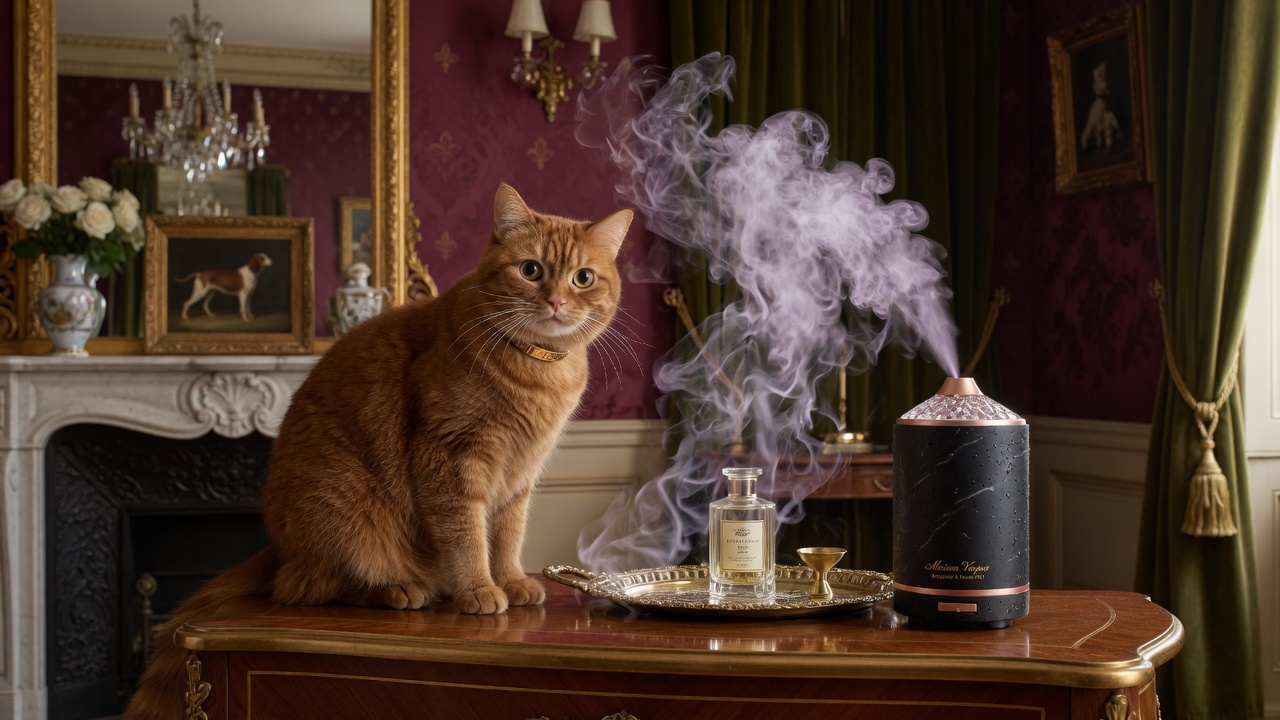
Imagine walking into a room where someone has poured several litres of perfume on the floor. Eyes burning, throat tightening, the room spinning — and you run for fresh air within seconds. Now imagine you cannot leave. The door is locked. This is what your home smells like — always. Day after day, month after month.
This is roughly what your cat experiences every time you switch on an aroma diffuser.
The home fragrance industry has grown into a multi-billion-dollar market over the past two decades. Electric diffusers, scented candles, toilet and car air fresheners, fabric sprays — all of it has become a fixture of modern life. Advertising promises “atmosphere,” “cosiness,” “a spa experience right at home.” What happens to the animals living inside that atmosphere is something the commercials never mention.
Alexander lives with two ginger cats — Persik and Tykva. One morning he sent his sister a message: “I moved the cats’ water fountain because someone placed an aroma lamp right next to it. Any fragrance in the house can kill cats. They have no protective mechanisms — their bodies treat every air freshener as a poison. That’s why I’ve removed all fragrances from my room. The humidifier now runs on plain water only.” This investigation began with that message.
A Nose That Knows Too Much
Before we get into chemistry and biology, one simple fact must land first: a cat’s world is, above all, a world of smell. Not sight, not sound — smell. For a cat, the nose is what eyes are for us: the primary channel through which it reads the world.
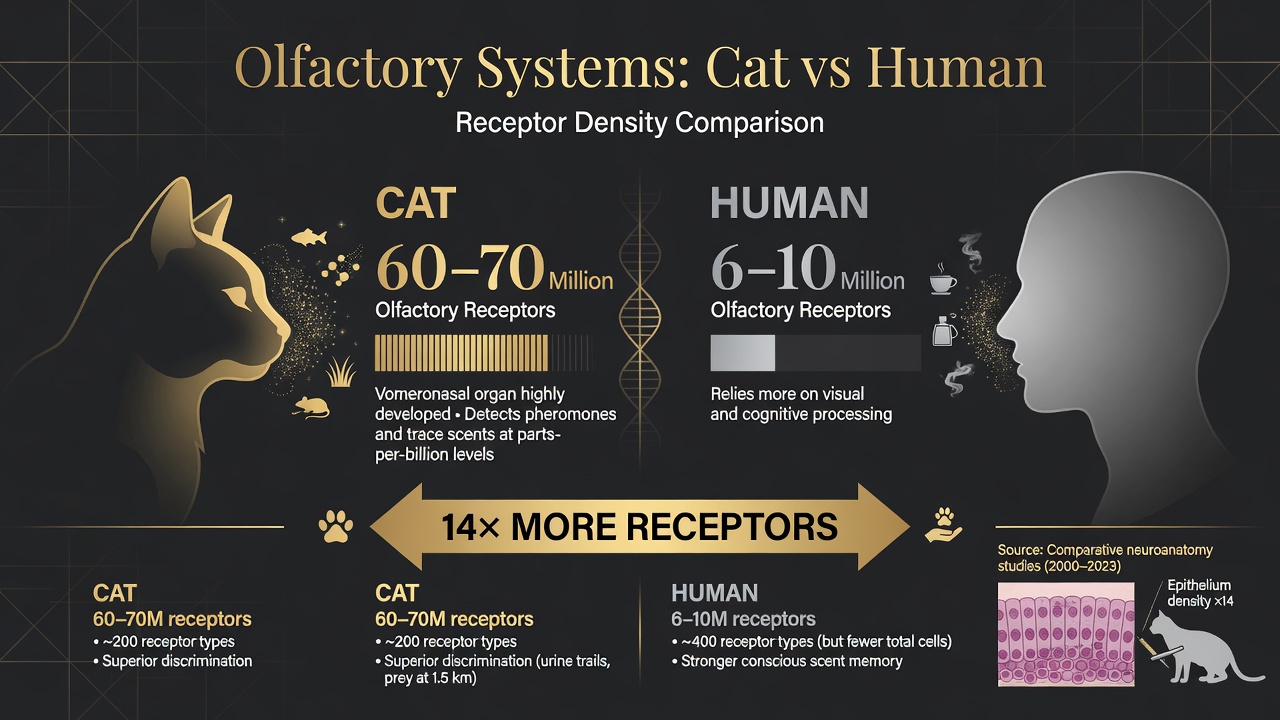
different sensory experience of the world
versus 6–10 million in a human
primary system + the Jacobson’s vomeronasal organ
A cat has between 60 and 70 million olfactory receptor cells, against 6–10 million in a human. Its sense of smell is roughly 14 times keener than ours. This is not simply “smells things better” — it is a fundamentally different perception of reality. A cat “sees” scents the way we see colours: with nuance, layering, and detail.
Beyond the primary olfactory system, cats possess the Jacobson’s organ — a vomeronasal organ in the roof of the mouth. It is responsible for the “flehmen response”: a cat opens its mouth slightly with a peculiar expression, as though tasting the air. It is, in fact, reading scent molecules directly. Two olfactory systems, running in parallel, all the time.
If an aroma diffuser is quiet background music to us, for a cat it is a heavy metal concert blasting directly into its ear. At full volume. That never stops.
And that is precisely why what seems to us like a pleasant, faint lavender scent is, for a cat, an overwhelming, inescapable, physically oppressive smell with nowhere to hide. Every lavender molecule you can barely detect is, for a cat, a loud and alarming signal — multiplied fourteen times over.
“Smell guides a cat from its very first days of life. Blind and deaf newborn kittens identify their mother exclusively by scent. Even a single molecule can trigger receptor stimulation.”Veterinary Reference Manual
A Liver Missing One Enzyme
But sensory discomfort is only half the problem. The real threat lies deeper — in the biochemistry of the feline body. And this is where the investigation truly begins.
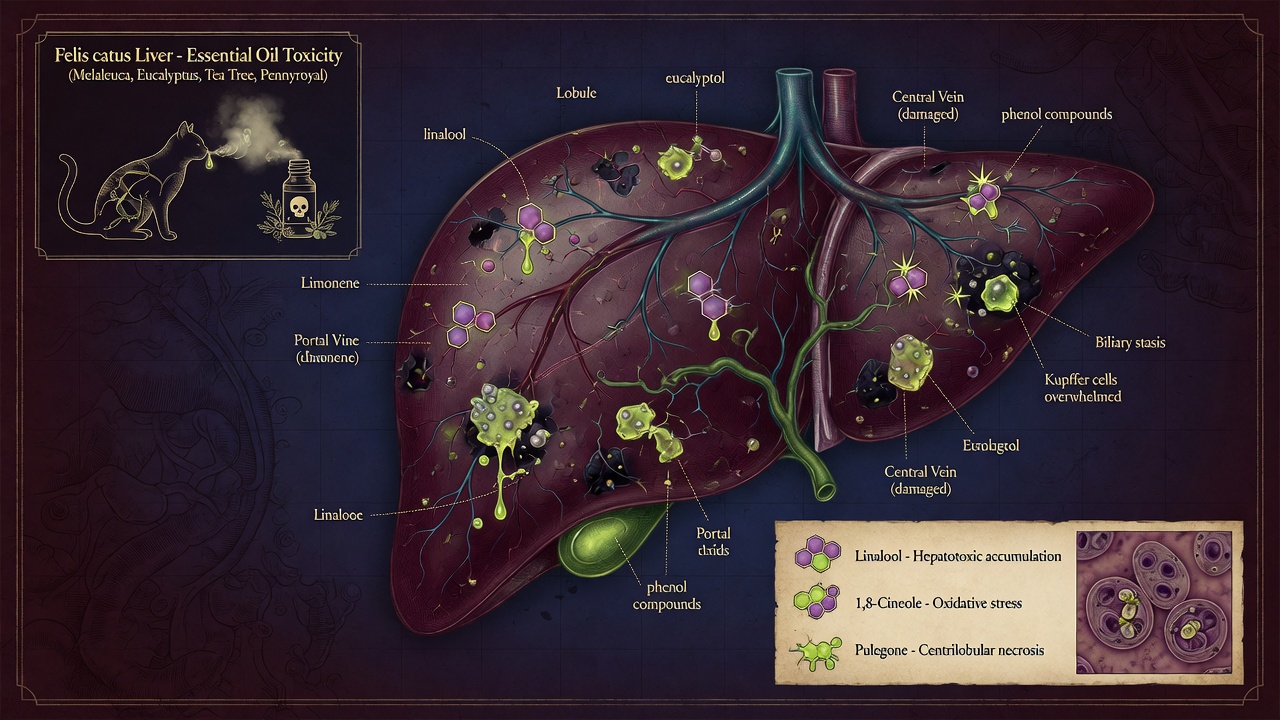
Imagine your body has no waste disposal system. Everything you breathe or eat accumulates inside because there is nowhere for it to go. That is exactly how a cat’s liver handles aromatic compounds.
Most mammals — dogs, humans, mice — have a specific detox enzyme in their liver: UDP-glucuronosyltransferase. Its job is to “package” toxic foreign molecules, making them water-soluble so the body can flush them out through urine. This process is called glucuronidation, and it is the liver’s primary detoxification system.
Cats essentially lack this enzyme. More precisely — it exists, but in negligibly small quantities, and it functions with extreme inefficiency when confronted with phenols, terpenes, and other aromatic compounds. This is not a disease or a defect. It is the result of evolution. Cats are obligate carnivores, and in the wild they never needed to neutralise plant compounds in any significant quantity.
“This is precisely why paracetamol and aspirin can kill a cat. Their livers cannot safely process these substances, even though most other mammals handle them with ease.”Merck Veterinary Manual
What happens when the enzyme is absent? Phenols and terpenes — the primary components of most essential oils — enter the cat’s bloodstream and cannot be neutralised. They accumulate. Slowly, invisibly to the owner — but relentlessly. Simultaneously, glutathione — the key antioxidant protecting liver cells — becomes depleted. In severe cases, the outcome is necrosis.
The conclusion is simple and brutal: what is to us a “light lavender fragrance” is, for a cat, an unceasing accumulation of poison. Slow. Silent. Imperceptible — until it is too late.
The Triple Strike: How the Poison Gets In
A cat does not have one route of absorption for toxins from air fresheners — it has three. And all three operate simultaneously, every single day.
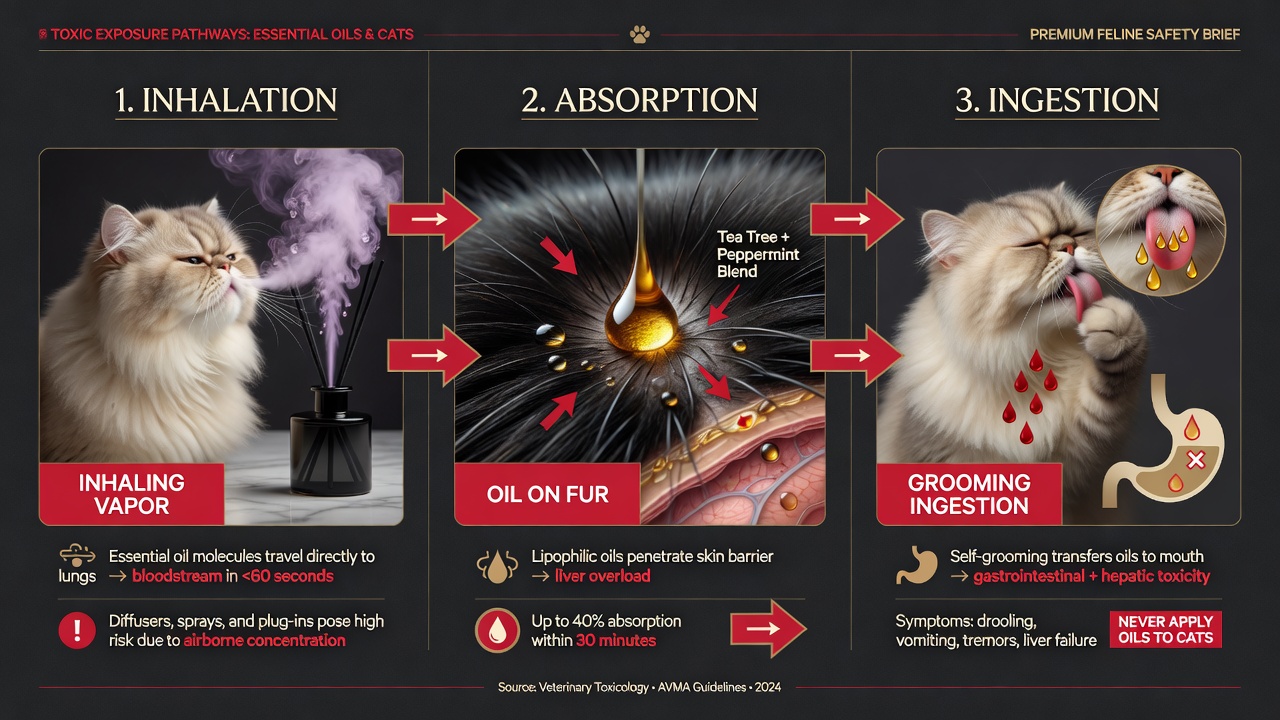
- Volatile compounds are absorbed through the lungs and enter the bloodstream faster than by any other route.
- Microscopic oil particles from a diffuser settle in the airways and cause inflammation.
- With chronic exposure — persistent asthma and structural changes in lung tissue.
- The oily mist from a diffuser settles on the cat’s coat — just as a greasy film settles on every surface in the room.
- The cat does not notice. It simply lies in the room, quietly collecting oil molecules onto its fur.
- Every strand of fur becomes a reservoir of toxins, waiting for the next grooming session.
- Cats groom themselves methodically, from head to tail, several times a day.
- Everything that settled on their fur inevitably enters the digestive system.
- Vets call this “self-poisoning through grooming” — the more meticulous the cat, the more poison it ingests.
- This is precisely why cats are more vulnerable than dogs — dogs groom themselves far less frequently.
If you wiped your face every morning with a cloth soaked in chemical solvent, then licked your lips — that is roughly what your cat does during every grooming session in a fragranced room.
What Exactly Is Dangerous: Breaking Down the Chemistry
It is a mistake to think the threat comes only from “chemicals.” “Natural” products are sometimes more dangerous than synthetic ones — their concentrations are higher and their compositions more aggressive.

- Tea tree oil — among the most dangerous. Causes neurological disorders even at low doses when inhaled
- Eucalyptus — irritates mucous membranes; toxic to the liver with regular inhalation
- Peppermint — contains menthol and other phenols; especially dangerous for kittens
- Citrus oils (lemon, orange, bergamot) — contain d-limonene and linalool, which metabolise into toxic intermediates in the liver
- Cinnamon and clove — high phenol content; cause chemical burns to mucous membranes on direct contact
- Pine, spruce, fir — conifer fragrances commonly found in toilet and car fresheners
- Oregano, thyme, marjoram — all oils with high phenol content
But the danger does not end with essential oils. Industrial air fresheners — electric plug-ins, aerosols, gel “odour absorbers” — contain a whole arsenal of volatile organic compounds (VOCs): acetone, benzene, formaldehyde, toluene, xylene.
A study published in the Environmental Impact Assessment Review analysed 25 of the most popular air fresheners and identified 133 distinct VOCs — an average of 17 per product. Of those, 24 compounds were classified as toxic or hazardous. And not one product was free of at least one such substance — including those marketed as “green” and “natural.”
The label “100% natural ingredients” on an air freshener is like writing “natural” on a bottle of arsenic. Arsenic occurs in nature too. Natural origin does not equal safety.
Formaldehyde is a recognised carcinogen linked to nasopharyngeal cancer. Phthalates disrupt hormonal balance. Naphthalene, found in many popular brands, caused lung tissue damage and cancer in rodents in laboratory studies. Cats, unlike us, cannot step out onto the balcony for fresh air. They live inside this atmosphere around the clock.
The Invisible Illness: Chronic Poisoning
Acute poisoning — when a cat knocks over a bottle of essential oil and licks its fur — is easier to recognise: vomiting, drooling, unsteady gait, an emergency trip to the vet. Far more dangerous is the other scenario: the one that unfolds invisibly over months and years.
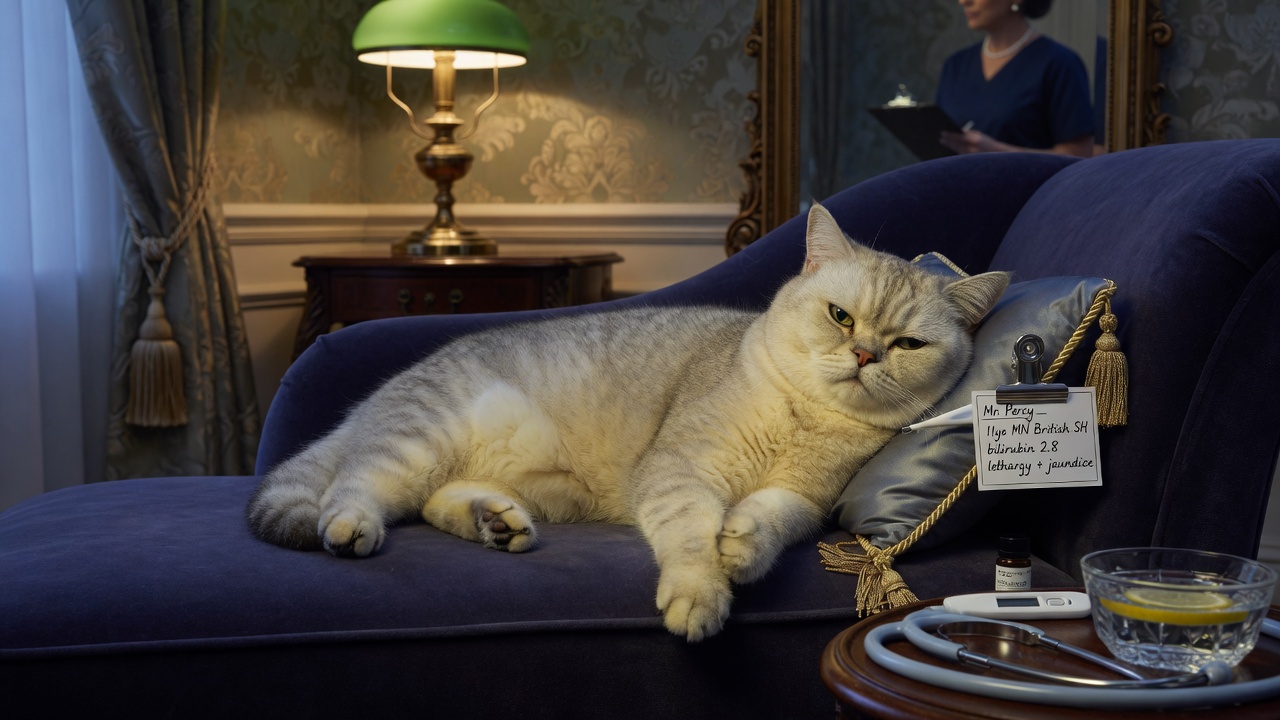
The electric plug-in runs around the clock. The aroma lamp is switched on every evening. The toilet freshener evaporates continuously. The cat inhales it daily, absorbs it through its coat, ingests it while grooming. Each individual dose is small — the liver manages somehow. But it is quietly failing.
Imagine someone is secretly adding a tiny dose of slow-acting poison to your coffee every day. Today — nothing. In a month — unexplained fatigue. In a year — liver damage. Doctors search for a cause. It was sitting on the kitchen shelf the whole time.
The symptoms of chronic aromatic poisoning are easy to mistake for “ordinary illness” or age-related changes: reduced appetite, lethargy, intermittent vomiting, weight loss. The owner thinks: “she’s getting older,” “stress,” “something she ate.” A vet without a detailed history of household fragrances may search a long time for the answer.
The owner of a British Shorthair named Mushi noticed for several months that the cat was becoming lethargic, refusing food, and occasionally vomiting. “She’s ageing,” she decided. The vet, after blood tests, said: “Serious liver damage. What fragrances do you use at home?” An electric plug-in had been running around the clock in the bedroom — directly beneath Mushi’s favourite spot on the windowsill. The owner had never connected the two facts. The plug-in had been purchased eight months before Mushi fell ill.
Stories like this number in the hundreds across veterinary forums online. Not one has made it into official statistics, because the causal link is nearly impossible to prove: air fresheners do not appear in most veterinary protocols as primary suspects.
- Excessive drooling, foaming at the mouth
- Vomiting or diarrhoea without apparent cause
- Refusing food for more than 24 hours
- Marked lethargy, apathy, hiding
- Unsteady gait, loss of coordination
- Laboured or rapid breathing
- Watery eyes, squinting, redness
- Frequent sneezing or coughing
- Yellowing of gums or inner eyelids
- Muscle twitching or seizures
- Unexplained weight loss over several weeks
- Sudden behavioural change — aggression or complete withdrawal
What Marketing Is Really Selling
The industry understands the problem — and suppresses it skilfully. Slogans like “natural ingredients,” “plant-derived essential oils,” “100% nature-based fragrance” create an illusion of safety. Yet it is precisely these natural essential oils — concentrated and highly active — that are often more dangerous than synthetic alternatives at lower concentrations.
In Europe and the United States, air freshener manufacturers are not required to disclose the full ingredient list on the label. Writing “fragrance composition” is enough. Behind that phrase can hide several dozen compounds. The consumer does not know what they are buying. Their cat certainly does not.
Car air fresheners deserve special attention. In the confined space of a vehicle, VOC concentrations are far higher than in a room. If you take your cat along for a drive — the pine tree dangling from the mirror or the plug-in in the cigarette lighter turns the journey into a toxic chamber from the cat’s perspective.
“Manufacturers are not required to disclose the composition of fragrance blends — it is a trade secret. But it is precisely these ‘secret’ substances that most often turn out to be toxic.”Environmental Working Group
The Test: How Safe Is Your Home for Your Cat?
Before reading the recommendations — check your own situation honestly:
What to Do: An Honest Answer
The good news: the situation is not hopeless. But it requires changing habits — not simply “moving the lamp to a different corner.”
- Remove electric plug-in diffusers — they operate continuously; the dose accumulates 24 hours a day
- Aerosol fresheners — only in a room the cat cannot enter, followed by at least one hour of ventilation
- If you use an aroma lamp — closed room, good ventilation, no more than once every few days
- Candles — soy or beeswax only, with no added fragrance
- Humidifier — plain water only, no oils, no additives, ever
- Toilet freshener — replace with regular ventilation and baking soda
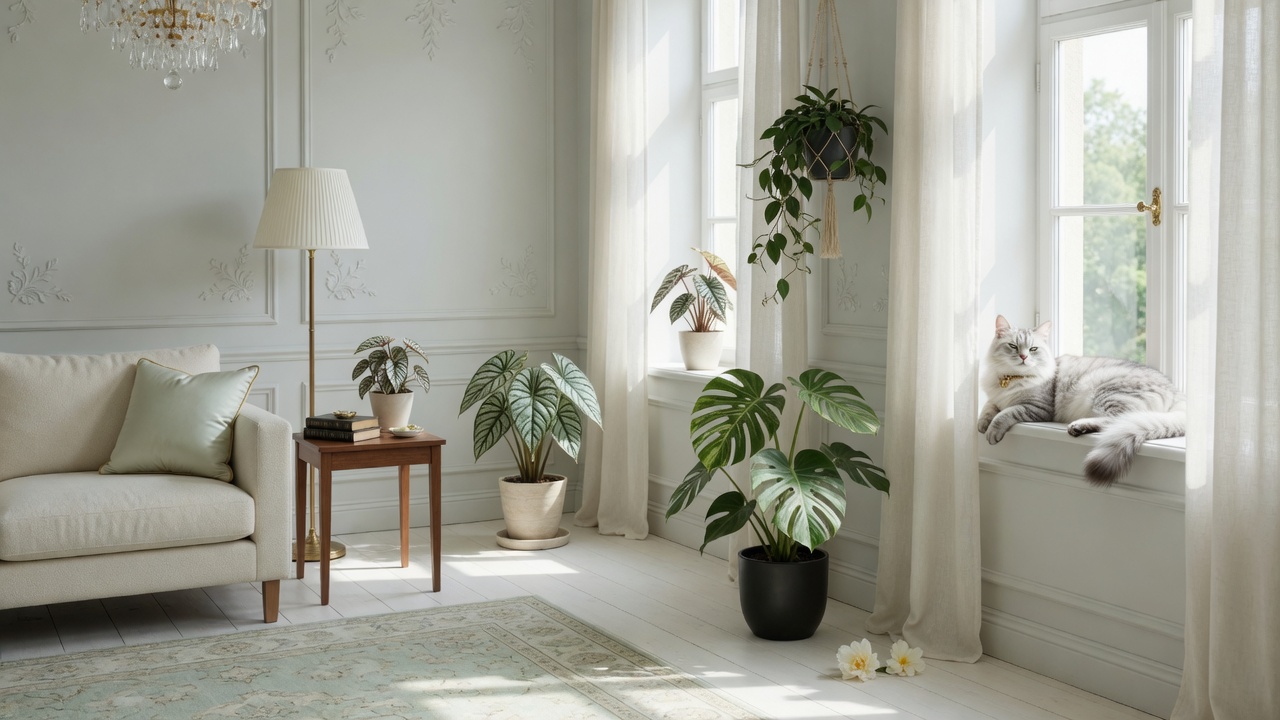
- Chlorophytum, ferns, spathiphyllum — safe for cats and genuinely clean the air
- Regular ventilation — the best air freshener that has ever existed
None of these adds a single fragrance molecule to the air your cat breathes. They do the opposite — clean it, measure it, or keep your cat hydrated and calm. This is what “cosy” looks like when it is built around the animal instead of against it.
A true HEPA stage traps the microscopic particles; the activated-carbon stage adsorbs the VOCs and odours — without producing any ozone, unlike the “ionizers” and “plasma purifiers” we warn about in Part II. It removes the threat instead of masking it. From top-tier medical-grade down to best value:
The whole danger in this article is that you cannot see it. A monitor turns the abstract into a number you can watch climb the moment a diffuser switches on — and fall the moment you open a window. The most persuasive argument is the one on your own screen.
This whole story started when someone moved the cats’ fountain away from an aroma lamp. Cats drink more from moving water, and stainless steel or ceramic — never plastic — keeps it clean. Give it a spot with fresh air, not fragrance.
Dry winter air is hard on a cat’s airways, and a humidifier helps. But it comes with one rule, and it is absolute.
⚠ Use plain water only. Never add essential oils, “aroma blends,” or scented additives — that turns a safe device into the exact diffuser this article warns against.On “safe” essential oils — veterinary opinion is divided. Some specialists consider frankincense, chamomile, and lavender conditionally acceptable at strict concentrations with good ventilation. But “less toxic” does not equal “safe” — especially with prolonged exposure.
The most honest advice: if cats live in your home, simply remove all fragrances from the rooms where they spend most of their time. The smell of “cosiness” is not worth the health of a living creature that trusts you completely.
“A cat cannot tell you it is unwell. It does not know the smell is killing it. It simply lives beside you — and depends entirely on your decisions.”
The Scent You Love May Be Slowly Killing Your Cat
Your cat cannot tell you it is unwell. It does not know the smell is harming it. It simply lives beside you — entirely dependent on the choices you make, day after day.
The biochemistry is unambiguous: a missing liver enzyme, three simultaneous absorption routes, an olfactory system fourteen times more powerful than yours. The science does not leave much room for doubt. What it does leave room for is a decision.
Open a window. That is enough to start.
— Fellow Earthlings, May 2026
Affiliate disclosure: some product links in this article are affiliate links. If you buy through them, Day Solis may earn a small commission at no extra cost to you — a quiet way to keep these investigations free, independent, and ad-free.
Sources
Merck Veterinary Manual — Toxicoses from Essential Oils in Animals (merckvetmanual.com) ·
Environmental Impact Assessment Review — Steinemann A. (2011): 133 VOCs in 25 scented products ·
PLoS One 2011, 6(3): e18046 — Evolutionary defects in feline glucuronidation ·
ASPCA Animal Poison Control Center (aspca.org) ·
VCA Animal Hospitals — Essential Oil and Liquid Potpourri Poisoning ·
BC SPCA — Safety Alert: The Dangers of Essential Oils and Pets (2025) ·
Royal Canin Veterinary Reference — Feline olfactory system ·
Environmental Working Group (ewg.org)
⚠ If you suspect your pet has been poisoned — contact a veterinarian immediately. Do not wait.
If this investigation was useful to you — support independent journalism
☕ Buy me a coffee