
The Scent of Death
in Beautiful Packaging
Part One was about cats and the biochemistry of poison. But cats are not the only victims of our love for air fresheners. For some pets, a diffuser can kill in minutes. For the rest of us — slowly, invisibly, over years.
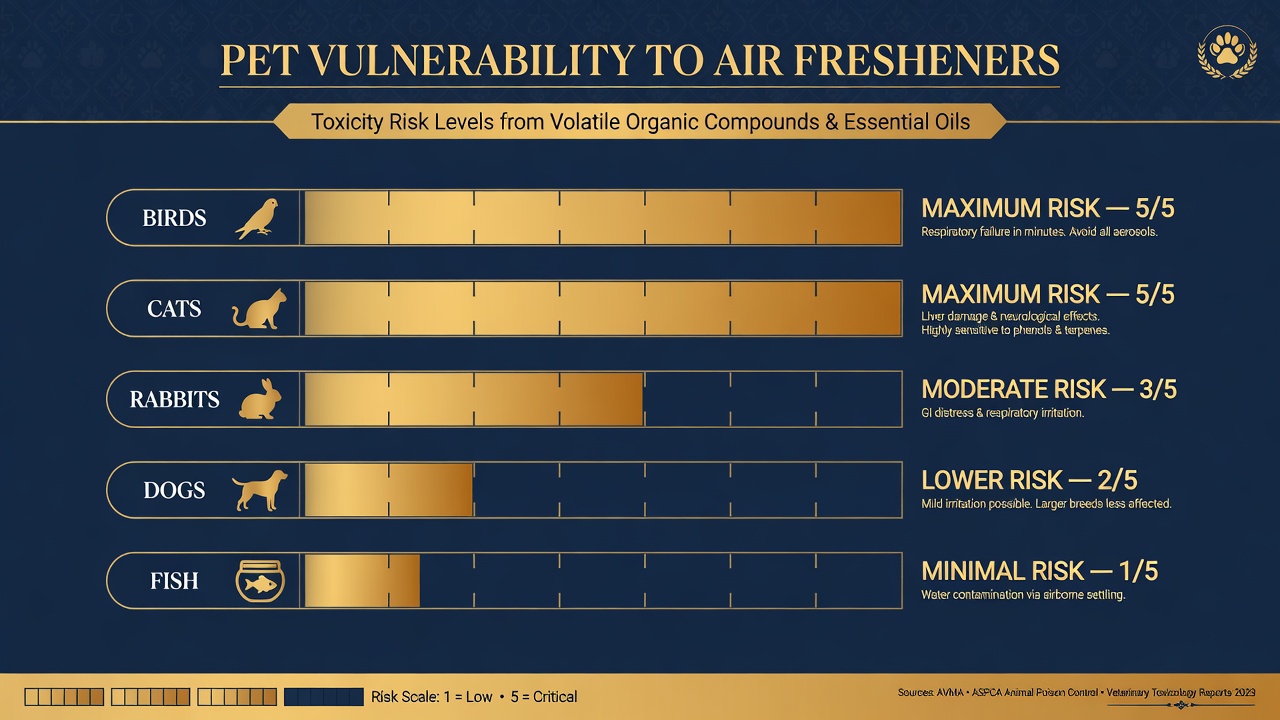
Before we dive into the story of each species — here is the full picture. Look at who in your household is most at risk.
🐦 Birds: The Canary in Your Living Room
Among all household pets, birds are in a category of their own. Veterinarians say it plainly: if a parrot lives in your home, an aroma diffuser is not a comfort question — it is a matter of life and death. And death can come before you even realise something has gone wrong.
In the 19th century, coal miners carried canaries into the tunnels. The bird died first from mine gas — and the men had time to escape. Your parrot in the living room is that same canary. Nobody warned it.
A bird’s respiratory system works fundamentally differently from a mammal’s. There is no diaphragm — air flows through the lungs continuously in one direction, driven by a system of air sacs. This is what makes birds magnificent fliers at altitude where oxygen is thin. And it is exactly what makes them perfect poison detectors: every toxic molecule is absorbed with maximum efficiency, with no chance of being “exhaled” back out.
Teflon (PTFE) is a particular catastrophe. Non-stick cookware coating, when heated above 280°C (536°F), releases fluorinated gases — colourless and odourless. According to the Merck Veterinary Manual, birds frequently die before the owner has understood what happened. Clinical signs — if they appear at all — develop within minutes.
Dr. Roger Wells, a veterinarian at Michigan State University, described a typical PTFE poisoning in a group of birds: “Clinical signs began with eyelid blinking at 8–10 minutes of exposure and progressed to open-beak breathing, biting at the wire cage, incoordination, wing stretching and flapping, and chirping — and usually ended in a terminal convulsion, with the birds lying on their sides or backs.” In 1997, eight birds of prey died over three months. The cause: Teflon-coated heat lamps.
But Teflon is only the most dramatic example. Any aerosol, essential oil, scented candle, hairspray, or air freshener carries a lethal risk for birds. The ASPCA Animal Poison Control Center states explicitly: do not use diffusers in a home where birds live. Not “be careful” — do not use them at all.
Mariana had kept her budgerigar Lorik for eight years. When she bought an electric diffuser with eucalyptus oil, Lorik was healthy. Three days later she found him on the bottom of his cage. The vet’s first question: “Do you have a diffuser or scented candles at home?” Mariana didn’t make the connection at first. Then she cried. The diffuser had been in the same room as the cage. Eucalyptus oil contains 1,8-cineole — a compound that causes bronchospasm in birds.

- Any aroma diffuser or essential oil — without exception (ASPCA)
- Teflon / PTFE non-stick coatings when overheated — death within minutes
- Aerosol air fresheners, hairspray, deodorant sprays
- Scented candles — especially paraffin with synthetic fragrances
- Carpet fresheners and fabric sprays
- Paint, varnish, adhesives — even if the bird is in another room
- Combustion products — cooking smoke, fireplace fumes, cigarette smoke
“If you can smell it — it may harm your bird’s respiratory tract. Harmful chemicals can linger in the air long after the smell has faded.”VCA Animal Hospitals
🐕 Dogs: “Lower Risk” Does Not Mean “No Risk”
The good news: dogs handle air fresheners better than cats. Their liver can neutralise many of the dangerous phenolic compounds — the enzyme glucuronosyltransferase works normally. This is why you can give a dog paracetamol, but not a cat.
The bad news: “better” does not mean “safe.” According to the ASPCA, calls to animal poison control centres related to essential oils have increased by 400% in recent years. The majority involve dogs.
Marianne bought a tea tree oil diffuser on a Friday evening. By Saturday, her dog didn’t recognise her at the door — he stared at her with confusion, as though seeing her for the first time. Sunday, he hid under the bed. Monday — an emergency vet clinic, blood tests, IV drip. His liver was “almost okay” — they got lucky. “We were close,” the vet said. Tea tree oil at just 7 drops of 100% concentration causes severe poisoning in a medium-sized dog.
Puppies, elderly dogs, and animals with liver or kidney disease are especially vulnerable. For them, even a “moderate” exposure that a healthy adult dog might tolerate with mild discomfort can be critical.
Wintergreen and birch oils contain methyl salicylate — the same molecule as aspirin. The dog receives, in effect, an invisible overdose of that drug through air and fur. Pennyroyal oil is toxic to the liver of both dogs and humans.
Imagine someone is slipping a quarter of an aspirin into your food every day, unnoticed. Today — nothing. In a week — mild discomfort. In three months — stomach bleeding or kidney damage. That is how chronic exposure to certain essential oils works in dogs.
The practical rule for dog owners: a diffuser is only acceptable in a closed room without the dog, with good ventilation — never running continuously, never in the space where the dog spends most of its time. Tea tree, pennyroyal, wintergreen, and birch oils are completely off-limits.

🐇 Rabbits, Hamsters, Guinea Pigs: The Smaller, The More Dangerous
These pets are often treated as “low-maintenance” — set up a cage, add food, clean once a week. In reality, they are in a particularly high-risk zone for one simple reason.
A hamster weighs about 150 grams. A person weighs 70 kilograms. That is a difference of 470 times. If the same dose of an aromatic substance enters both — for the hamster, it is 470 times larger relative to body weight. This is why what seems to us a “gentle fragrance” can be a lethal concentration for a hamster.
According to the ASPCA and veterinary publications, rabbits, guinea pigs, and hamsters are just as sensitive to essential oils as cats. Unlike cats, they do not even have a grooming system as an “indicator” — they simply sit quietly in their cage and breathe.
A telling detail: when the smell is strong, small rodents refuse to eat. The scent is so overwhelming that the animal simply cannot feed normally. The owner notices “not eating” and looks for illness. The pet is simply being suffocated by a smell its owner finds pleasant. Prolonged refusal to eat in a small rodent is rapid death.

Irina plugged in an electric “fresh cotton” scented plug-in in the room where her three guinea pigs lived. Within a week the animals were visibly less active. Within two weeks they had stopped eating normally. The vet found no infection. When Irina removed the plug-in and ventilated the room — on a friend’s advice — the guinea pigs recovered within days. The plug-in had been just two metres from their cage.
Another hidden trap: scented bedding. Some manufacturers add a “fresh” fragrance directly to wood shavings. This is direct contact with the animal’s skin and mucous membranes around the clock. Always choose unscented, fragrance-free bedding.
🦎 Reptiles: Cold Blood, Hot Problem
Reptiles seem indestructible. A tortoise or lizard feels like a creature that has outlasted dinosaurs and will outlast everything else. That is a dangerous assumption when it comes to aromatic substances.
Reptiles absorb chemicals through skin and mucous membranes far more actively than mammals. Their thermoregulation depends entirely on external temperature — meaning toxic compounds enter the body through multiple pathways simultaneously, while a slower metabolism means poison accumulates faster and is eliminated more slowly.
Signs of poisoning in reptiles are easy to miss: “just moving slower,” “eating less.” For the owner this seems normal — reptiles are unhurried creatures. But that stillness can conceal chronic poisoning that has been building for months.
Imagine a person living in a room with very slow ventilation. The concentration of harmful substances rises gradually, and they have time to “adapt” — until one day they collapse. Reptiles react to chronic aromatic toxicity in exactly that way: quietly, invisibly, until a critical threshold is reached.
The rule is simple: no aromatic substances in a room with a terrarium. No aerosols near an open container. Ventilation comes from an open window — not from an air freshener.
🐠 Aquarium Fish: The Poison Dissolves in Water
This is the most unexpected section for most readers. An aquarium and an air freshener — what is the connection? A direct one. And it works quietly, invisibly — until one morning you find your fish floating belly-up.
An aquarium breathes. The water surface constantly exchanges gases with the room air — this is necessary for oxygenation. At the same time, everything in the air enters through that surface: essential oil vapours, VOCs from fresheners, microscopic aerosol particles. They dissolve into the water, alter its chemical balance, disrupt pH, and consume oxygen. The fish are, quite literally, swimming in a poisoned solution.
Three mechanisms operate simultaneously: a chemical film on the water surface blocks gas exchange (fish suffocate for no visible reason); dissolved toxins alter pH and water chemistry; at high concentration — direct destruction of gill cells and internal organs.
Clove oil is used by fish breeders as an anaesthetic in micro-doses. In the concentrations produced by a typical aroma diffuser, it is lethal. Formaldehyde and benzene from air fresheners are toxic to fish at vanishingly small concentrations.
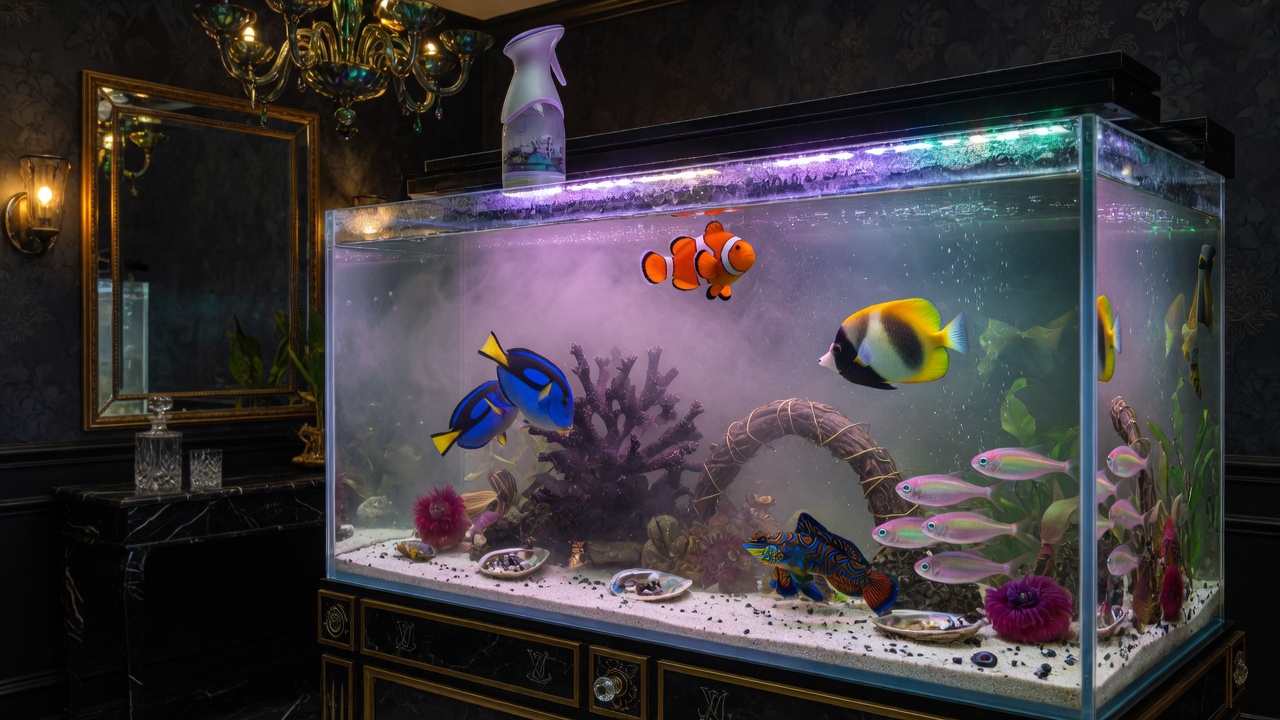
The owner of a marine reef aquarium used Febreze in the living room. The following morning several fish had died and the corals began “closing up.” Water tests showed parameter deviation. The forum community explained: Febreze contains cyclodextrin and other compounds that form a film on the water surface and disrupt gas exchange. The corals were hit hardest — they require virtually perfect water chemistry to survive.
Practical rules for aquarists: no aerosols in a room with an aquarium. Remove plug-in diffusers — they run continuously, and the cumulative daily dose is significant. If you want aromatherapy — do it in another room with the door closed. After any chemical use in the room — do a partial water change and test your parameters.
👤 Us: When Comfort Becomes a Carcinogen
It would be unfair to speak only of animals. Because the data on what air fresheners do to human health is no less alarming. We simply rarely think about it.
Steinemann et al., 2011
including products marketed as “green” and “natural”
US EPA data
Benzene and formaldehyde from air fresheners are recognised carcinogens linked to nasopharyngeal cancer and leukaemia. Phthalates disrupt hormonal balance and are associated with reproductive disorders and birth defects. 1,4-dichlorobenzene — a common deodorising agent in toilet fresheners — reduces the function of the lungs, liver, and kidneys.
Children are at particular risk. Their lungs are still developing. They breathe more frequently than adults — meaning they receive a larger dose per unit of body weight. A systematic review of 69 studies (1991–2021), published in the International Journal of Environmental Research and Public Health, confirmed a direct link between high indoor VOC levels and childhood asthma. Also in the high-risk group: pregnant women, the elderly, and anyone with a chronic respiratory condition.
- Every indoor space contains background ozone — generated by printers, photocopiers, some air cleaners, and drifting in from outside.
- VOCs from air fresheners react chemically with this ozone.
- The reaction produces new toxic compounds and ultrafine particles that did not exist in either the freshener or the air independently.
- These secondary products are often more dangerous than the original components.
- Conclusion from a NASA technical report (2021): your “natural” air freshener is turning your room into a carcinogen-producing chemistry lab.
What to do about this in practice? Ventilation is your primary ally. Fresh outdoor air, however “unfragrant” it may seem, is incomparably safer than any freshener. This matters most in homes with young children.
“Air fresheners mask unpleasant odours, but in reality they expose people to hazardous chemicals in a pleasantly scented environment.”NASA Technical Report, 2021
⚡ Ozone Generators: The “Air Purifier” That Poisons
This is the most dangerous topic in our investigation — and the most suppressed. These are devices sold as “air purifiers,” “virus and bacteria protection,” and “mountain-fresh air.” They are bought by people who care about their health. And those very people, without knowing it, are creating one of the most toxic indoor environments imaginable.
One thing upfront: an ozone generator and an ionizer are different devices with different operating principles. They are constantly confused — in stores, in advertising, and in online articles. We will cover each separately — and then it will be clear what to fear and what can be trusted.
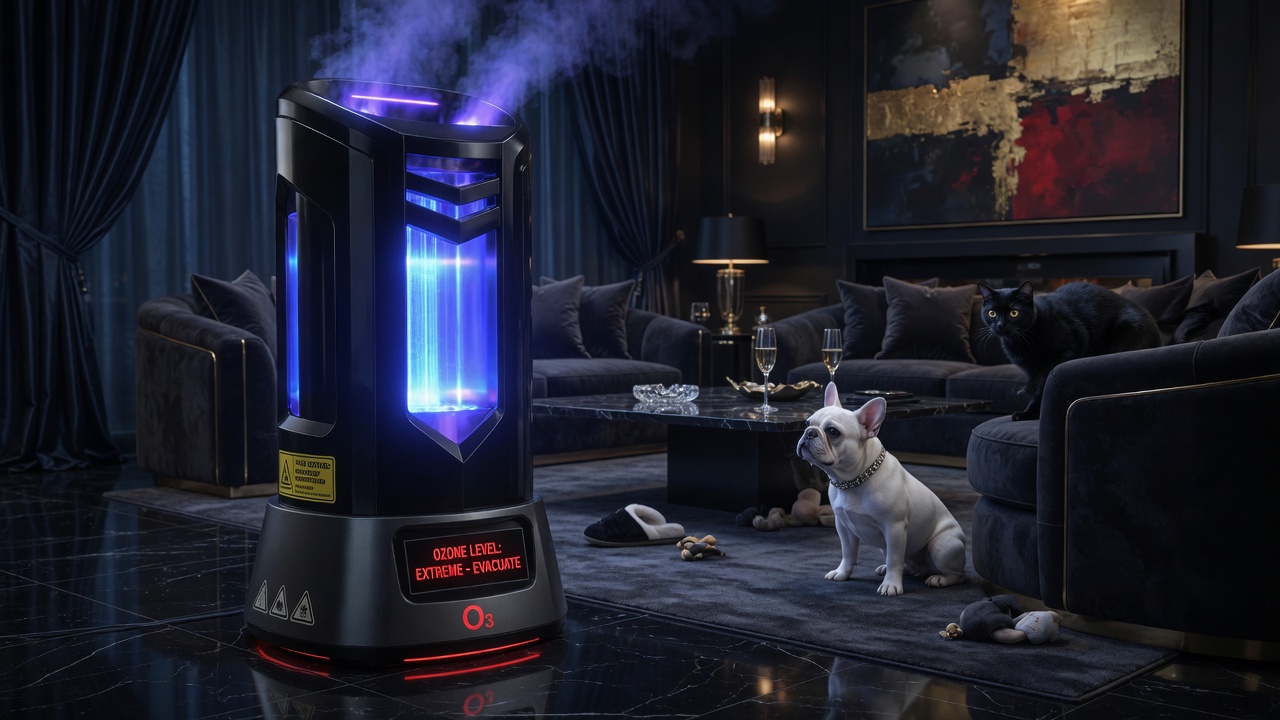
Ozone (O₃) is a molecule made of three oxygen atoms. The ordinary oxygen in air consists of two atoms (O₂). That third atom makes ozone unstable and extremely reactive — it is desperate to bond with anything: air molecules, lung tissue, living cells. This reactivity is what destroys bacteria. And it is exactly what destroys living cells when inhaled.
Home ozone devices are not new. In the Soviet era, the “Chizhevsky chandelier” was popular — an electroeffluvia ionizer that generates a stream of negative ions. Alexander Leonidovich Chizhevsky was a brilliant scientist, and his research had a genuine scientific foundation. The irony: Chizhevsky himself warned that a person should stand under his device for no more than 5 minutes, and that the air around it became saturated with ozone. Today, nobody reads that warning.
What happens in today’s market is a different story entirely. Chinese and international manufacturers have flooded the market with cheap devices labelled “ionizer,” “air purifier,” “plasma sterilizer,” “active oxygen generator.” They are built into night lights, fans, air conditioners, car USB adapters, and mini-boxes the size of a matchbox. Sold on marketplaces for pennies. Bought by millions.
- “Activated oxygen” / “active oxygen” — this is ozone. Always.
- “Super-oxygenated air,” “trivalent oxygen,” “energized oxygen” — ozone.
- “Plasma ionizer,” “plasma cluster,” “plasma air cleaning” — contains ozone as a byproduct.
- “Air ionizer” without a HEPA filter — almost always emits ozone during ionization.
- “Photocatalytic oxidation” (PCO) with UV-V lamp — ozone as a byproduct.
- “Eliminates odours, kills bacteria and viruses without filters” — that is how ozone works.
- A smell of “thunderstorm” or “freshness after rain” coming from the device — that is ozone.
What does science say? The US EPA states: “No federal agency has approved ozone generators for use in occupied spaces.” The California Air Resources Board (CARB) — one of the world’s strictest environmental regulators — recommends completely avoiding ozone generators in any space occupied by people or animals. These devices cannot be sold in California without special certification.
A cat owner ran an ozone air purifier in a closed room for two weeks, unaware of the danger. “I noticed he has been growing increasingly lethargic for the past week. He plays less, eats less. I only figured it out when I Googled it. I’m so scared I may have caused irreversible damage.” The vet explained: ozone generators produce harmful oxidants that irritate a cat’s respiratory tract. Symptoms: decreased activity, loss of appetite. Treatment: remove the ozone source immediately, provide fresh air. If symptoms persist — a short course of steroids to restore the airways.
What happens inside the body when ozone is inhaled? According to the CDC and NIOSH, a concentration of 15–20 ppm (parts per million) is lethal to small animals within two hours. Cats show airway cell damage at just 0.25 ppm — a level easily reached by household ozone devices. At higher levels: pulmonary oedema, haemorrhage, death. The EPA notes: even when following the manufacturer’s instructions, ozone concentration in a room can exceed safe limits.
US EPA standard
NCBI / Boatman et al., 1974
CDC / NIOSH data
One more trap: ozone fools the nose. With prolonged exposure, it dulls the sense of smell — and a person stops detecting its odour. This creates the illusion that “everything is fine, no smell.” In reality, the room concentration may be dangerous; the receptors have simply stopped responding. The person has adapted. The animals have not.
- Birds are the most ozone-sensitive of all household animals.
- CARB states explicitly: “Birds are especially sensitive to the effects of air pollutants, including ozone.”
- Their unique respiratory system (air sacs) absorbs ozone with maximum efficiency.
- Even concentrations considered “safe” for humans can be lethal for birds.
- No ozone generator in a home with birds. Ever. Even in another room with the door closed.
- NCBI study (Boatman et al., 1974): cats exposed to 0.25–1.0 ppm ozone for 4–7 hours showed significant desquamation of the ciliated airway lining cells.
- The ciliated epithelium is the lung’s “brush” — it cleans the air. Without it, a cat is defenceless against infection.
- Chronic exposure equals chronic asthma and heightened susceptibility to respiratory infections.
- Veterinary Internal Medicine study: cats with respiratory disease were more likely to live in households with higher indoor air pollution.
- CARB: experimental studies showed respiratory effects in dogs, cats, hamsters, and guinea pigs exposed to ozone.
- Brachycephalic dogs (pugs, bulldogs, boxers) are at particular risk — their airways are anatomically narrowed.
- Rabbits, hamsters, guinea pigs: small lung volume + high breathing rate = rapid dose accumulation.
- Reptiles: slow metabolism means damage accumulates slowly but remains invisible for a long time.
- Ozone is used in professional aquaculture for water disinfection — but strictly dosed, with mandatory decomposition through activated carbon before water reaches the tank.
- A household ozone generator in a room with an open aquarium delivers uncontrolled ozone directly into the water.
- Ozone in water destroys fish gills and kills the beneficial bacteria of the biofilter.
- Result: fish suffocate; the aquarium’s biological balance collapses.
- Corals and invertebrates are even more sensitive — they may be the first to die.
What about humans? According to the EPA, inhaled ozone damages the lungs. Even relatively low concentrations cause chest pain, coughing, shortness of breath, and throat irritation. Lung capacity decreases. Mucous membranes become inflamed. Bronchitis, emphysema, and asthma worsen. At the same time, ozone does not treat allergies and does not kill mould inside materials — it only masks odours by numbing the sense of smell.
The most vulnerable: children, asthmatics, the elderly, pregnant women. These are exactly the people who most often buy “air purifiers” to protect their health. Marketing is working against them.
“Manufacturers sometimes call ozone ‘activated oxygen’ or ‘super-oxygenated air,’ implying that ozone is a healthy kind of oxygen. In fact, no federal agency has approved ozone generators for use in occupied spaces.”US EPA — Ozone Generators Sold as Air Cleaners
The only legitimate use for an ozone generator at home: a shock “ozone treatment” of an empty space after fire, flooding, or severe contamination. All people and animals — including fish — must be removed. After treatment, the space is ventilated for several hours until the residual ozone fully decomposes. Only then is it safe to return.
🔵 Ionizers: The Relative With a Different Character
An ionizer is not an ozone generator. These are fundamentally different devices, although they are constantly confused — in stores, in advertising, and across the internet. Let us settle this once and for all.
An ozone generator releases a reactive oxidising gas that chemically destroys pollutants — and lung cells along with them. An ionizer releases electrically charged particles that attract dust and allergens, causing them to settle on surfaces. The first is an aggressive disinfectant for empty rooms. The second is a quiet air cleaner for occupied spaces.
How does an ionizer work? The device generates a stream of negative ions — molecules that have gained an extra electron. In nature, negative ions are abundant near waterfalls, at the ocean, in the mountains, in forests after a thunderstorm. This is precisely why the air in those places feels unusually fresh and easy to breathe — not a subjective impression, but a real effect of ionisation. In closed indoor spaces, ion concentration is 15–20 times lower than in nature.
Negative ions bond with dust, pollen, bacteria, and smoke particles, giving them a charge and making them heavier than air. The particles settle onto floors and surfaces — and stop floating in the air you breathe. This is why wet-mopping after running an ionizer is important: all the “catch” is now on the floor and furniture.
- Columbia University research: negative ions normalise serotonin levels — the mood neurotransmitter. Effect comparable to antidepressants for seasonal affective disorder (SAD).
- Meta-analysis by Bailey et al. (2018) in the Journal of Affective Disorders: high ion concentration significantly improves mood.
- Psychiatry Research study (2020): regular negative ion exposure reduces irritability and improves stress resilience.
- Ionizers remove 90–97% of airborne particles in controlled conditions — more effective than many filters for ultrafine particles.
- Negative ions may increase oxygen flow to the brain — improving concentration and reducing fatigue.
But there is an important caveat. The US EPA warns: ionizers do not remove gases or odours — only particles. They are ineffective against large allergens like pollen and dust mites. And crucially — most ionizers produce small amounts of ozone as a byproduct of the electrical discharge. In 2005, Consumer Reports tested the popular Ionic Breeze ionizer and found it emitted ozone above safe limits. The company went bankrupt.
An ionizer is like a kitchen knife — a useful tool in skilled hands, a dangerous one in the wrong ones. A certified ionizer with low ozone emission (below 0.05 ppm per CARB standards) is a reasonable choice for homes without birds. A cheap, uncertified “ionizer” from an online marketplace is a lottery — you have no idea how much ozone it actually produces.
Ionizers and pets — what to do? The key question is: how much ozone does the specific device emit?
A CARB-certified ionizer with ozone emissions below 0.05 ppm is relatively safe for dogs, cats, and small rodents with good ventilation — roughly what you inhale in the mountains during a thunderstorm. For birds — any ionizer is questionable: their respiratory system is too sensitive even to trace concentrations.
A low-quality uncertified ionizer is effectively a weak ozone generator. The only difference is that the manufacturer called it an “ionizer” to sidestep regulations. This is exactly why we included “ionizer without HEPA” in the list of disguised ozone generator warning signs above.
| Criterion | Ozone Generator | Ionizer |
|---|---|---|
| What it releases | Ozone O₃ — intentionally | Negative ions + trace ozone |
| How it works | Chemical oxidation of pollutants | Electrical precipitation of particles |
| Removes odours | Yes, effectively | No |
| Removes particles | No | Yes — they settle on surfaces |
| Safe with people present | No — empty rooms only | Yes — with CARB certification |
| Safe with cats | No, never | Conditionally — certified only |
| Safe with birds | No, never | No — too sensitive |
| Safe with fish | No — open tank is dangerous | With caution |
| Cleaning needed after | No | Yes — particles on floors & furniture |
The bottom line on ionizers: they are neither enemies nor a cure-all. A high-quality certified ionizer is a moderately useful tool for reducing dust and allergens, with proven positive effects on mood. A cheap uncertified one is a potentially dangerous ozone generator in disguise. For homes with birds — no ionizer of any kind is recommended. For homes with cats and dogs — only CARB-certified, in well-ventilated rooms.
- HEPA filter (H13 or H14) — mechanically traps 99.97% of particles. Safe. Effective. Recommended by the EPA and CARB.
- Activated carbon — absorbs gases, VOCs, and odours. Safe; produces no harmful byproducts.
- HEPA + activated carbon combined — the optimal choice for homes with pets.
- CARB (California) or AHAM certification — guarantees the device does not produce dangerous ozone levels.
- Look for “ozone-free” or “zero ozone emission” labelling on the packaging.
- Ionizer — only CARB-certified, only in rooms without birds, only with good ventilation.
- Avoid without certification: “ionizer,” “plasma,” “PCO,” “active oxygen,” “UV-V” — these all risk hidden ozone production.
✅ What to Do: Five Minutes That Change Everything
The good news: most of these changes require no sacrifice. This is not a call to austerity — it is a call to awareness. The scent of home comfort is not a chemical in a bottle.
- Unplug the electric plug-in diffuser from the outlet — right now
- Move the aerosol air freshener away from places where pets spend time
- Open a window — real fresh air is better than any “freshness” fragrance
- Move the bird cage or rodent enclosure away from any fragrance source
- Tell everyone in the household: no fragrances in the room with the pet
- Regular ventilation — the only truly safe “air freshener” that exists
- Baking soda or activated charcoal neutralises odours without chemistry
- Soy or beeswax candles with NO added fragrance — only in rooms without birds
- Chlorophytum (spider plant), ferns, spathiphyllum — clean the air and are safe for cats and dogs
- Humidifier — plain water only; no oils, no additives, ever
- A vase of fresh flowers (verify they are non-toxic for your specific pet species)
- Freshly brewed coffee, a cinnamon stick simmering in water — natural aroma without any diffusion
If you cannot fully give up aromatherapy — the strict rule is: only in a closed room without the pet, only with an open window, no more than once every few days, and ventilate for at least an hour afterwards. Never on a continuous setting. Never near a bird.
- Birds: no fragrances in the home at all. No ozone generators or ionizers — even in another room. Teflon cookware only on a well-ventilated hob, bird in a different room.
- Cats: no plug-in diffusers. No ozone generators. Candles and occasional aerosol use — only in a closed room without the cat, with thorough ventilation.
- Dogs: tea tree, pennyroyal, wintergreen oils are completely off-limits. Brachycephalic breeds (pugs, bulldogs) are especially sensitive to ozone and air pollutants.
- Rabbits, hamsters, guinea pigs: no fragrances in the room with the cage. No scented bedding. No ionizers nearby.
- Reptiles: no aerosols or ozone generators near the terrarium. Ventilation through an open window only.
- Aquariums: no aerosols in the room. Remove plug-in diffusers. Ozone only via professional equipment with activated carbon on the output, strictly per protocol.
🛡️ Premium Safe Picks: The Tools Worth Buying
Everything below is a safe alternative — never one of the products this investigation warns against. Every purifier is purely mechanical (True HEPA + activated carbon), CARB-certified and ozone-free: no ionizers, no “active oxygen,” no plasma. These are premium-tier choices, picked to last for years.
Affiliate links — full disclosure at the foot of the article.
🌿 Instead of an Epilogue: The Open Window
This investigation is not an indictment of comfort. Nobody is forbidding you to love beautiful scents. It is simply an invitation to ask: whose comfort, exactly, is this?
Your pets chose to live with you. Not because they had nowhere else to go — because they trust you. The bird in its cage, the cat on the windowsill, the fish in the aquarium, the hamster in its wheel — all of them live in a world you are building for them, decision by decision. Every decision you make.
The scent of home is not a chemical in a bottle. It is bread from the oven, wet earth after rain, morning coffee, a favourite book. All of that is real. None of it requires extra molecules in the air.
Open a window. Let real air in. Your pets will thank you — silently, with their health and their years beside you.
“The smallest change in your home can be the greatest gift for those who live there with you.”
Every Creature in Your Home Is Affected. The Good News: Every Creature Can Be Protected.
From birds that can die in under ten minutes to ozone generators sold as health devices — the investigation reveals a consistent pattern: the fragrance industry profits from ignorance, and our pets pay the price. The science is not ambiguous. The fixes are not complicated.
A HEPA purifier instead of an ionizer. An open window instead of a plug-in. Unscented beeswax instead of a paraffin candle. None of these changes require sacrifice. They require only the decision to make them.
The window is right there. Open it.
— Fellow Earthlings, May 2026
Sources
Merck Veterinary Manual — Toxicoses of Pet Birds / PTFE toxicosis ·
VCA Animal Hospitals — Household Hazards and Dangers to Birds ·
VCA Animal Hospitals — Teflon (PTFE) Poisoning in Birds ·
Environmental Working Group — Canaries in the Kitchen (ewg.org) ·
ASPCA Animal Poison Control Center — Essential Oils and Pets ·
Texas A&M TVMDL — PTFE Toxicosis ·
PMC / NCBI — PTFE Toxicosis in Chickens, 2012 ·
AKC — Are Essential Oils Safe for Dogs? ·
BC SPCA — Safety Alert: Dangers of Essential Oils (2025) ·
NASA Technical Report (2021) — VOCs Emitted from Air Fresheners ·
IJERPH Systematic Review — Indoor Air Pollution and Children’s Health, 2022 ·
Columbia University Irving Medical Center — Do Air Fresheners Impact Our Health? (2025) ·
US EPA — Volatile Organic Compounds and Indoor Air Quality ·
Steinemann A. (2011) — Indoor Air Journal: Fragranced consumer products ·
PracticalFishKeeping — Toxic Shock: Everyday Chemicals That Kill Fish ·
FishTankSetups.com — Can Air Freshener Affect My Aquarium? ·
Small Pet Select — Essential Oils and Pet Safety ·
US EPA — Ozone Generators Sold as Air Cleaners (epa.gov) ·
California Air Resources Board (CARB) — Hazardous Ozone-Generating Air Purifiers ·
CDC / NIOSH — IDLH for Ozone: 15–20 ppm lethal for small animals in 2 hours ·
NCBI — Boatman et al. (1974): Ozone effects on feline ciliated airway epithelium ·
ECHA — Ozone acute toxicity registration dossier ·
IQAir — Are Ionizers and Ozone Air Purifiers Safe? (2026) ·
Columbia University — Negative ion research on serotonin and mood ·
Bailey et al. (2018) — Journal of Affective Disorders: negative ion meta-analysis ·
HouseFresh — Are Air Purifiers Safe for Pets? (2025)
Affiliate disclosure: some links in “Premium Safe Picks” are affiliate links (Amazon Associates). If you buy through them, we may earn a small commission at no additional cost to you. It helps keep this work free and independent — and it never influences which products we recommend or how we rate them.
⚠ If you suspect your pet has been poisoned — contact a veterinarian immediately. Do not wait.
If this investigation was useful to you — support independent journalism
☕ Buy me a coffee